The look of it
Clean, Shaven is a 1994 American drama written, directed and produced by Lodge Kerrigan, intended as a sustained formal experiment in rendering subjective experience — specifically the daily reality of schizophrenia — without recourse to exposition, diagnosis or external commentary. It does not dramatise treatment, recovery or institutional life; it begins after release, with Peter Winter (Peter Greene) re-entering a world whose sensory texture has become hostile, unstable and untrustworthy. Kerrigan’s stated aim was to avoid cinematic cliché — the madman as villain, spectacle or metaphor — and instead construct a narrative architecture that mirrors perceptual fragmentation: discontinuous sound design, abrupt cuts, withheld context, mirrored surfaces that distort rather than reflect, and recurring motifs of intrusion and containment. The film refuses to anchor itself in objective chronology or stable cause-and-effect, treating plot not as a sequence of events but as a pressure system built from anxiety, memory, and misperception. Its ambition is not explanatory but experiential: to make the viewer feel the weight of uncertainty as a physical condition.
How it holds your attention
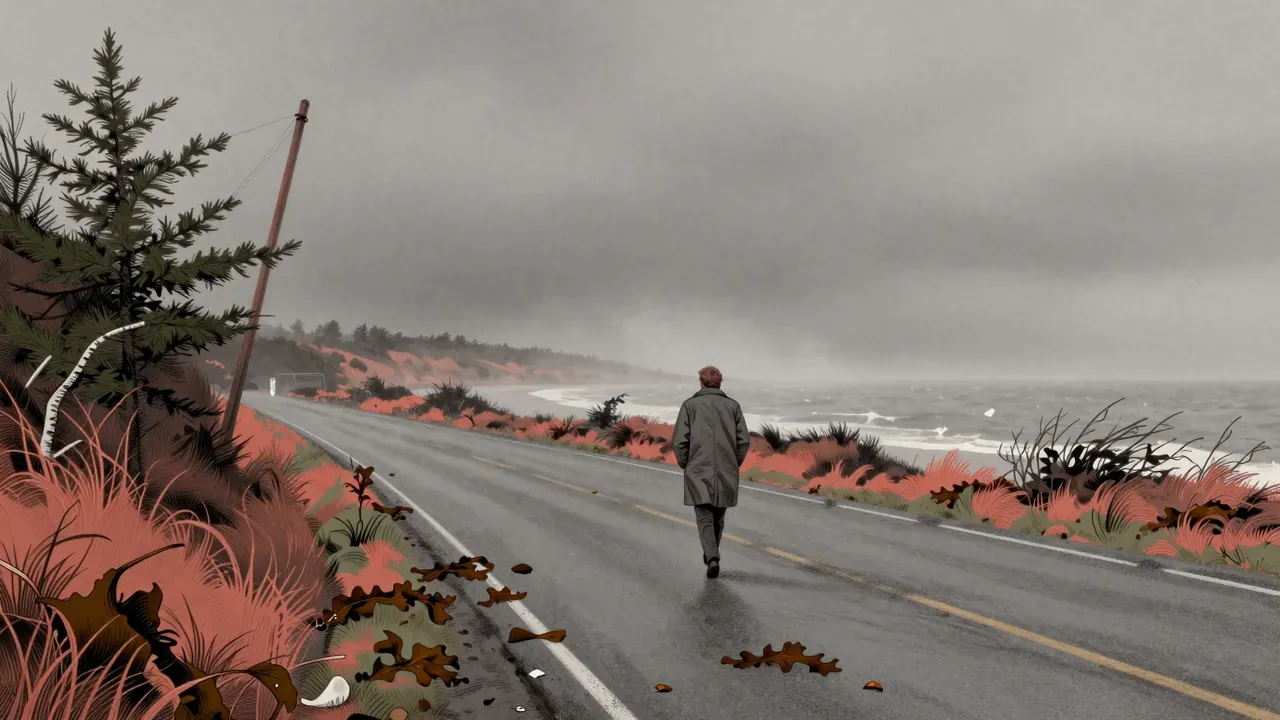
The story follows Peter’s fragmented quest to locate his daughter Nicole, intercut with moments of acute sensory overload — a car radio blaring static, footsteps echoing too long, fluorescent lights humming at pitch-shifted frequencies. Peter Greene performs with tightly coiled physicality: his posture is defensive, his gaze darting, his hands often clenched or trembling. Hahn Rowe’s score uses dissonant strings and processed field recordings — not to underscore emotion but to replicate neural interference. Kerrigan shoots on grainy 16mm, favouring tight close-ups and shallow focus; interiors in New York are cramped and underlit, exteriors on Miscou Island are wind-scoured and desolate. Editing avoids continuity logic: scenes cut before resolution, dialogue trails off mid-sentence, and crucial actions — like the implied violence with the girl at the start — are suggested through sound alone. The orange bag recurs as both prop and void: its contents remain ambiguous until the final frame. There is no voiceover, no flashbacks with clear temporal markers, no character exposition beyond what Peter himself registers — which is rarely reliable.
What stays with you
What lands is the cumulative effect of sustained, unwavering perspective. The film’s refusal to step outside Peter’s consciousness produces a rare kind of immersion: not empathy as comfort, but empathy as exposure. The audience shares his suspicion of mirrors, his flinch at sudden noise, his exhaustion at having to parse every social exchange for hidden threat. The police pursuit feels less like procedural thriller and more like an extension of his own paranoia made manifest — Jack McNally’s doggedness reads not as professional diligence but as confirmation of Peter’s deepest fear: that he is already presumed guilty, not because of evidence, but because of who he is. The ending’s quiet revelation — the empty orange bag — lands not as a twist but as a moral pivot: the horror lies not in whether Peter killed anyone, but in how readily the world assigns guilt to a man whose illness makes him unreadable. That ambiguity is held rigorously, never exploited for shock, and sustains its force across the full seventy-nine minutes.
Who is left out
What does not land is any sustained engagement with Nicole as a person. She appears only in fragments — a photo, a voice on tape, a silhouette — and her adoptive mother remains a functional obstacle, not a character with interiority. The film’s commitment to Peter’s subjectivity comes at the cost of relational depth: we never see Nicole react to him, never hear her voice directly, never witness a moment where she might recognise or reject him beyond the script’s narrow framing. Similarly, Mrs. Winter’s maternal ambivalence is sketched in broad strokes — her fear and condescension read as archetypal rather than specific. The detective’s motivation stays procedural, not psychological; his certainty feels less like character logic and more like narrative necessity. These omissions are structural, not failures of execution: Kerrigan chose not to widen the frame, but the narrowing does leave certain emotional connections underdeveloped, particularly where parental love is meant to anchor the film’s ethical weight. Some viewers will find that imbalance deliberate; others, a limitation.
What it says about care
The themes that matter are perception as territory, stigma as violence, and care as erasure. Clean, Shaven treats schizophrenia not as a deviation from normalcy but as a different mode of processing reality — one that renders ordinary environments threatening and routine interactions perilous. The film’s real antagonist is not psychosis itself, but the systems that respond to difference with surveillance, containment and preemptive judgment. Peter’s attempts to remove a transmitter from his scalp are not delusional in isolation; they are a logical response to a world that constantly invades his senses and refuses him agency over his own body. His mother’s infantilisation, the police’s assumption of guilt, even the adoptive mother’s legal custody — all operate on the same premise: that Peter is unfit to interpret his own experience. The film asks not whether he is dangerous, but whether danger is assigned before action, and whether love can survive when the beloved is no longer legible to those around him.
Who it asks for
This film is for viewers who value formal rigour over narrative clarity, who seek cinema that resists catharsis and rewards attention to texture, rhythm and silence. It suits those with prior interest in mental health representation, avant-garde American independent film of the early 1990s, or the work of directors like Chantal Akerman or early Gus Van Sant. It is not for viewers who require exposition, emotional resolution or conventional pacing; those who rely on visual or auditory cues for orientation may find the sound design physically distressing. Anyone sensitive to depictions of self-harm, auditory hallucination or intense anxiety should approach with caution. A critic who values psychological realism above stylistic experimentation — or who believes cinema must offer moral guidance — would likely reject its withholding. The verdict changes if the film were to offer even one sustained moment of intersubjective recognition between Peter and Nicole: that absence is the hinge on which its difficulty turns.
Why it endures
Yes, it is worth your evening — provided you watch it on a screen large enough to register the grain, with headphones that convey the layered dissonance of Rowe’s score, and without expectation of narrative payoff. Its seventy-nine minutes pass with unnerving slowness, yet none of it feels wasted: each shot, each edit, each pause serves the central proposition. It repays rewatches not with new plot information but with deeper attunement to its construction — how a flicker of light, a shift in bass frequency, or the duration of a held breath recalibrates what is real. Those who dismiss it as ‘difficult’ or ‘unwatchable’ mistake discomfort for failure; the film’s power resides precisely in its refusal to soothe. It is not entertainment, nor therapy, nor advocacy — it is a controlled, unsentimental act of seeing. To sit with it is to accept its terms: no distance, no explanation, no relief. That is its demand — and its reward.