The shape of time
Husbands is a self-consciously raw, durational study of male grief and avoidance, built around three middle-class American men whose friendship fractures under the weight of mortality. It tries to hold space for unvarnished emotional behaviour—drunkenness, shouting, silence, clumsy seduction—not as plot points but as evidence of interior collapse. Cassavetes does not dramatise their crisis so much as occupy it with the camera, letting scenes run long enough to exhaust pretence. The film refuses narrative economy: there are no reversals, no revelations, no character arcs that resolve. Instead, it tests endurance—of the actors, the crew, the audience—as a formal principle. Its ambition is anti-cinematic in the commercial sense: to reject editing as correction, dialogue as wit, performance as containment. It treats improvisation not as spontaneity but as methodological exposure—what remains when scripting is stripped back to gesture, repetition, and fatigue. This is not realism as verisimilitude but realism as residue: what sticks to the lens after intention has worn thin. Word count: 142
The weight of presence
The story follows Gus, Harry, and Archie across four days: a funeral, a subway ride, a flight to London, and two nights in a Mayfair hotel. There is little forward motion; scenes loop or stall—singing contests, arguments, failed flirtations, long walks with no destination. Ben Gazzara, Peter Falk, and John Cassavetes play versions of themselves shaped by shared history and mutual provocation; their performances rely on physical presence—slumped shoulders, forced laughter, sudden stillness—more than exposition. Victor J. Kemper’s cinematography keeps the frame loose and handheld, often at shoulder height, favouring medium shots that trap bodies in cramped rooms or shallow-focus corridors. John Cassavetes’s editing avoids rhythm, cutting on breath or hesitation rather than beat. Sound is unfiltered: overlapping speech, muffled street noise, hotel air conditioning hum. The craft serves duration over clarity: every technical choice extends time rather than compresses it. There are no establishing shots, no score, no visual metaphors—only proximity, repetition, and the slow accrual of exhaustion. Word count: 153
The truth in silence
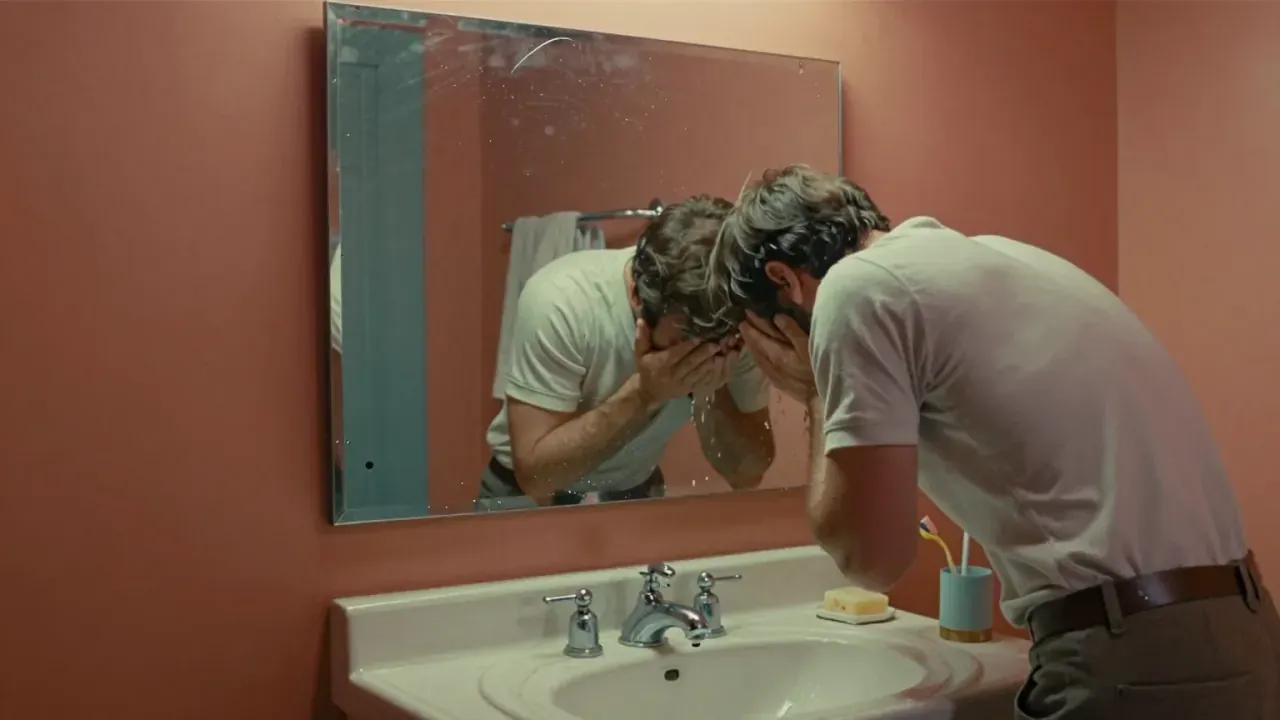
What lands is the cumulative weight of performed vulnerability. When Gus sits alone in a bathtub, staring at his hands, or when Archie stumbles through a hotel corridor at dawn, shirt untucked and eyes unfocused, the film achieves a kind of documentary honesty that bypasses psychology and lands in physiology. The awkwardness between the men and the women they meet in London feels real because it is under-rehearsed, under-lit, under-explained—the camera watches without interpreting. Falk’s physical comedy—his lurching walk, his exaggerated gestures—anchors moments that might otherwise dissolve into abstraction. Gazzara’s stillness works as counterpoint: he absorbs more than he emits, and his silences become structural. The film’s refusal to judge its characters allows room for ambiguity: their cruelty is never excused, but neither is it framed as villainy. It registers as symptom, not sin. These moments do not build to insight, but they accumulate as texture—rough, uneven, tactile. They land because they resist translation into meaning. Word count: 148
The edge of exhaustion
What does not land is the film’s sustained refusal of narrative discipline. Long stretches—particularly the London casino sequence and the extended bar singalong—feel less like immersion and more like detention. The improvisation, while generative in theory, often produces verbal tedium: repetitions without variation, jokes without timing, arguments without stakes. The film assumes that authenticity emerges from unedited behaviour, but some unedited behaviour is simply dull. The misogyny is not stylised or interrogated—it is presented as ambient fact, and the script offers no counterweight, no perspective beyond the men’s own limited view. Jenny Runacre’s Julie is given no language, no interiority, no agency beyond being looked at and misread. The film’s commitment to its own process becomes indistinguishable from indulgence: the 138-minute runtime includes stretches where nothing changes except the light through a window. It mistakes duration for depth, and repetition for revelation. Word count: 149
The atmosphere of loss
The themes that matter are ageing as bodily erosion, friendship as shared delusion, and grief as a state of suspended animation. The film treats midlife not as a phase but as a condition—chronic, low-grade, resistant to resolution. Mortality enters not as tragedy but as banal interruption: Stuart dies off-screen, his absence registered in pauses, not speeches. The men’s attempts to outrun time—through drink, travel, sex, noise—are all revealed as rituals of postponement, not rebellion. Class is present but unspoken: their suburban comfort, their corporate jobs, their ability to vanish to London on impulse—all sit beneath the surface, shaping what they fear losing. Masculinity appears here not as ideology but as habit: the way they touch each other (claps, shoves, grips), the way they speak over one another, the way they measure worth in volume and velocity. There is no critique of these patterns, only documentation—but the documentation is precise enough to function as indictment. Word count: 147
The terms of attention
This film is for viewers who value directorial conviction over coherence, who find emotional risk more compelling than narrative payoff, and who accept that sincerity can be exhausting. It rewards patience with moments of startling, unmediated humanity—moments that feel less like acting and more like witnessing. It is not for those who require cause-and-effect storytelling, psychological clarity, or ethical framing. Viewers who expect satire will find none; those who seek catharsis will leave unsatisfied. Roger Ebert and Pauline Kael dismissed it precisely because it refuses their terms of engagement. A viewer who values structure, wit, or moral orientation will find it alienating. But if you trust that duration can be expressive, that silence can carry weight, and that flawed people deserve attention without redemption, then Husbands meets you on its own ground—and holds that ground longer than most films dare. Word count: 145
The length of feeling
Yes, it is worth your evening—if you approach it as an event rather than entertainment. It demands attention not as spectacle but as encounter: you are asked to sit with discomfort, boredom, and unresolved tension for nearly two and a half hours. That is not a flaw but the point. Its value lies in its resistance to consumption: it cannot be skimmed, summarised, or absorbed passively. Those who find it tedious are not wrong; they are responding honestly to its design. But its power emerges in retrospect—in how certain images linger (a suitcase left open on a bed, a man staring at a mirror without recognition), and how its rhythms echo long after the credits. It is not a film to enjoy, but one to absorb, question, and return to. If you need your evenings to yield clear returns—laughter, suspense, insight—you may leave frustrated. But if you accept that some truths arrive slowly, and some feelings take time to settle, then Husbands earns its length. Word count: 146