The look of it
Black Girl is Ousmane Sembène’s first feature, a French-language drama made in Senegal in 1966, and it sets out to show colonialism not as abstract policy but as daily, intimate violence. It does so by narrowing its focus to one woman—Diouana—and tracking how her sense of self unravels when transplanted from Dakar to Antibes as a domestic worker. The film avoids exposition or polemic; instead, it works through contrast: open streets versus sealed apartments, communal life versus enforced silence, agency versus erasure. Sembène wrote the script himself, adapting his own short story, and he frames the project as an act of counter-narration—not just against French cinema’s invisibility of Black African subjects, but against the internal logic of colonial labour that treats personhood as transferable property. There is no voiceover, no explanatory title cards, no score beyond diegetic sound. What matters is what Diouana sees, hears, and is denied the right to say. The film’s ambition is precise: to make visible the psychological mechanics of dehumanisation without ever naming them outright. It assumes the viewer will follow the weight of a glance, the duration of a pause, the placement of a mask on a wall. (158 words)
The shape of time
The story moves between Dakar and Antibes in tight, unadorned cuts, with flashbacks triggered not by music or dissolve but by objects—a dress, a letter, the mask—anchoring memory in material reality. Mbissine Thérèse Diop’s performance is restrained, deliberate, built on stillness and withheld reaction; her face registers shifts in status before her body is allowed to move. Pierre Laville and Robert Fontaine play Monsieur and Madame with flat, uninflected authority—no caricature, no raised voice, just routine condescension. Anne-Marie Jelinek’s Madame speaks slowly, pauses often, and never raises her tone; her power lies in withholding permission. Gordon Willis did not shoot this film—Sembène worked with local technicians and used available light, often shooting in real apartments and courtyards. The camera stays at eye level, rarely dollies, avoids close-ups until the final sequence. Sound is sparse: footsteps on tile, water running, distant traffic, the rustle of fabric. Diouana’s French dialogue was dubbed, but the dubbing is not smoothed over—it sits slightly apart from her mouth, adding another layer of dislocation. Editing is rhythmic but unsentimental: scenes end when the action ends, not when emotion peaks. There are no establishing shots of France; the country appears only as walls, doors, and thresholds Diouana is not permitted to cross. (159 words)
The weight of silence
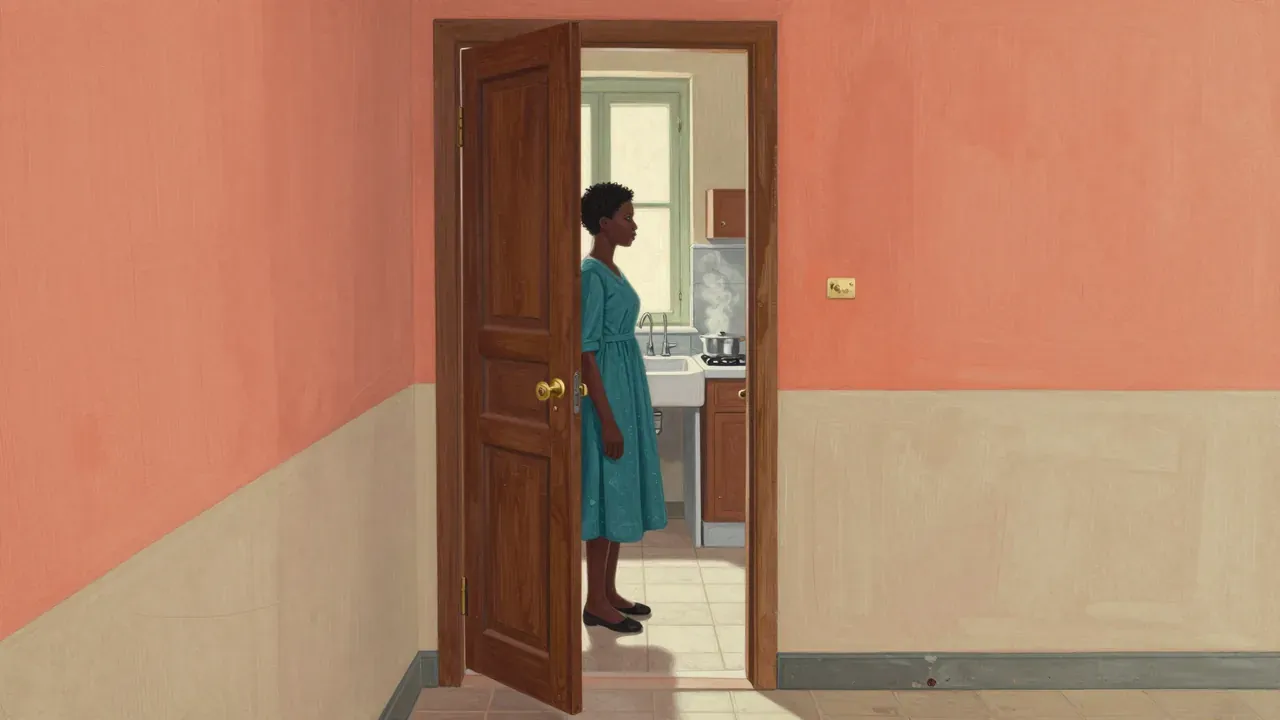
What lands is the cumulative pressure of small exclusions—the way Diouana is handed a plate but not invited to sit, the way she is kissed as spectacle not as person, the way her letter is read aloud and rewritten without her consent. These moments do not shout; they settle. The mask functions precisely because it is never explained: it hangs, then it is fought over, then it is returned, then it is carried by a child. Its meaning accrues through repetition and placement, not commentary. The film’s structure—alternating present and past—does not serve nostalgia but comparison: we see Diouana walking freely in Dakar’s sunlit square, then cut to her standing motionless in a French kitchen, steam rising behind her like a barrier. The suicide is not dramatised for shock but presented as the last possible assertion of control: a single, quiet act in a space where every other choice has been removed. The final shot—Monsieur walking away while the boy follows—lands because it refuses closure. It does not offer hope or vengeance, only continuity: the same mask, the same gaze, the same unresolved tension between giver and taker. Nothing here feels staged for effect; everything feels observed, remembered, necessary. (157 words)
The mask on the wall
What does not land is the film’s occasional reliance on symbolic shorthand that risks flattening complexity into illustration. The mask, though potent, begins to function less as Diouana’s double and more as a textbook prop—its meanings multiply in the encyclopedia extract, but the film itself gives no room for ambiguity beyond its physical presence. Some transitions between timelines feel abrupt not by design but by limitation: the low budget shows in repeated locations and sparse set dressing, which can blur rather than clarify the contrast between Senegal and France. Diouana’s boyfriend, played by Momar Nar Sene, appears only in two brief scenes and remains emotionally opaque—his role is functional, not felt. The French couple’s motivations are left entirely blank, which strengthens realism but weakens moral texture; their indifference reads as systemic, yet the film offers no glimpse of how they arrived at it. A few scenes—like the dinner party kiss—land with historical accuracy but lack the tonal nuance to avoid feeling like a checklist of colonial microaggressions. The dubbing, while conceptually resonant, occasionally undermines emotional continuity: Diouana’s voice does not match her breath, her hesitation, her fatigue. None of this breaks the film, but it does leave certain passages feeling schematic rather than lived. (159 words)
The rules of the house
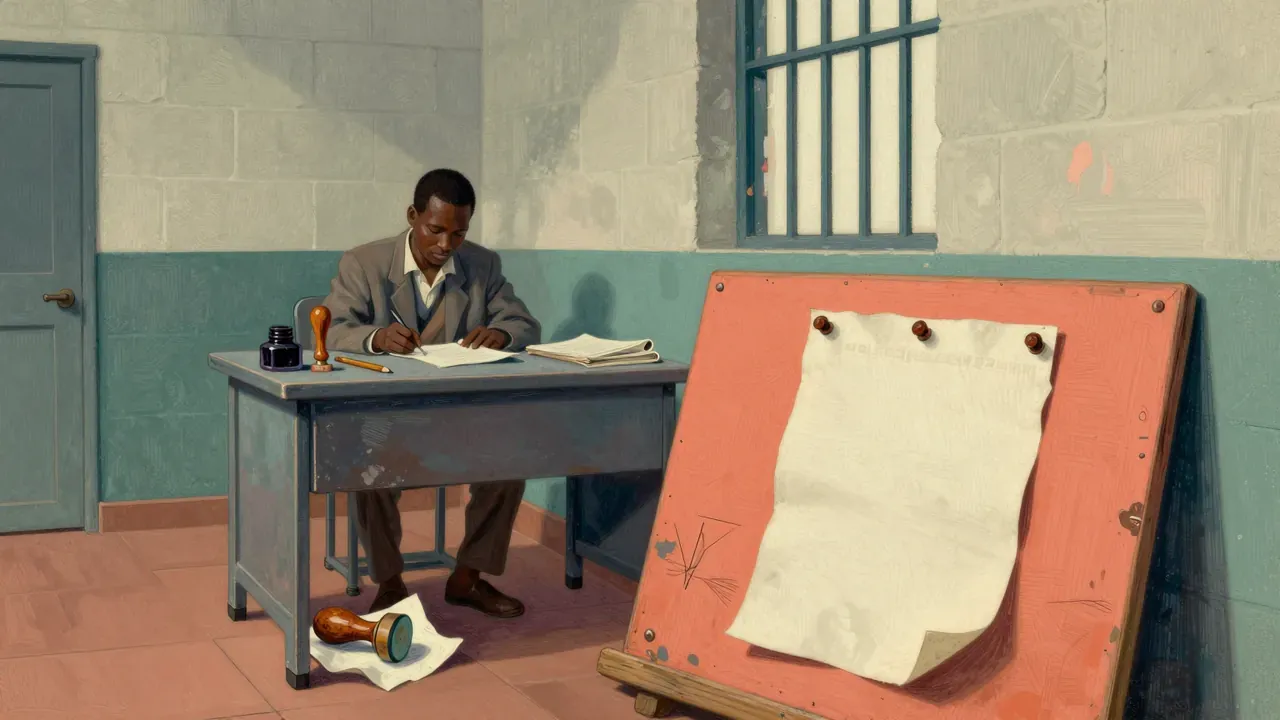
The themes that matter are not colonialism as history but colonialism as grammar: the unspoken rules that assign value, dictate movement, and determine who may speak and who must be spoken for. Literacy is central—not as skill but as sovereignty. When Diouana cannot write her own reply to her mother, the couple do it for her, and she does not correct them; the film treats this not as passivity but as structural silencing. The mask recurs not as relic but as contested object: first gift, then decoration, then trophy, then return, then inheritance. Its journey maps Diouana’s own—given freely, displayed distantly, seized back violently, surrendered finally, then taken up again by someone else. Race operates not through slurs but through spatial logic: Diouana is always indoors, always behind glass, always framed by doorways. Even her polka-dot dress—her only costume not drawn from her own wardrobe—is marked as inappropriate the moment she wears it. The film insists that racism is not an attitude but a system of access: who enters which rooms, who handles which objects, who decides what a letter says. It makes no claim to universality; its specificity—to Dakar, to 1960s Senegal, to French domestic employment law—is its strength. (158 words)
Who watches who
This film is for viewers who accept that some stories refuse catharsis, who understand that witnessing erosion can be as urgent as witnessing resistance. It is for students of postcolonial theory, yes, but also for anyone who has ever been made invisible by routine bureaucracy or polite dismissal. It is not for those who require narrative momentum, character arcs, or emotional release—there is no redemption, no justice, no revelation that alters the terms of Diouana’s world. Someone who expects the film to ‘explain’ colonialism through exposition or testimony will find it withholding. A viewer seeking affirmation of resilience may feel unsettled by its insistence on rupture over recovery. That said, the verdict would change if the film were approached not as tragedy but as testimony: not a story about failure, but a record of what happens when personhood is treated as provisional. Those who reject its austerity often do so because they mistake restraint for absence—when in fact every held breath, every unblinking stare, every empty frame is full of argument. (159 words)
The boy behind the man
Yes, it is worth your evening—not because it entertains, but because it recalibrates attention. At 65 minutes, it asks for little time but demands full presence: no scrolling, no pausing, no background viewing. Its pacing is unhurried but never slack; each shot has weight because nothing is wasted. Someone who watches it expecting conventional drama may leave dissatisfied, but that dissatisfaction is part of the point—the film denies the comfort of resolution. It is worth your evening if you are willing to sit with discomfort without reaching for explanation. It is not worth it if you need clarity over complexity, closure over continuity, or empathy that flatters the viewer rather than implicates them. The verdict would shift only if the film were seen not as a period piece but as a diagnostic tool: its observations about language, labour, and belonging remain current, not because history repeats, but because the structures it documents have not been dismantled—they have been relocated, renamed, and refined. (159 words)