What it is about
Downhill Racer is a sports film that treats skiing not as spectacle but as terrain for character study — specifically, the brittle self-regard of an American athlete who mistakes isolation for integrity. It sets out to depict ambition without mythologising it: David Chappellet is neither heroic nor tragic, but stubbornly consistent in his refusal to be shaped by team, coach, or country. The film avoids the arc of redemption or collapse; instead, it traces how talent and temperament cohere into a fixed posture — one that wins races but cannot sustain relationships, loyalty, or even self-knowledge. Its aim is anatomical, not inspirational: to show how a man’s discipline becomes indistinguishable from his detachment. It does not argue that sport reveals character so much as it demonstrates how character colonises sport — how Chappellet uses racing not to test himself against others, but to confirm his separateness from them. The film’s restraint — its refusal to moralise, explain, or resolve — is structural, not accidental. It was conceived as a modern High Noon, but Ritchie and Salter strip away the genre’s moral scaffolding, leaving only the lone figure, the cold light, and the slope.
How it tells its story
The story unfolds in episodic, uninflected sequences: arrivals, races, brief encounters, silences. James Salter’s script avoids exposition, backstory, or interior monologue; motivation is inferred from gesture, timing, and what is withheld. Robert Redford plays Chappellet with minimal inflection — no swagger, no smirk, just a steady, unblinking gaze and a physical economy that makes every movement deliberate. Gene Hackman, as coach Eugene Claire, underplays authority with quiet exhaustion, never raising his voice, never needing to. Brian Probyn’s cinematography favours medium shots and shallow focus, keeping faces half-obscured in snow glare or shadow; interiors are lit like waiting rooms, not homes. Kenyon Hopkins’ score is sparse — strings held in suspension, brass muted, no leitmotif for triumph. Richard A. Harris’ editing avoids rhythmic build-up before races; cuts land flat, often mid-turn or mid-sentence. There are no slow-motion crashes, no crowd reactions held for emphasis. Even the ski footage — shot on real World Cup courses during actual races — is integrated without fanfare: the camera stays at ground level, tracking skiers as they pass, not soaring above them. The craft serves a single principle: remove all mediation between viewer and subject.
What sticks
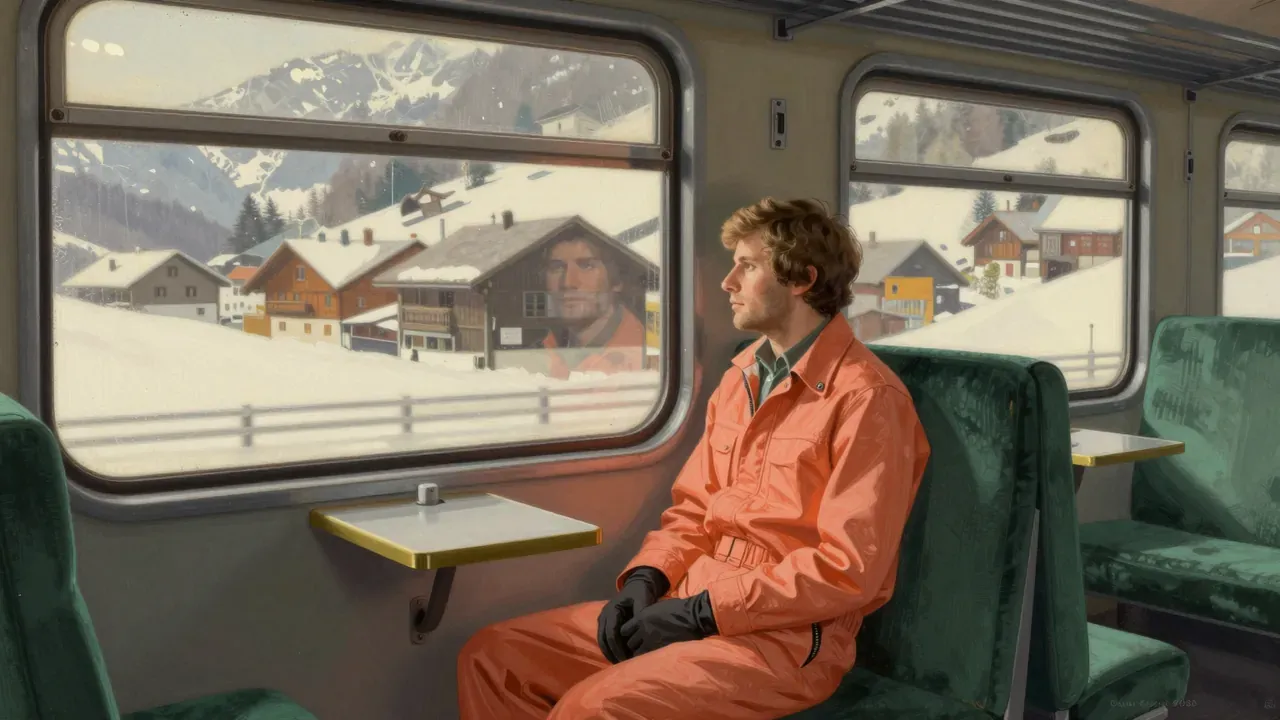
What lands is the cumulative weight of Chappellet’s consistency — not as virtue, but as limitation. His refusal to race at Lauberhorn because of a late start feels less like petulance than a logical extension of his worldview: if the conditions do not conform to his terms, the event has no claim on him. His silence after sex with Lena, his indifference to his father’s quiet disappointment, his dismissal of Carole’s absence at Christmas — none are dramatised for pathos, yet each accumulates into a portrait of emotional stasis. The film’s most resonant moments are off-slope: Chappellet sitting alone in a train compartment, staring out at blurred alpine villages; him watching teammates laugh in a bar while he stands apart, not sullen but simply elsewhere. The skiing itself lands because it is never stylised — the speed is real, the falls are abrupt and unedited, the exhaustion visible in the actors’ breathing. When Chappellet wins Kitzbühel, there is no celebration, only a slow pan across his face as he absorbs the result, then turns away. That restraint earns its gravity.
Where it holds back too far
What does not land is the film’s attempt to suggest depth where it offers only surface. Chappellet’s Idaho Springs origins are sketched but never inhabited — the town scenes feel like location scouting rather than world-building, and his relationship with his father remains a series of static, unresolved exchanges. The romance with Carole lacks texture: their meetings are functional, their parting perfunctory, and her character exists primarily as a mirror for his indifference. Sylvester Stallone’s extra appearance — noted in the fact sheet — is invisible in context and adds nothing. The film’s refusal to explain also risks opacity: without clearer signposting of Chappellet’s internal logic, some viewers may read him as merely arrogant rather than systematically detached. The structure, too, falters in the final stretch — the Olympic build-up dissolves mid-sentence, cutting off narrative momentum without thematic payoff. It is not ambiguity that fails here, but omission: the film assumes a shared understanding of athletic psychology that it does not establish on screen.
What it says about winning
The themes that matter are ambition as self-enclosure, professionalism as erasure of self, and success as a condition that deepens isolation rather than alleviates it. Chappellet’s skill is never in question; what the film interrogates is the cost of treating excellence as a solitary metric. His relationship with the U.S. Ski Team is transactional, not communal — he joins not to represent, but to validate. The coach’s repeated attempts to integrate him are not rebuffed with anger but with silence, which functions as both boundary and weapon. The film treats nationality as backdrop, not identity: the American flag appears only once, on a jacket, and is never saluted or invoked. Even the Olympics — the ultimate symbol of collective aspiration — arrive as a logistical detail, not a destination. What matters is not victory or legacy, but the unbroken line of Chappellet’s attention: inward, downward, always forward. The mountain is not a challenge to be overcome but a neutral field on which his character repeats itself, season after season.
Who it is for
This film is for viewers who value precision over persuasion — those who find resonance in understatement, who prefer character studies that resist interpretation, and who trust long takes and silence more than dialogue or music cues. It suits fans of Ken Loach, early John Cassavetes, or the observational realism of French New Wave sports documentaries. It is not for viewers seeking narrative propulsion, emotional catharsis, or clear moral framing — those who expect growth, consequence, or resolution will find the film withholding. Anyone who requires context, exposition, or psychological explanation will leave frustrated. The film assumes patience and rewards attention, but offers no hand-holding. Those who dislike ambiguity or find emotional austerity alienating should look elsewhere. Its appeal lies entirely in its rigour: if you respond to films that treat human behaviour as a set of observable facts rather than interpretable symbols, this holds your attention. If you need meaning to be declared, not implied, it will feel inert.
Is it worth your time?
Yes, it is worth your evening — provided you approach it as a study in restraint, not a story with stakes. At 101 minutes, it moves deliberately but never drags; its pacing matches Chappellet’s own unflinching rhythm. You will not leave uplifted or unsettled, but quietly recalibrated — aware of how much can be said without saying anything at all. Those who expect traditional drama may find it thin; those attuned to behavioural nuance will find it dense with implication. It repays rewatching not for hidden clues but for shifts in emphasis: a glance held half a second longer, a pause before a reply, the way snow gathers on a shoulder before being brushed off. Its value lies in its refusal to flatter the viewer’s desire for clarity. It asks only that you watch closely — and in return, it shows you something rare: ambition stripped of romance, sport emptied of symbolism, and a man who remains, to the end, exactly who he was at the beginning.