The look of it
Street Without End is Mikio Naruse’s final silent film, made in 1934 for Shochiku, adapting Komatsu Kitamura’s newspaper serial. It sets out to trace the quiet erosion of a working-class woman’s autonomy across intersecting pressures: romantic expectation, class mobility, familial duty, and studio-era celebrity culture. The film does not aim for spectacle or moral resolution but for sustained observation — of how small choices accumulate into irreversible turns, how silence functions as both constraint and resistance, and how urban space (Ginza’s café life, the Yamanouchi mansion, hospital corridors) shapes possibility. Its ambition lies in restraint: no intertitles announce theme; no score swells to underscore emotion. It treats Sugiko’s trajectory not as tragedy or triumph but as drift — socially legible, emotionally precise, structurally inevitable. This is not a film about breaking free, but about the weight of staying within reach of what one knows, even when it no longer fits.
The pace of it
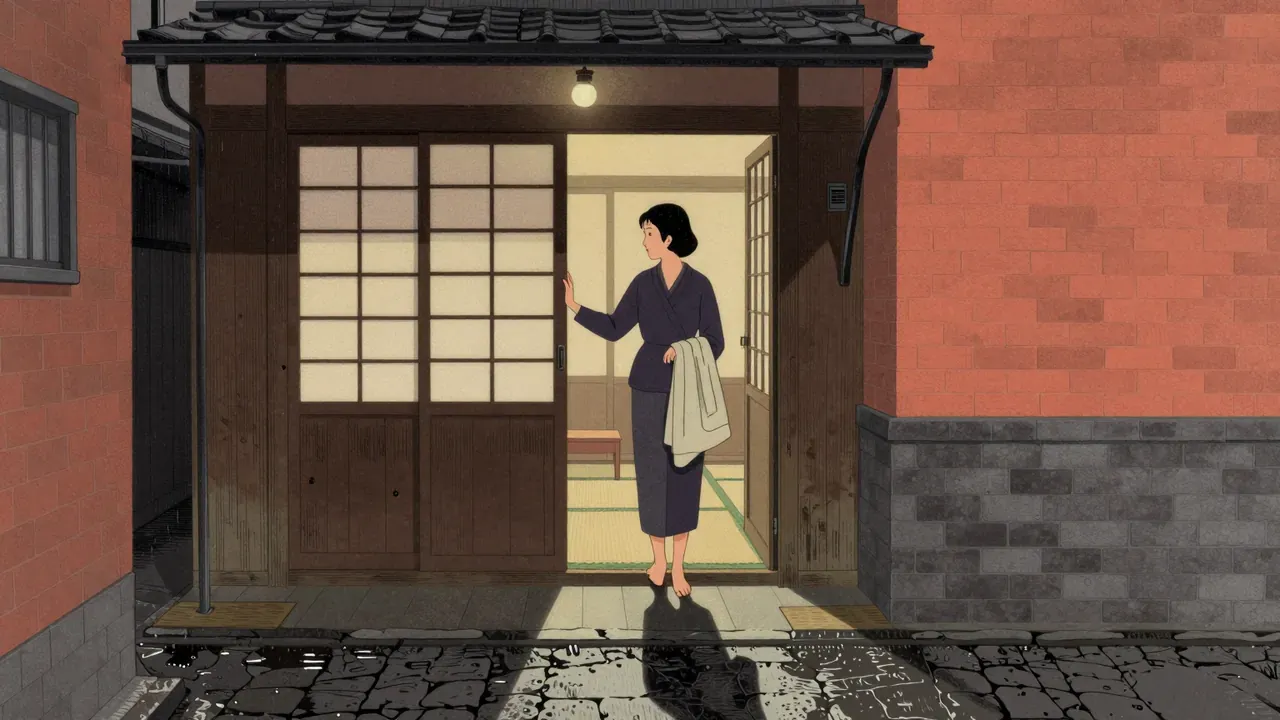
The story moves with the uninflected rhythm of daily routine: Sugiko serves coffee, receives proposals, steps off the pavement, enters a car, changes address, returns to work. Performances are internalised and economical — Setsuko Shinobu’s Sugiko registers distress through posture shifts and pauses in movement rather than facial contortion; Sozo Okada’s Hiroshi conveys growing alienation in his stiffening shoulders and delayed reactions. Naruse and cinematographer Masao Tamai keep compositions shallow and grounded: doorways frame characters in transit, mirrors reflect partial views, café counters divide foreground from background. Editing avoids emphasis — cuts land on neutral moments, not climaxes. Intertitles are sparse and functional, never explanatory. There is no musical score in the original; live accompaniment would have been variable and local, meaning the film’s sonic texture was always contingent. Craft here serves erasure: the more polished the surface, the more visible the friction beneath.
The weight of it
What lands is the cumulative pressure of social hierarchy made tactile — the way Sugiko’s hands hesitate before touching a lacquered table in the Yamanouchi home, how Kesako’s new studio uniform sits too neatly on her body, how Hiroshi’s mother’s silence occupies more space than her dialogue. The film’s refusal to moralise makes its critique sharper: no character is villainous, yet every institution — family, studio, marriage, class — exerts quiet, unyielding force. The ending lands because it offers no reversal, only return: Sugiko back at the counter, same apron, same colleagues, same city, but with a different kind of exhaustion. That return feels earned, not resigned — the result of having seen every corridor she walked down, every glance she absorbed, every decision deferred until it hardened into inevitability. The film trusts the viewer to hold the weight of that quietness without relief.
The strain in it
What does not land is the structural reliance on coincidence as narrative engine: Sugiko stepping into the street just as Hiroshi passes, Machio seeing her enter the car but not the context, Hiroshi’s fatal accident occurring precisely after Sugiko leaves him. These are not implausibilities in themselves — they belong to the logic of melodrama — but Naruse’s otherwise rigorous naturalism makes them stand out as concessions to plot over psychology. The subplot involving Kesako and Shinkichi remains underdeveloped, its stakes unclear beside Sugiko’s arc; their reunion at the end feels tacked on rather than earned. Some performances — particularly Fumiko Katsuragi’s mother — lean on archetypal stillness without yielding interiority. And while the film’s silence is a formal choice, it also limits access: without expressive scoring or vocal inflection, emotional transitions can blur, especially for viewers unfamiliar with 1930s Japanese acting conventions or silent-film syntax.
The cost of it
The themes that matter are class permeability and its illusions, the gendered labour of assimilation, and the hollowness of upward mobility when it demands self-erasure. Street Without End treats marriage not as union but as relocation — physical, social, linguistic — and shows how quickly ‘belonging’ curdles into surveillance. It interrogates aspiration not as individual failure but as systemic funnel: Sugiko is offered two paths — cinema stardom or bourgeois matrimony — both requiring her to perform versions of herself that do not originate in her own desire. The film’s quietest theme is endurance as repetition: returning to the café is not defeat but recalibration — the only space where Sugiko’s gestures remain uninterpreted, her time unclaimed, her presence unmediated by status. Naruse does not ask whether she is happy, only whether she is still recognisable to herself — and the answer, in the final shot, is yes.
The demand of it
This film is for viewers who value precision over propulsion, who find tension in stillness and resonance in restraint, and who approach silent cinema not as historical curiosity but as a distinct language with its own grammar of implication. It rewards patience with psychological density and rewards rewatching with new details — a shift in lighting, a repeated prop, a glance withheld. It is not for those who require narrative momentum, explicit motivation, or cathartic release. Anyone expecting the heightened expressiveness of German Expressionism or the rhythmic drive of Soviet montage will find it withholding. Those unfamiliar with interwar Japanese social codes may miss layers of subtext around familial obligation or studio hierarchies. A viewer who needs closure or moral clarity will leave unsettled — not because the film is ambiguous, but because it refuses to resolve what society itself leaves unresolved.
The measure of it
Yes, it is worth your evening — if you are prepared to meet it on its own terms: slow, unsentimental, and anchored in gesture rather than exposition. Its ninety minutes unfold like a series of held breaths, each one calibrated to show how much pressure ordinary life exerts on ordinary people. It gains power not from incident but from accumulation — of glances, silences, spatial displacements. Those who dismiss it as ‘dated’ or ‘static’ mistake economy for emptiness. A different verdict would follow only if Naruse had chosen emphasis over observation, or if the film had offered explanation instead of implication — but that would make it another film entirely. Its value lies precisely in what it refuses: uplift, judgement, and easy answers. For anyone willing to sit with its quiet gravity, it repays attention with uncommon honesty.