The premise
Elena and Her Men is a fin de siècle political farce dressed as a romantic comedy, set in Paris during the Boulanger Affair of the 1880s. Jean Renoir wrote and directed it as a deliberate return to theatrical artifice — not realism — using historical allusion, exaggerated character types and self-conscious staging to explore how power circulates through performance, desire and spectacle. It does not aim to reconstruct the Third Republic’s politics but to stage them as a game of mirrors: ambition is contagious, loyalty is conditional, and influence flows most freely when disguised as flirtation or folly. The film treats statecraft as improvisation, diplomacy as seduction, and revolution as a matter of timing, costume and crowd management. Renoir frames it as light entertainment, yet its structure insists on the instability of authority — whether held by generals, industrialists or princesses — and the ease with which serious consequences emerge from unserious premises. Its tone is wry, unhurried, and deliberately unmoored from psychological realism.
The look of it
The story follows Elena Sokorowska, a Polish princess who moves between suitors like a conductor between instruments, believing her presence catalyses their success. Ingrid Bergman plays her with physical ease and unforced charm, her face often lit to catch shifts in intention rather than emotion. Claude Renoir’s cinematography avoids dramatic contrast: interiors are softly defined, exteriors bathed in even, late-summer light, with few close-ups and no visual urgency. Jean André’s sets at Billancourt Studios blend period detail with theatrical flatness — staircases recede too neatly, salons feel like backdrops for rehearsal. Joseph Kosma’s score is lyrical but unobtrusive, underscoring rhythm over revelation. Jean Marais and Mel Ferrer offer contrasting masculinity — one dashing and impulsive, the other languid and ironic — while Jacques Morel’s General Rollan carries weight without gravitas. The editing sustains a steady, almost strolling pace, refusing to heighten stakes even at moments of apparent crisis.
The rhythm of it
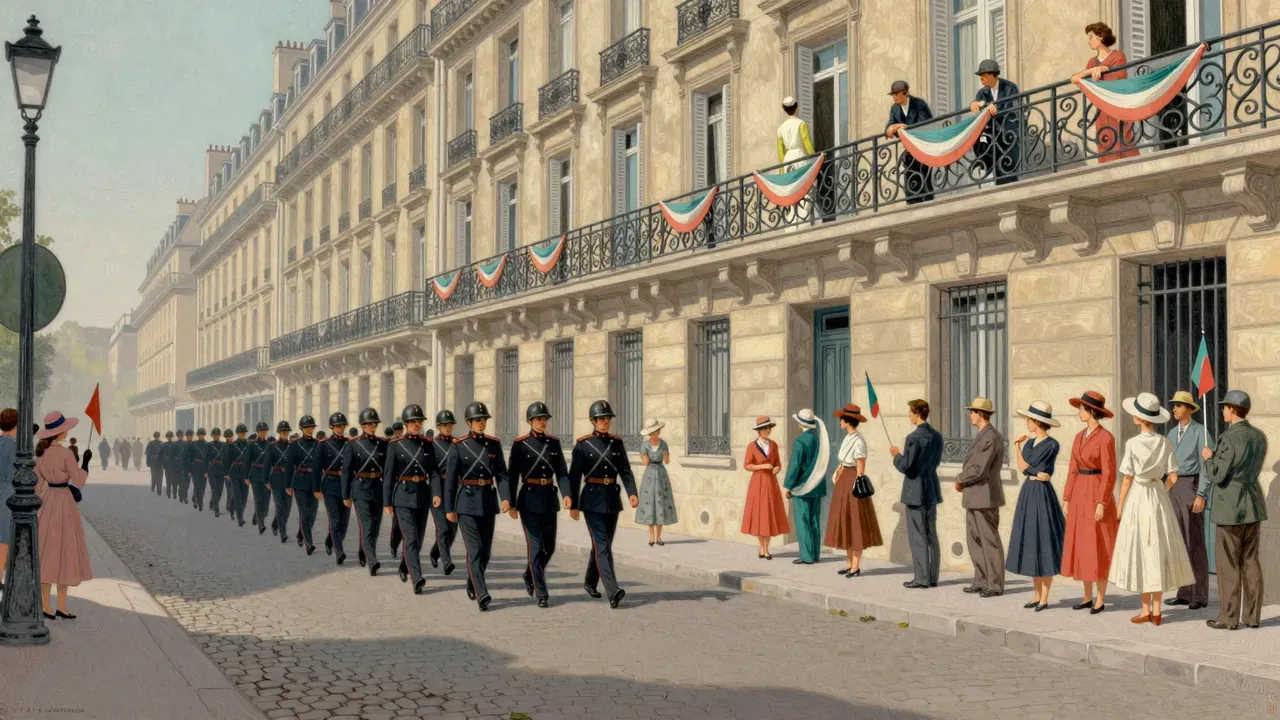
What lands is the film’s sustained tonal control: its refusal to choose between satire and sincerity, farce and feeling. The Bastille Day sequence works because it treats national celebration and personal infatuation as equally performative — fireworks, uniforms and declarations all arrive with the same lightness. The brothel climax lands not as suspense but as choreography: the clothes swap, the window gesture, the mistaken wagon departure — each beats with the logic of vaudeville, not thriller. Bergman’s physical presence anchors the abstraction; her gestures — a tilt of the head, a pause before speaking — carry more narrative weight than exposition. The film’s belief in surface as substance pays off in scenes where costume, posture and timing do the work of psychology. Renoir trusts the audience to read irony without cues: when Martin-Michaud releases Elena after a business deal, the transaction is stated plainly, then dropped. There is no wink, no undercutting — just the quiet absurdity of power negotiated over dinner.
The politics of it
What does not land is the film’s attempt to sustain political resonance beyond its own theatrical frame. The Boulanger parallel remains ornamental: General Rollan never feels like a man wrestling with history, only with his next line. The government’s fear of coup lacks texture — ministers appear as silhouettes behind doors, their motives vague, their authority unexamined. The subplot involving Paulette Escoffier dissolves without consequence, and her final appearance in the wagon feels less like resolution than narrative convenience. The film’s lightness becomes a liability in the final act: the switch from political intrigue to romantic clinch happens without transition, leaving the stakes of both underdeveloped. Some viewers will find the pacing too slack, the satire too gentle to bite, the romance too detached to stir. The film assumes familiarity with Renoir’s earlier triptych — without that context, its structural repetitions feel mannered rather than meaningful.
The power in it
The themes that matter are performance as agency, eroticism as leverage, and the porous boundary between private desire and public consequence. Elena’s power is provisional and representational: she influences events not through decree or inheritance but by being seen in certain places, wearing certain clothes, uttering certain phrases — always in full view of others who interpret her actions as signals. The film treats romantic choice as political choice, and vice versa: marriage proposals, diplomatic interventions and coup plots all follow the same social grammar. Class operates as costume — Martin-Michaud’s shoes, Rollan’s uniform, Henri’s riding breeches — each signifying access, not essence. The film also insists on ambiguity as ethical stance: no character is wholly cynical or idealistic, no outcome fully triumphant or disastrous. Even the ending — a kiss that begins as theatre and ends as truth — refuses to resolve the tension between role and reality. Power here is not seized, but borrowed, worn, and handed on.
The audience for it
This film is for viewers who value tonal precision over plot momentum, who enjoy watching actors inhabit roles without psychologising them, and who find pleasure in the architecture of a scene — how bodies move in space, how dialogue loops back on itself, how music enters and exits. It rewards patience, attention to gesture, and tolerance for unresolved endings. It is not for those who require clear moral positions, escalating stakes or character arcs with cause-and-effect logic. Viewers expecting Bergman’s intensity from Stromboli or Gaslight may find her here too relaxed, too lightly sketched. Those who prefer Truffaut’s emotional directness or Godard’s conceptual rigour will likely see Elena and Her Men as underpowered — a charge Renoir would accept, since the film’s point is that power is rarely pure, rarely singular, and rarely what it appears to be.
The time it takes
Yes, it is worth your evening — provided you watch it as Renoir intended: not as a puzzle to solve or a message to extract, but as a piece of choreographed lightness, like a well-timed waltz. Its ninety-five minutes pass without strain, its pleasures are cumulative and subtle, and its ideas settle slowly, like dust in sunlit air. Those who dislike it tend to judge it against tighter farces — Lubitsch or Wilder — or against Renoir’s own Rules of the Game, expecting sharper satire or deeper melancholy. But this film’s value lies in its refusal to sharpen or deepen: its soft edges are its argument. A change in pacing, a stronger political throughline or more psychological shading would not improve it — it would make it a different, less coherent film. Its worth lies precisely in its consistency, its calm, and its quiet insistence that seriousness need not be solemn.