The look of it
Peeping Tom is a psychological horror film that sets out to anatomise voyeurism not as a quirk but as a structural condition of seeing, filming, and being seen. It does so by making the camera an active agent in the narrative: the protagonist’s tripod-mounted blade kills, his viewfinder frames each murder, and his father’s childhood films are both evidence and inheritance. The film refuses to treat its violence as spectacle or catharsis; instead, it embeds cruelty in routine — in focus-pulling on a film set, in developing prints in a darkroom, in the quiet exchange of a birthday cake downstairs. Its ambition is clinical, not sensational: to show how trauma becomes methodology, how observation hardens into compulsion, and how the apparatus of cinema itself can be weaponised as extension of self. It is not a slasher in the genre’s later sense of ritualised body count, but a study in the preconditions of looking — what precedes the cut, not what follows it. It treats fear not as reaction but as data, recorded, archived, replayed. That this was written by a wartime cryptographer is audible in every precise, unblinking shot.
The grammar of watching
The story unfolds with surgical restraint: Mark Lewis murders three women, each death preceded by prolonged, intimate observation, each filmed from his point-of-view. Karlheinz Böhm plays him without affectation — no snarling, no grand monologues — just stillness, hesitation, and a gaze that never quite settles. Anna Massey’s Helen is equally unadorned: her kindness feels earned, not scripted, her curiosity unforced. Otto Heller’s cinematography avoids expressionist shadows; instead, he uses shallow depth of field and tight framing to mimic the limits of a viewfinder, keeping faces half-lit, doorways half-open, rooms just beyond reach. Brian Easdale’s score is sparse, percussive, often silent — strings enter only when Mark winds film or adjusts a lens. Leo Marks’ script gives no exposition about motive beyond what Mark shows Helen in his father’s reels: a boy flinching at lizards, weeping at a deathbed, then staring blankly at the camera. There are no flashbacks, no voiceover, no dream logic — only the slow accumulation of footage, the weight of repeated gestures, the grammar of surveillance made visible.
What holds the eye
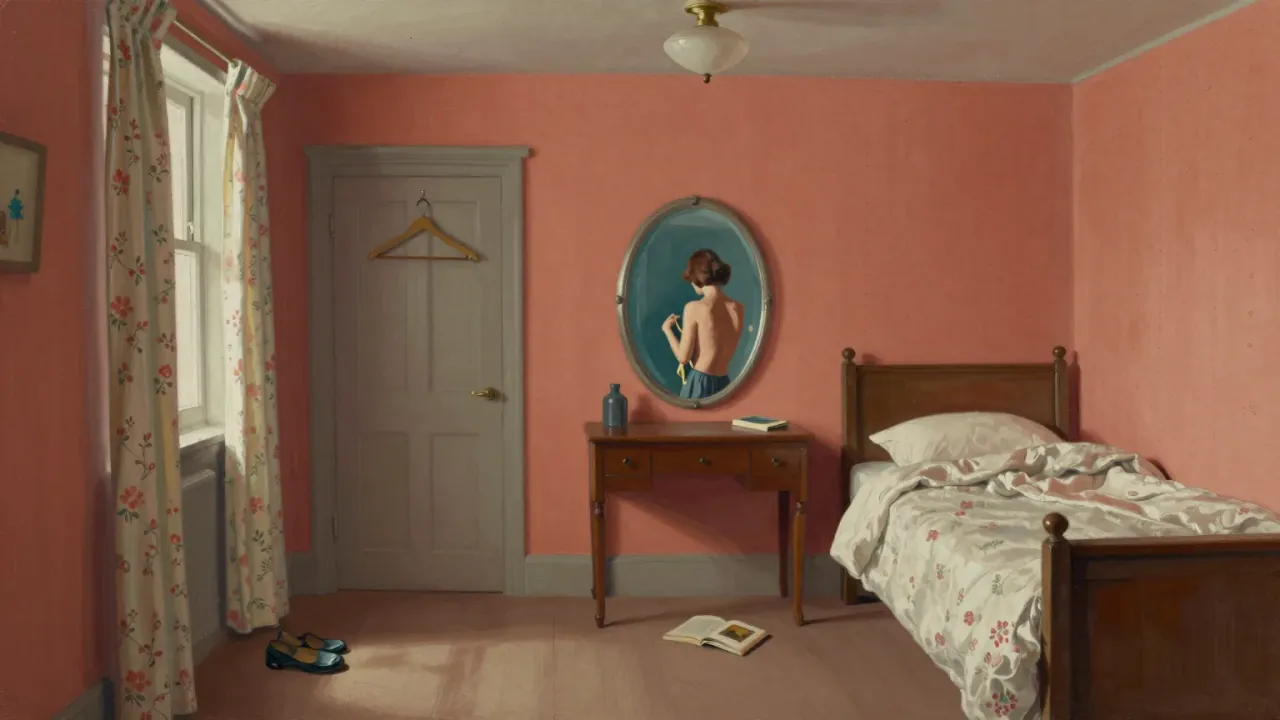
What lands is the suffocating consistency of its perspective. The film never breaks its own contract with the viewer: we see what Mark sees, hear what he hears, and are denied access to any interiority he does not choose to reveal — including his own. That constraint generates real unease, not through jump scares or gore, but through duration: the long take of Milly undressing in front of a mirror, the static shot of Mark watching her die on screen, the silence after Helen kisses him and he pulls away without speaking. Moira Shearer’s brief, brittle turn as the studio actress who faints mid-scene lands because it is played as professional exhaustion, not hysteria. Even the film’s most notorious moment — Pamela Green’s frontal nudity — works not as titillation but as exposure: she is framed like a test subject, lit like evidence, her body measured by the lens before it is pierced by it. The horror is procedural, not performative, and that proceduralism is what makes it endure.
What stays out of frame
What does not land is the attempt to frame Helen’s mother as a moral counterweight. Her blindness is introduced with symbolic weight — she ‘sees’ Mark’s strangeness before anyone else — but the film never develops her perception beyond that single note. Her dialogue remains functional, her presence atmospheric rather than active. Similarly, the police investigation exists only to confirm pattern, not to interrogate it: they notice the terror on victims’ faces but do not question why that expression matters, or how it might reflect back on the viewer. The studio scenes, though sharply observed, lack texture beyond utility — the director’s fussiness, the actors’ fatigue, serve only to place Mark within a working world, not to critique it. And while the father’s experiments are chilling in concept, their execution relies on archive footage that feels archival rather than visceral: grainy, distant, emotionally sealed off. The film’s rigour leaves little room for ambiguity where ambiguity might deepen meaning — particularly around class, gender, or post-war British psychology — and that austerity sometimes reads as omission rather than discipline.
The laboratory of looking
The themes that matter are not voyeurism as peccadillo, but as epistemology: how knowledge is gathered, stored, and weaponised through the act of looking. The film treats the camera not as tool but as limb, not as medium but as nervous system — extending Mark’s anxiety into the world, then feeding the world’s fear back to him as sustenance. It also treats childhood not as origin story but as laboratory: the father’s films are not flashbacks but source code, and Mark’s entire life is runtime. Trauma here is not something to overcome but something to calibrate — his darkroom is both sanctuary and control room, his apartment a set built around absence. The film’s London is not a character but a substrate: grey, rain-slicked, full of thin walls and shared stairwells, where privacy is architectural fiction. There is no escape into nature, no refuge in community — only proximity, observation, and the quiet hum of developing chemicals. These are not metaphors dressed as plot points; they are the film’s operating system, running beneath every scene.
Who sits with it
This is a film for viewers who tolerate discomfort without demanding catharsis, who value precision over pace, and who understand that horror can reside in duration, not disruption. It is for those who watch films not to be carried but to be implicated — who do not mind sitting with a character’s silence longer than feels comfortable, who accept that some questions are posed only to be held, not answered. It is not for viewers who require narrative resolution, emotional payoff, or moral clarity — those who expect the killer to be unmasked, punished, or explained will find the ending withholding, even perverse. Nor is it for those who conflate realism with naturalism: the film’s psychology is forensic, not documentary. Some critics have argued its formal rigour distances the viewer too much; others say that distance is the point. What would change the verdict? A willingness to sit with unresolved tension — not as flaw, but as form.
What remains after
Yes, it is worth your evening — but only if you approach it as a sustained act of attention, not passive consumption. Its 101 minutes unfold with the weight of accumulated evidence, not escalating stakes. You will not leave exhilarated, but you may leave unsettled in a way that lasts: noticing how often you look, how rarely you ask why, how easily the lens becomes habit. It rewards rewatching not for hidden clues but for shifts in emphasis — a glance held too long, a door left ajar, the sound of a shutter clicking just off-screen. Those who expect entertainment will find it austere; those who accept it as inquiry will find it exacting, unsparing, and quietly revolutionary. Its power lies not in what it shows but in how relentlessly it refuses to look away — from Mark, from the camera, from the viewer. That refusal is what makes it endure, and what makes it demand time, not just attention.