The look of it
Journey to Italy is a film about two people failing to speak, not because they lack words, but because language has hollowed out beneath them. It does not aim to resolve their marriage, nor to dramatise a crisis with cause and effect; instead, it holds still while Katherine and Alex Joyce drift through Naples and its environs, registering disaffection as physical fact — a glance held too long, a silence that thickens, a hand withdrawn before it is offered. Rossellini abandons exposition, backstory, and psychological explanation. The inheritance of a villa is merely the pretext for arrival; the poet Charles Lewington exists only as a name and a mood. This is not a story told forward in time but a state observed in duration: emotional stasis made visible through landscape, architecture, and ritual. The film’s ambition lies in its refusal to narrativise alienation — it treats estrangement not as a problem to be solved but as a condition to be inhabited, studied, and left unresolved. Its modernity begins here: in the decision to stop explaining and start attending. (158 words)
The way it moves
The story proceeds by subtraction: scenes are stripped of dialogue, motivation, or transition. Bergman and Sanders perform without rehearsal, their lines delivered moments before filming — a method that leaves their delivery unpolished, hesitant, sometimes flat, but never theatrical. Enzo Serafin’s cinematography avoids emphasis: light falls evenly, compositions are frontal and uninflected, movement is minimal. There are no close-ups to cue emotion, no score to underscore tension — Renzo Rossellini’s music appears sparingly, almost apologetically. Jolanda Benvenuti’s editing sustains duration rather than pace: a museum visit lasts longer than an argument; a drive through countryside occupies more screen time than a confession. The film’s craft is anti-craft in the conventional sense — it resists shaping, guiding, or interpreting. Even the dubbing history — Italian release with muffled English voices, later English versions cut to 70 minutes — becomes part of its texture: a reminder that coherence is always provisional, translation always partial. What emerges is not polished storytelling but a series of exposures: of place, of time, of bodies moving through space without narrative purpose. (159 words)
What sticks
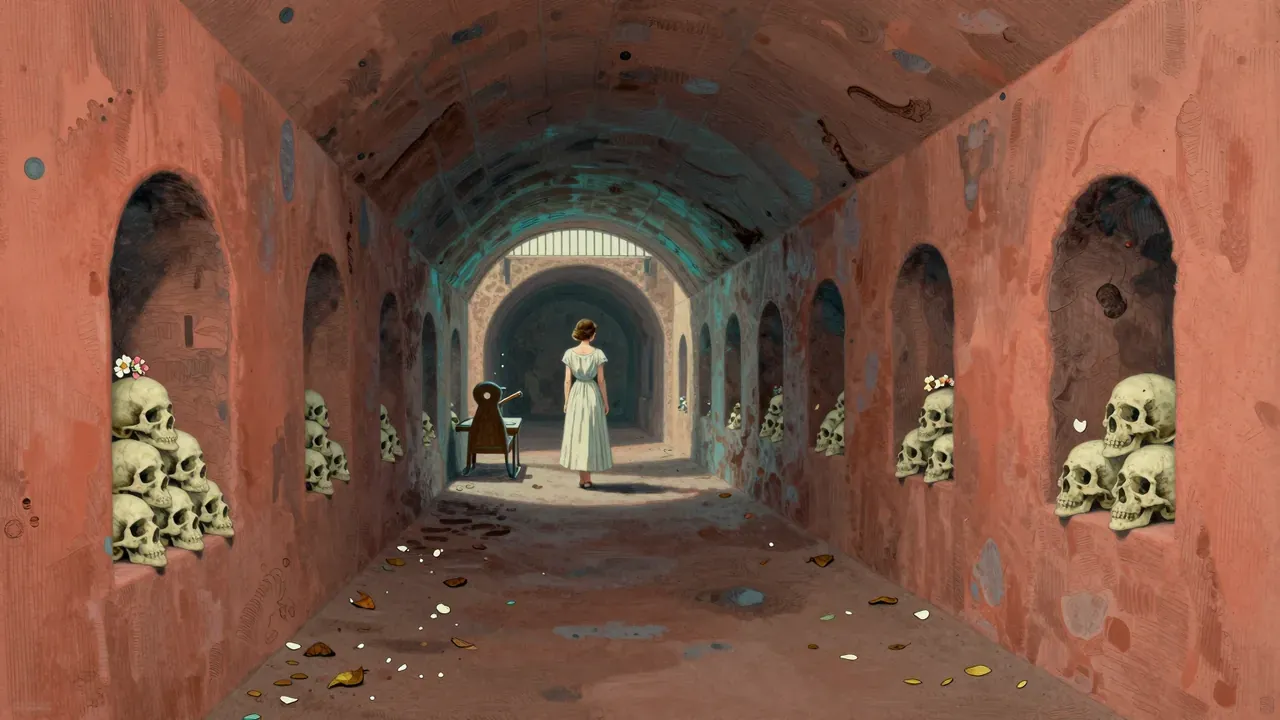
What lands is the weight of unspoken history — between the couple, between nations, between past and present. The Fontanelle cemetery, with its stacked skulls adopted by local families, does not shock so much as settle into the viewer like sediment. Pompeii’s unearthed lovers do not catalyse change but deepen unease: their petrified embrace mirrors Katherine and Alex’s own frozen intimacy. The Saint Gennaro procession works not as miracle but as rupture — a sudden, irrational surge of collective feeling that sweeps Katherine away and forces Alex to move, finally, toward her. These moments land because they are not framed as turning points but as intrusions: real things happening in real time, indifferent to character arcs. The film’s restraint makes the few instances of physical contact — a hand on a shoulder, the final embrace — feel earned not by plot but by accumulated duration. Bergman’s face, filmed without flattery or concealment, registers shifts so subtle they register less as emotion than as physiological response: a tightening at the jaw, a blink held too long. The film trusts the audience to notice these things, and rewards that attention with a rare kind of gravity — not dramatic, but geological. (156 words)
Where it slips
What does not land is any attempt to read the film as psychological realism. The characters’ motivations remain opaque not by design but by omission: we are never told why Katherine mourns Lewington, nor why Alex resents her sensitivity, nor what precisely binds them beyond habit and shared geography. The script offers no exposition, and the direction supplies no subtextual reinforcement — so viewers expecting causal logic or emotional payoff will find only gaps. Some performances falter under the method: Sanders’ detachment reads as indifference rather than exhaustion; Anna Proclemer’s prostitute scene feels stranded, neither integrated nor explained. The film’s resistance to narrative also means its structure can feel arbitrary — days tick by without clear progression, locations accrue without thematic patterning. Those who rely on plot as scaffolding may find themselves adrift after twenty minutes. The English-language version’s cuts compound this: the 81-minute runtime omits material that might have anchored certain transitions, leaving some sequences unmoored. It is not that the film fails to communicate, but that it communicates in a grammar many viewers no longer recognise — one where meaning resides in pause, not pivot. (157 words)
What it’s really about
The themes that matter are not abstract but embedded in matter itself: stone, ash, bone, breath. Sterility appears not as metaphor but as lived fact — the couple’s childlessness, the barren slopes of the Phlegraean Fields, the hollowed-out villa. Time is not linear but stratified: Pompeii, Naples Museum, Fontanelle all layer millennia into a single afternoon. Ritual matters not for its meaning but for its persistence — the procession continues whether Katherine is in it or not. The film treats religion not as belief but as physical event: incense, chanting, press of bodies, heat. Mortality is not a concept but a presence — in the skulls, the volcanic soil, the dead poet’s name spoken once and never again. Even love is rendered materially: not as feeling but as proximity, as touch, as the effort required to cross a crowd. These are not themes argued but conditions registered — the film’s modernism lies in its refusal to separate idea from object, thought from texture. It asks the viewer to experience time not as story but as accumulation: of dust, of memory, of silence. (152 words)
Who it’s for
This film is for viewers who tolerate ambiguity as a condition, not a problem — those who find value in duration over development, in observation over explanation. It suits people accustomed to Antonioni, Bresson, or early Tarkovsky, or those willing to meet slow cinema on its own terms. It is not for viewers who require narrative propulsion, emotional clarity, or character arcs — those who expect films to answer questions rather than hold them open. Anyone needing exposition, psychological insight, or catharsis will leave frustrated. The film assumes patience as prerequisite, not virtue. Its demands are formal, not moral: it asks for sustained attention to uneventful surfaces, for tolerance of pauses that do not resolve. A viewer who values craftsmanship in editing or performance may find little to admire here; someone drawn to atmosphere, texture, and historical resonance will find it rich. The Criterion restoration makes the grain and light legible — but no remastering can supply what the film deliberately withholds: guidance. (158 words)
Whether it’s worth your time
Yes, it is worth your evening — provided you set aside the expectation that a film must earn its length with incident. Its eighty-one minutes pass without hurry, but not without consequence: by the end, Naples has ceased to be backdrop and become participant, and the couple’s embrace feels less like resolution than reorientation. It repays attention not with rewards but with recalibration — of how time moves, how silence functions, how bodies occupy space together without speaking. Those who find it inert are not wrong; they are responding honestly to its refusal of conventional engagement. But its influence on Godard, Truffaut, and Scorsese is not academic — it changed how films could breathe. To watch it now is to encounter a hinge moment: the point where cinema stopped illustrating psychology and began inhabiting it. That shift remains consequential. If you watch it expecting drama, you may leave disappointed. If you watch it as archaeology — of feeling, of form, of mid-century European cinema — you will leave altered. (159 words)