The look of it
La Vie de Jésus is Bruno Dumont’s 1997 debut feature, a French drama set in the flat, rain-slicked outskirts of Bailleul, near the Belgian border. It attempts to render adolescence not as transition but as stasis — a condition of physical presence without psychological agency. The film follows Freddy, an epileptic young man with learning difficulties, unemployed and drifting between his mother’s bar, hospital appointments, and time with Marie, his supermarket-worker girlfriend. Its method is forensic: long takes, minimal camera movement, sparse dialogue, and deliberate pacing. Dumont refuses exposition or interior monologue; motivation is withheld, cause-and-effect blurred. The title — unexplained, unironic, unattributed — functions less as reference than as provocation: it invites comparison not in narrative parallel but in scale of consequence, in the weight of a single life collapsing under its own inertia. The film does not argue for empathy or condemn outright; it holds its characters at a distance calibrated to frustrate interpretation. Word count: 142
The way it moves
The story unfolds in episodic, almost ritualistic blocks: band rehearsal, sex, hospital visit, rape, betrayal, murder, arrest. Performances are non-professional, grounded in physicality rather than psychology — David Douche as Freddy moves with heavy-limbed uncertainty, Marjorie Cottreel’s Marie registers disgust through posture and silence, not speech. Philippe Van Leeuw’s cinematography fixes on faces and hands, using natural light and shallow focus to flatten depth and compress emotional space. Editing by Lecorne, Choukroun and Deschamps avoids rhythm or emphasis; cuts land without punctuation, often mid-action or mid-breath. Richard Cuvillier’s score is sparse, mostly absent — ambient sound dominates: distant traffic, muffled voices, the clatter of a supermarket trolley. The unsimulated sex scene, confirmed by Dumont as involving body doubles, is shot without eroticism or intimacy, its discomfort arising from duration and exposure, not content. Craft serves austerity, not style. Word count: 153
What stays with you
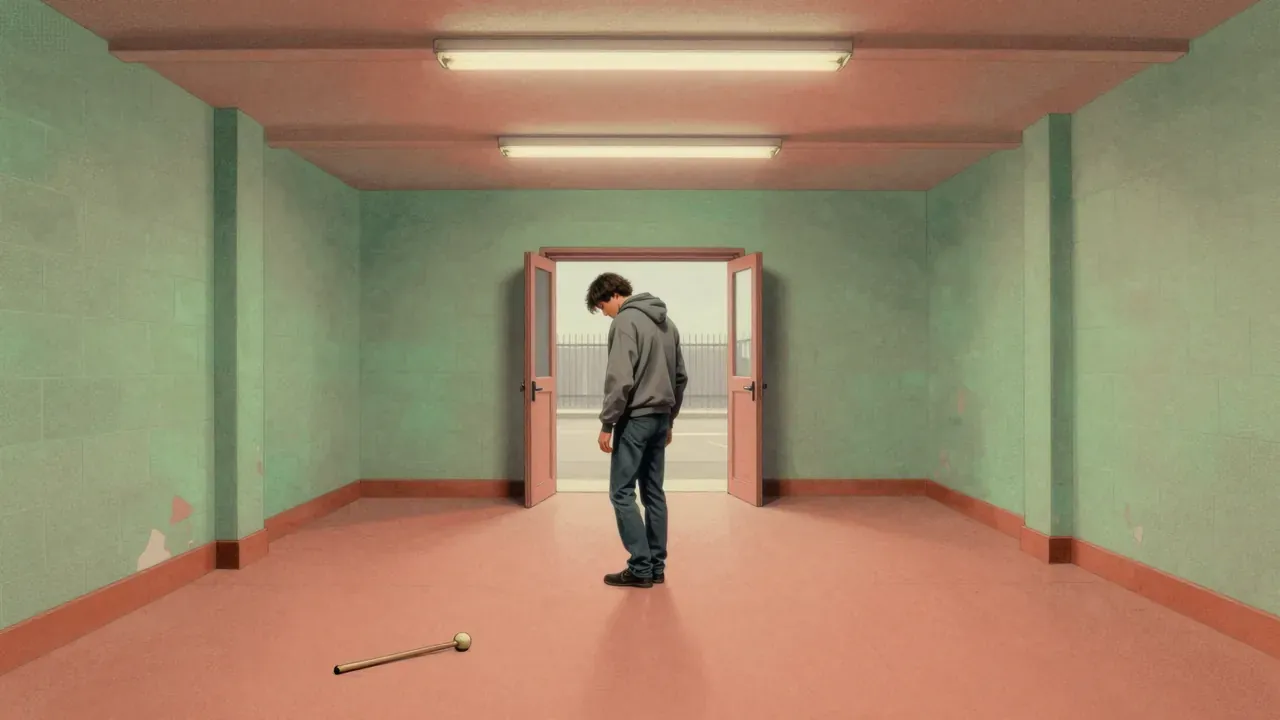
What lands is the texture of provincial neglect: the damp concrete of band practice rooms, the fluorescent glare of the supermarket, the hollow echo of Freddy’s mother’s bar after closing. The film’s refusal to explain or judge makes its moral gravity inescapable — not because it tells us what to feel, but because it denies us the comfort of narrative resolution or psychological clarity. The rape sequence is not sensationalised, but neither is it excused; its horror resides in its banality, in the way it follows directly from idle conversation and group mimicry. The final confrontation — Freddy kicking Kader to death — gains force from its lack of build-up: no music swells, no close-ups linger, no cutaway softens the blow. The police inspector’s verdict lands precisely because it is delivered not as climax but as administrative fact. This is not realism as imitation, but realism as refusal: to flinch, to interpret, to narrativise suffering into meaning. Word count: 150
Where it stalls
What does not land is the film’s structural rigidity when sustained over ninety-six minutes. Its repetitions — the same walk down the same street, the same band formation, the same silences — accumulate without accrual of insight. The absence of interiority becomes indistinguishable from absence of characterisation; Freddy remains opaque not as a formal choice but as a limit of access. Some viewers will find the pacing not deliberate but inert, the stillness not charged but vacant. The title’s irony — if it is irony — never resolves into coherence; it hangs unresolved, neither clarified nor deepened by the events that follow. The film’s ethical stance risks collapsing into aesthetic detachment: when every gesture is equally weighted and none is explained, moral distinction blurs. A viewer seeking causality, development or even consistent tone will leave frustrated, not challenged. Word count: 148
What it’s really about
The themes that matter are not those announced by the title but those embedded in the film’s geography and rhythm: the erosion of agency under unemployment, the violence of group identity without purpose, the physicality of thoughtlessness. It treats epilepsy not as metaphor but as condition — a body interrupting itself, mirroring the social environment’s failure to sustain continuity. Learning difficulties are shown not as deficit but as misalignment: Freddy processes the world differently, and the world has no infrastructure for that difference. The marching band — all male, all idle — is both symptom and structure: discipline without direction, order without function. Race enters not as ideology but as proximity: Kader is not othered in dialogue, but in spatial exclusion — he walks alone, speaks little, appears only when the group acts. The film’s Christianity is nominal, its Jesus a cipher — the real subject is the life before transcendence, before meaning, before even the possibility of redemption. Word count: 149
Who it’s for
This film is for viewers who treat slowness as syntax, not obstacle — those accustomed to Bresson, early Tarr or late Akerman, who read silence as density, not void. It rewards attention to gesture, to weather, to the weight of a pause. It is not for those who require narrative propulsion, psychological legibility or moral framing. Viewers expecting social critique with explanatory voiceover, or crime drama with procedural logic, will find it withholding to the point of obstruction. Those unsettled by unsimulated sex or unflinching depictions of sexual violence should avoid it entirely. The film’s power depends on its refusal to accommodate; soften its rigour, and it dissolves. A viewer who values clarity over ambiguity, explanation over implication, or catharsis over accumulation will not find what they seek here — and the film makes no apology for that. Word count: 144
Is it worth your evening?
It is worth your evening only if you accept that some films exist not to be consumed but to be endured — not as entertainment but as calibration. Its ninety-six minutes recalibrate perception: how long you can watch a face without expression, how much silence a scene can hold before it becomes unbearable, how much moral weight rests in a kick delivered without warning. It is not ‘enjoyable’ in any conventional sense, but it is consequential — one of those rare debuts that reorients what cinema can do with stillness and refusal. Anyone who has watched it once remembers the light on the pavement outside the bar, the sound of a dropped plastic bag, the way Freddy blinks before acting. That persistence is its value. To call it ‘difficult’ is to mistake its purpose: it is not difficult to understand, but difficult to sit with — and that difficulty is the point. Word count: 147