The premise
Gate of Flesh is a 1964 Japanese drama directed by Seijun Suzuki for Nikkatsu, adapting Taijiro Tamura’s novel. It sets out to portray the moral and material collapse of post-war Tokyo not as recovery but as reconfiguration — where militarised discipline, patriarchal control and social exclusion persist under new labels: yakuza authority, American occupation presence, and the self-policing codes of a female collective. The film does not aim for documentary realism but for stylised allegory, using the micro-society of five prostitutes in a bombed-out building to mirror national structures. Its ambition is structural critique, not character study or historical record. It treats the Occupation not as rupture but as continuity — the same hierarchies, now draped in khaki and cigarette smoke. The script by Gorō Tanada sharpens this intention through rigid rules (no love, no betrayal, no individualism) that echo pre-war bushidō codes, transposed onto women who have no state, no family, no legal personhood. This is not a lament for lost innocence but an indictment of how power reassembles itself in the rubble.
The look of it
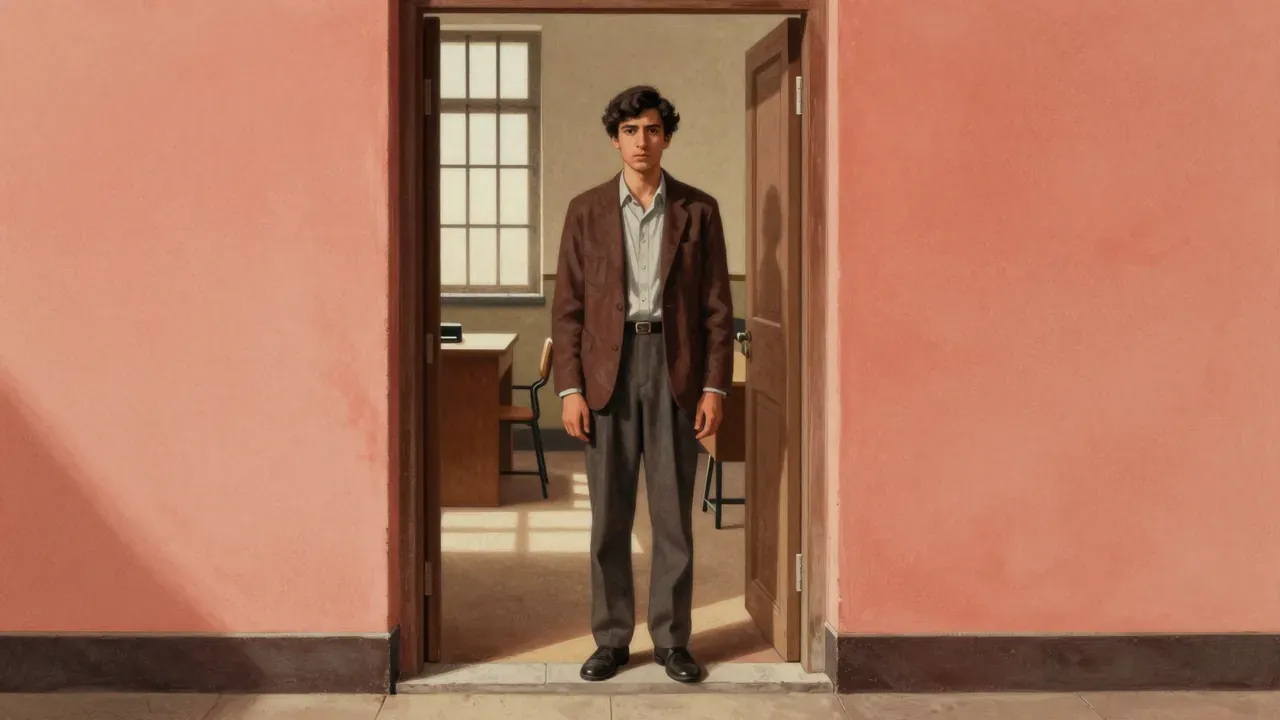
The story follows Maya’s entry into a tight-knit group of sex workers who govern themselves with quasi-military rigour, until the arrival of Shintaro Ibuki — a wounded ex-soldier whose presence fractures their consensus. Joe Shishido plays Ibuki with coiled stillness; Yumiko Nogawa’s Maya carries grief like physical weight, her gestures small, her voice rarely rising above a murmur. Tomiko Ishii, Kayo Matsuo and Isao Tamagawa ground the ensemble in lived weariness, not caricature. Takeo Kimura’s production design — assembled from scavenged studio lumber and theatrical flats — gives the setting a deliberately unstable texture: walls tilt, light bleeds unevenly, ceilings sag. Akira Suzuki’s editing avoids continuity cuts, favouring jarring juxtapositions that deny comfort. Naozumi Yamamoto’s score uses sparse percussion and dissonant strings, never underscoring emotion but punctuating silence. There are no establishing shots of Tokyo; the city exists only as rumour, gunfire, and the distant hum of American trucks. Every craft choice serves the film’s refusal of naturalism.
The weight of the code
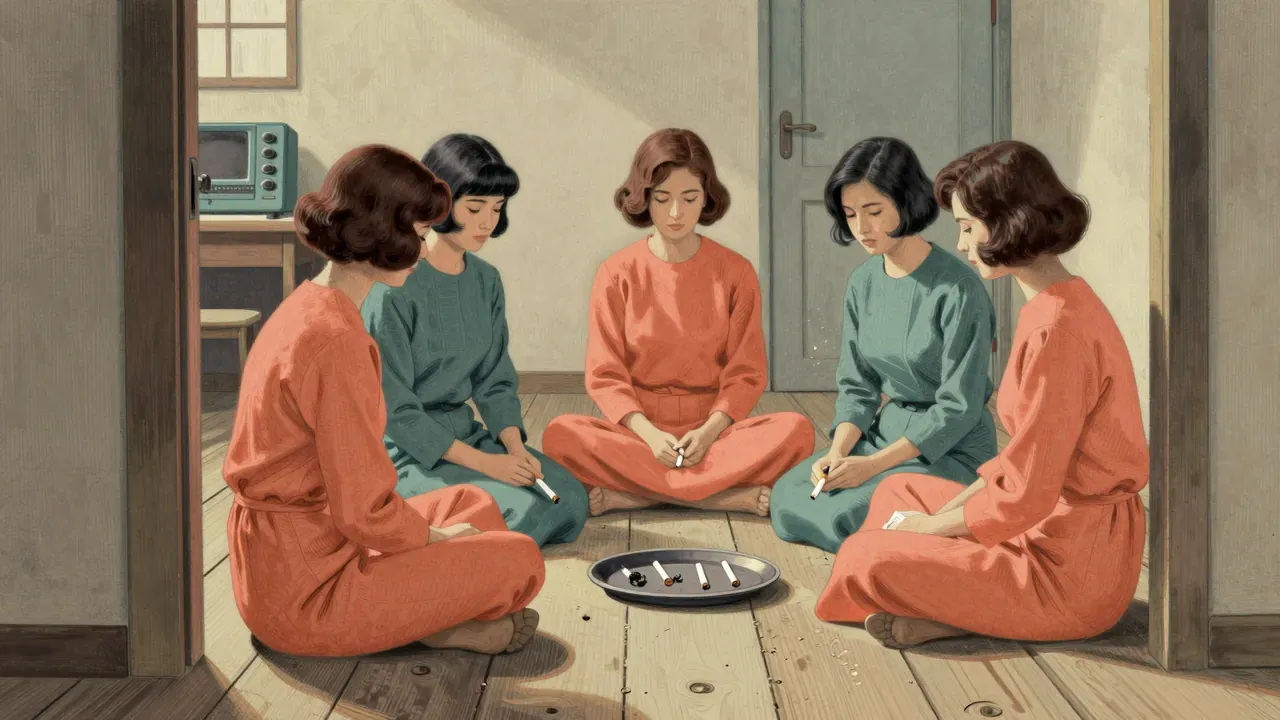
What lands is the suffocating logic of the group’s code — its cruelty feels necessary, its solidarity non-negotiable, its collapse inevitable once desire enters the frame. The scene where Maya and Ibuki flee into drunken euphoria works because it is not romantic but desperate: their laughter is thin, their embrace unsteady, their bodies moving as if underwater. The visual grammar reinforces this — low angles make the ruined building loom like a cathedral of survival, while tight framing traps characters in corners they cannot talk their way out of. The film’s most persuasive moments are those of enforced ritual: shared meals, collective punishment, the silent passing of cigarettes. These are not gestures of sisterhood but of mutual surveillance. Even the nudity — which caused studio resistance — is functional, not sensational: skin is shown as surface, not spectacle; vulnerability is structural, not erotic. Suzuki refuses catharsis, and that refusal lands with cumulative force. The ending does not resolve but resets: Maya alone again, not broken but emptied, her posture unchanged from the opening shot.
Where the scaffolding shows
What does not land is the Catholic priest character, whose brief appearance feels grafted on — a symbolic device without dramatic weight or internal logic. His dialogue is vague, his function unclear: neither moral counterpoint nor institutional foil, he remains inert. Similarly, the yakuza figures operate as ambient threat rather than active agents; their menace is atmospheric, not dramatised, so their interventions lack consequence. The film’s compression — ninety minutes for a full social ecosystem — means some relationships remain schematic: Roku’s pragmatism, Mino’s volatility, Machiko’s quiet withdrawal — all register, but none deepen beyond archetype. The allegory occasionally overreaches: when Horidome recites wartime slogans verbatim, it reads less as psychological realism and more as lecture. And while the set design’s artifice is intentional, a few sequences — particularly the rooftop confrontation — suffer from visibly flimsy construction, pulling focus from performance to physics. These are not flaws in intent, but in execution’s uneven reach.
What love costs
The themes that matter are continuity of power, the gendered cost of reconstruction, and the illusion of autonomy within constraint. The film treats ‘freedom’ as a hollow term when survival depends on internalising the very rules imposed by occupiers and former elites. Love is forbidden not because it is weak, but because it introduces a private loyalty that undermines collective discipline — a direct parallel to pre-war collectivism. The body is both commodity and boundary: sold, punished, displayed, but never truly owned. Class is rendered tactile — in patched kimonos, in the way rice is scraped from bowls, in the silence after American soldiers leave. Colonialism appears not as foreign imposition but as domestic repetition: the yakuza replicate military hierarchy; the Occupation forces replicate imperial bureaucracy. There is no nostalgia for pre-war Japan, nor hope for post-war democracy — only the grinding persistence of systems that demand sacrifice, obedience, and erasure of the self. These are not abstract ideas but lived conditions, made visible through gesture, space, and rhythm.
Who it’s for
This film is for viewers who value formal rigour over exposition, who accept allegory as argument, and who can sit with unresolved tension. It rewards attention to composition, editing cadence, and vocal restraint. It is not for those needing narrative clarity, emotional hand-holding, or historical context supplied on screen. Anyone expecting a conventional war drama or a character-driven romance will find it withholding. Those who dislike stylised artifice — tilted sets, abrupt cuts, muted performances — may mistake its discipline for coldness. A viewer who values psychological realism over structural critique will likely reject its methods. The verdict would shift only if Suzuki had softened the allegory’s edges or expanded the supporting characters’ interiority — but that would undermine the film’s central point: that in such conditions, interiority is a luxury, and survival demands flattening the self into function.
The time it takes
Yes, it is worth your evening — provided you approach it as a tightly wound mechanism, not a window onto reality. Its ninety minutes pass with unnerving economy: every shot advances theme, every silence tightens the coil. It repays rewatching not for plot revelation but for noticing how light falls across a cracked wall, how a glance shifts power between three women, how silence stretches before violence. It is not ‘entertaining’ in the usual sense, but it is gripping in its precision and unsparing in its intelligence. Those who dismiss it as dated or opaque are missing its deliberate refusal of accessibility — a refusal that is itself political. It asks for patience, not empathy; attention, not identification. If you expect cinema to soothe or explain, it will disappoint. But if you accept that some truths are best told obliquely, through architecture and absence, then Gate of Flesh delivers with uncompromising force. Its value lies not in what it says, but in how relentlessly it enacts its ideas.