The look of it
Prisioneros de la tierra is a 1939 Argentine drama that sets out to depict the systemic violence and moral suffocation of forced labour in the yerba mate plantations of northern Argentina. It does so not through exposition or political speechifying but by anchoring its critique in the physical and psychological erosion of individuals: Esteban Podeley’s quiet dignity, Dr. Else’s dissolving competence, Andrea’s fragile agency, Köhner’s cold authority. The film treats the jungle not as backdrop but as an active, oppressive presence — humid, inescapable, indifferent. Its ambition is social realism with tragic weight, aiming to expose how debt, geography, and racialised hierarchy conspire to trap men not just physically but existentially. It refuses redemption through reform or legal intervention; justice arrives only as rupture, and even then it fails. The film’s project is neither documentary nor allegory, but a tightly wound dramatisation of structural cruelty — one that insists on the body’s response to injustice before the mind can name it. It seeks to make visible what official records erased: the mensú as subject, not statistic.
The weight of silence
The story unfolds with deliberate, almost ritual pacing: boarding the river ship, arrival at the plantation, the slow accrual of small humiliations, then the sudden, brutal turn toward revolt and collapse. Pablo Tabernero’s cinematography keeps the frame dense and low-contrast — interiors are shadowed, exteriors washed in flat, humid light, the camera rarely moving beyond medium shots that hold characters within their own exhaustion. Ángel Magaña plays Podeley with minimal inflection, his resistance built into posture and pause rather than speech. Francisco Petrone’s Köhner is chillingly untheatrical — no mustache-twirling, just bureaucratic menace made flesh. Elisa Galvé’s Andrea carries quiet gravity, her gestures precise, her silences weighted. Lucio Demare’s score avoids melodrama; strings and piano motifs recur like half-remembered lullabies, underscoring loss more than action. The editing, too, resists emphasis: cuts land without flourish, letting scenes breathe until their emotional pressure becomes unbearable. Every craft choice serves containment — not spectacle, but the feeling of walls closing in.
The river’s logic
What lands most firmly is the film’s unblinking physicality: the heat you feel in the actors’ sweat, the weight of a cane strike, the way dirt clings to Podeley’s hands as he digs his fingers into the earth at the end. The river is never picturesque — it is a conduit for coercion, a boundary that cannot be crossed without consequence, a grave. The relationship between Podeley and Andrea works because it is defined by proximity and restraint, not dialogue; their few shared glances carry the full burden of hope and futility. The hallucinations suffered by Dr. Else register not as psychological flourish but as physiological fact — the body breaking down under stress and alcohol, rendered with clinical precision. Even Köhner’s final rafting is not symbolic but logistical: he is disposed of like refuse, swept away by currents that care nothing for justice. The film’s power resides in this refusal to elevate suffering into poetry. It lets the mud stay muddy, the grief stay mute, the ending stay unresolved except in its final, literal stillness.
The shape of resistance
What does not land is the orange distiller subplot — Roberto Fugazot’s character appears briefly, speaks little, and vanishes without narrative function or thematic echo. His presence feels like a vestigial scene from an earlier draft, disrupting the film’s otherwise tight focus. Likewise, Pepito Petray and Félix Tortorelli occupy roles that gesture toward collective resistance but remain underdeveloped; their motivations and inner lives are left blank, making their participation in the uprising feel procedural rather than earned. The film also struggles with Dr. Else’s descent: while his drunkenness is established early, the shift into full hallucination lacks the necessary gradation — it arrives abruptly, without the physiological or behavioural cues that would ground it in lived reality. This weakens the tragedy of Andrea’s death, which depends on the audience believing in the father’s disorientation as both real and inevitable. Without that conviction, the moment reads less as inevitability and more as contrivance — a plot device wearing the mask of fate.
The corridor at night
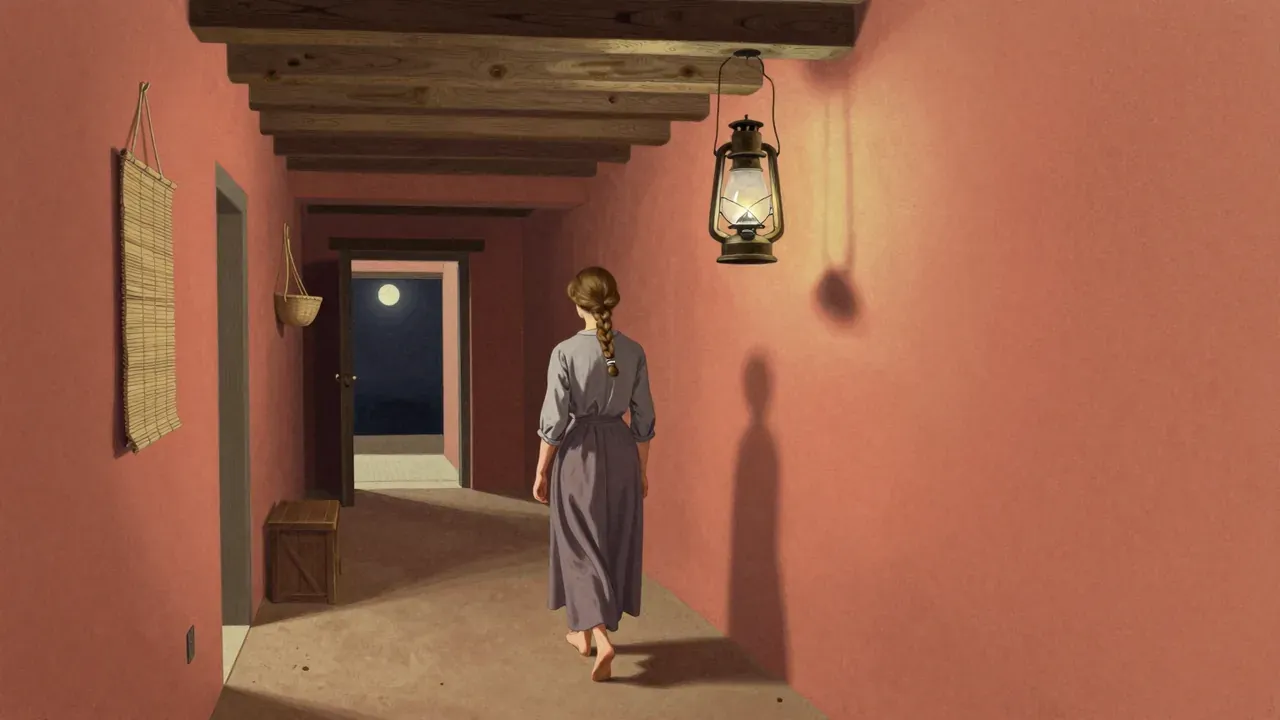
The themes that matter are debt as bondage, silence as complicity, and landscape as moral agent. The film treats debt not as a financial instrument but as a mechanism of erasure — it cancels personhood before it cancels wages. Silence recurs not as peace but as suppression: the overseers’ silence around abuse, the workers’ silence born of fear, Andrea’s silence when she walks the corridor at night, the final silence after the gunshot. The jungle is never neutral; it absorbs sound, muffles protest, hides escapees, and returns bodies — it is nature as enforcer, not refuge. Class is rendered tactile: Köhner’s clean linen against Podeley’s fraying shirt, the doctor’s empty bottle versus the workers’ shared gourd. There is no nostalgia for rural life or folk virtue — the film rejects pastoral myth entirely. What remains is a stark equation: land, labour, and law are all held by one party, and the rest are merely temporary tenants of their own bodies. That equation has no solution within the frame — only interruption, and then dissolution.
The loose dirt
This film is for viewers who value historical specificity over narrative convenience, who find tension in stillness and meaning in texture, and who accept that social critique need not offer resolution to be urgent. It rewards attention to gesture, lighting, and rhythm over plot mechanics. It is not for those who require clear moral binaries, explanatory dialogue, or catharsis — the film denies all three. Anyone expecting the pacing or emotional scaffolding of contemporary drama will find it withholding, even inert. Those who associate ‘Golden Age’ cinema with ornate production or star-driven glamour may misread its austerity as poverty of means rather than precision of intent. A viewer who values psychological realism over symbolic shorthand will engage deeply; one who relies on exposition or character backstories will feel adrift. The restoration makes its formal choices newly legible — but it does not soften them. Its demands are unchanged: patience, attention to subtext, and tolerance for endings that settle like dust, not conclusions.
The 2019 print
Yes, it is worth your evening — provided you approach it as a historical artefact with aesthetic integrity, not as entertainment. Its eighty-five minutes unfold with the gravity of a civic document, and its power accumulates slowly, in increments of light, gesture, and silence. You will not leave uplifted, but you may leave unsettled in a way that lingers — not because of shock, but because of recognition: the mechanisms it shows are not archaic but adaptable. Some will argue it is too slow, too bleak, too remote; they are not wrong about the slowness or the bleakness, but they mistake its distance for irrelevance. What would change the verdict? A different cultural context — one where forced labour in agro-industrial supply chains is not a current reality but a closed chapter. As long as that chapter remains open, Prisioneros de la tierra is not a relic. It is a mirror, slightly warped by time, but still reflecting.