The look of it
Black River is a 1957 Japanese drama directed by Masaki Kobayashi, adapted from a screenplay by Zenzo Matsuyama. It sets its action in the immediate post-occupation landscape of Japan, centring on a university student’s displacement into a squalid district adjacent to a US military base. The film attempts to articulate systemic dispossession—not through abstract critique but through tightly wound personal violation: rape, coercion, eviction, and murder all stem from overlapping structures of local gang power, American military presence, and crumbling civic order. Its ambition is neither allegorical nor didactic; it refuses symbolic resolution or moral uplift. Instead, it sustains a low, unrelenting pressure on the viewer, asking not what justice looks like, but how dignity persists—or fails—when every institution has already withdrawn. It is not a protest film in the rhetorical sense, but a forensic one: it documents the texture of complicity, the quiet accumulation of small surrenders that precede violence. At 114 minutes, it moves without flourish, its pacing calibrated to the weight of waiting, of being watched, of being priced out. (158 words)
The shape of the district
The story follows Nishida, a student displaced into a decaying tenement, and Shizuko, a waitress drawn into an abusive relationship with gangster Joe after he rapes her. Their tentative bond forms against a backdrop of orchestrated evictions, where Joe colludes with the landlady to clear tenants for a speculative hotel. Tatsuya Nakadai plays Joe with physical menace and unsettling stillness; his performance avoids caricature, locating cruelty in routine condescension rather than outbursts. Ineko Arima’s Shizuko registers trauma not as breakdown but as erosion—her eyes narrow, her posture tightens, her speech grows quieter, not louder. Eijirō Tōno as Kurihara offers muted gravitas, a counterpoint to the film’s pervasive helplessness. Cinematography by Kazuo Miyagawa keeps interiors dim and cluttered, using shallow focus to isolate faces within cramped frames. Editing avoids rhythm or punctuation; scenes bleed into one another, mirroring the characters’ lack of recourse. There are no establishing shots of the base—its presence is felt in distant sirens, passing jeeps, and the way light falls differently on asphalt near the perimeter fence. (159 words)
The rhythm of violation
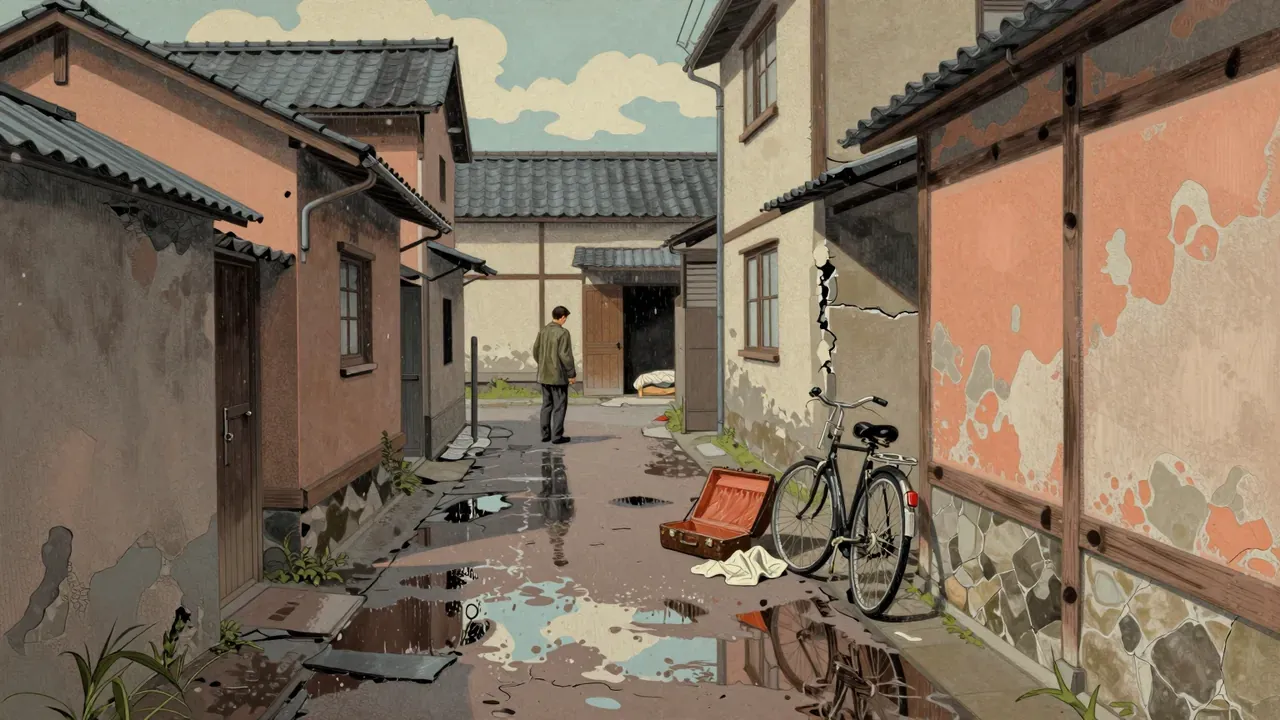
What lands is the film’s refusal to separate personal violation from structural reality. Shizuko’s killing of Joe does not read as catharsis but as exhaustion made kinetic: she pushes him not in rage, but because the truck is there, because he is drunk, because she has no other exit. The eviction sequence works precisely because it shows no confrontation—just paperwork handed over, doors locked, belongings left on rain-slicked pavement. The landlady’s pragmatism, played by Isuzu Yamada, feels chillingly plausible: she does not sneer or gloat, but sighs, counts money, and turns away. The film’s restraint makes its anger more durable. Even minor characters register as lived-in: Keiko Awaji’s Yasuko speaks little but watches everything; Seiji Miyaguchi’s Kin moves through scenes like a man who has already accepted defeat. The score—sparse, mostly diegetic—is used only to mark transitions between day and night, reinforcing the cyclical nature of the characters’ entrapment. Nothing feels staged for emphasis; instead, the film accumulates detail until the air itself seems thick with resignation. (157 words)
The paperwork of dispossession
What does not land is the underwritten role of Nishida as moral centre. Fumio Watanabe performs dutifully, but the script gives him little interiority beyond concern and occasional outrage—his political awareness remains vague, his agency minimal. His love for Shizuko arrives without sufficient groundwork, making their connection feel functional rather than earned. Some supporting figures blur into types: the procuress, the nervous tenant Okada, the opportunistic Sakazaki—all serve plot mechanics more than thematic purpose. The film also struggles with spatial coherence: the geography of the district is never clarified, so the proximity of the base, the tenement, and the bar remains impressionistic rather than concrete. This weakens the intended critique of occupation’s permeation—it feels atmospheric rather than anchored. A few scenes linger too long without shift or revelation, particularly early exchanges between Nishida and his fellow students, which establish little beyond generic disillusionment. Kobayashi’s later work would tighten such passages; here, they risk monotony. Those expecting the formal rigour of Harakiri or the procedural precision of The Human Condition may find Black River’s pacing diffuse at points. (156 words)
The gravity of the perimeter
The themes that matter are dispossession as process, not event; consent as conditionally revoked by environment; and masculinity as performance sustained by impunity. The film treats the US military base not as foreign intrusion but as gravitational field—its presence warps local economics, law, and desire without needing direct intervention. Joe’s power derives less from his own force than from his ability to broker access: to the base’s periphery, to off-limits spaces, to American currency. Shizuko’s coerced relationship exposes how survival narrows the definition of choice until ‘no’ becomes indistinguishable from ‘not yet’. Class is rendered tactile—the peeling wallpaper, the shared latrine, the way tenants fold bedding each morning to reclaim floor space. Gender operates similarly: women’s labour is visible (serving, cleaning, enduring), while men’s violence is often delegated or deferred. There is no nostalgia for pre-war order, nor hope in post-war renewal—only the grinding persistence of people adapting to ground that keeps shifting beneath them. The film’s quietest theme is silence as strategy: who speaks, who is heard, and whose voice is erased before it forms. (158 words)
The language of the push
This film is for viewers who value moral ambiguity over resolution, who attend to gesture over exposition, and who accept that some endings are logistical, not emotional. It suits those familiar with mid-century Japanese cinema’s pacing and restraint, or those willing to adjust to its unhurried syntax. It is not for viewers seeking narrative propulsion, character arcs, or tonal relief—there is no comic interlude, no moment of reprieve, no voice of wisdom to clarify meaning. Those who require psychological explanation for Shizuko’s choices, or who expect Nishida to organise resistance, will find the film withholding. A viewer might reasonably argue it undercuts its own critique by rendering systemic forces so ambient they become atmospheric rather than actionable. That verdict would change if the film offered clearer lines of accountability—or if it showed collective response rather than solitary collapse. But as it stands, its power lies in its refusal to offer either. (159 words)
The morning after the truck
Yes, it is worth your evening—if you approach it as a study in endurance, not entertainment. Its 114 minutes unfold with the inevitability of tide, not plot. You will not leave energised, but you may leave attentive: to how space is weaponised, how consent erodes incrementally, how violence wears the clothes of routine. It rewards patience, not passive viewing. Those who dislike films that resist interpretation or withhold catharsis may find it unrewarding—but that resistance is the point. A viewer who values clarity of message over complexity of implication will likely reject it. The verdict does not hinge on whether it is ‘enjoyable’, but whether it compels attention to realities most narratives soften or omit. Its worth lies not in what it resolves, but in what it insists you hold in mind after the final frame: the sound of a truck passing, the weight of a hand on a shoulder, the silence after a door closes for the last time. (159 words)