The weight of a name
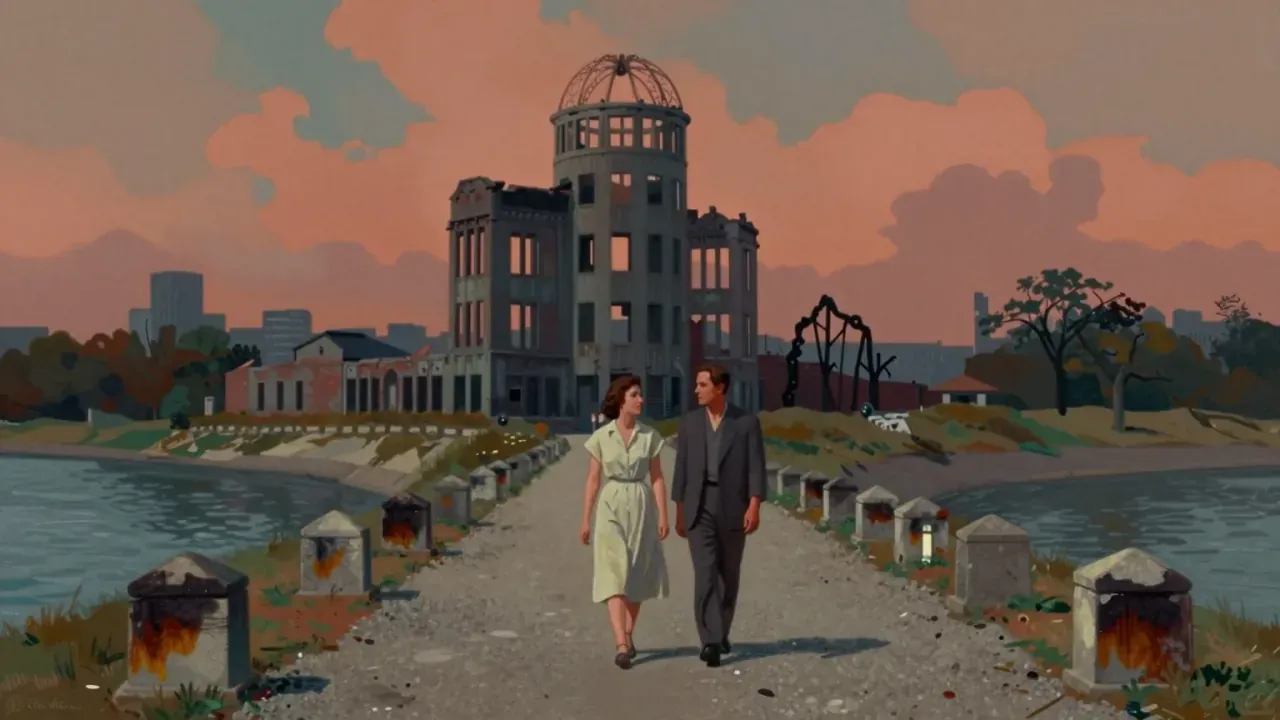
Hiroshima mon amour is a French-Japanese co-production, Resnais’ first feature, conceived not as a documentary about the atomic bombing but as a love story anchored in its aftermath. It attempts something precise: to make Hiroshima legible not through statistics or spectacle, but as a shared emotional ground between two people whose histories are otherwise irreconcilable — a French actress and a Japanese architect. Marguerite Duras’ script refuses exposition; instead, it treats memory as unstable, physical, and morally entangled. The film does not seek to explain Hiroshima, nor to resolve grief, but to hold space for how trauma echoes across geography, language, and time — how forgetting becomes both survival and betrayal. Its ambition is structural as much as thematic: to build a narrative where the past is not recalled but re-embodied, where a twitching hand or a word like ‘Nevers’ carries the weight of history. It asks whether intimacy can be an act of witness — and whether love, under such conditions, is possible without erasure.
The look of it
The story unfolds over slightly more than twenty-four hours, moving between Hiroshima’s present and Nevers’ past via intercut flashbacks so brief they register less as scenes than as involuntary flinches. Emmanuelle Riva’s performance is calibrated in micro-gestures: a pause before speaking, a glance held too long, breath catching mid-sentence. Eiji Okada matches her restraint, his quiet presence anchoring the film’s emotional gravity without recourse to theatricality. Sacha Vierny and Michio Takahashi’s cinematography avoids symbolic framing; their compositions are tight, unadorned, often static — letting sweat, ash, and silence carry meaning. Anne Sarraute and Henri Colpi’s editing stitches memory into dialogue with surgical precision, never clarifying chronology but insisting on its instability. Georges Delerue’s score is sparse, hovering at the edge of audibility, reinforcing the sense that emotion here is not declared but endured. There are no establishing shots of Hiroshima as monument; only streets, hands, skin, and the occasional newsreel fragment, inserted not as evidence but as counterpoint.
The shape of silence
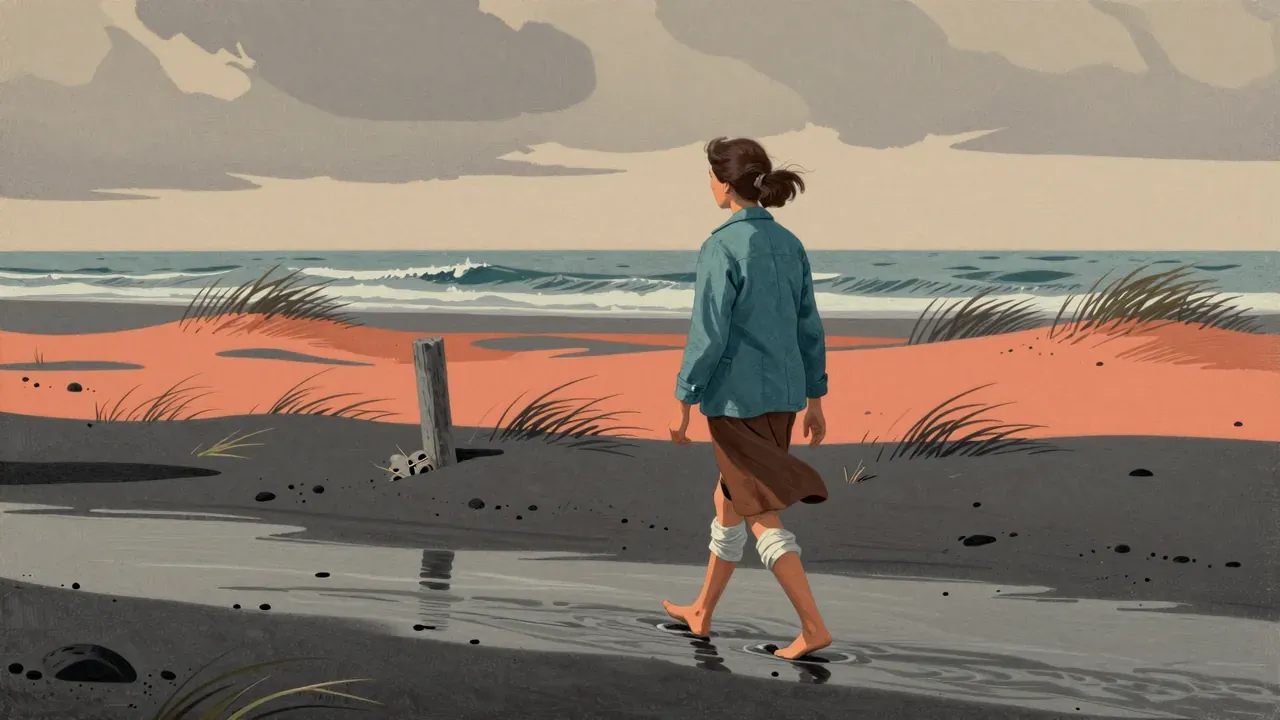
What lands is the film’s refusal to separate personal and historical grief. The woman’s shame in Nevers — the shaven head, the cellar, the locked room — is not framed as private melodrama but as one local manifestation of the same violence that flattened Hiroshima. The architecture of memory feels physically real: when she says she is already forgetting the architect, it lands not as irony but as physiological truth. The film’s structure — looping, hesitant, circling back on itself — makes forgetting feel inevitable, even necessary, rather than a failure. The final sequence, where Hiroshima and Nevers dissolve into one another visually, works because it has earned that collapse: the cities are no longer locations but states of mind. The performances land because neither actor gestures toward catharsis; their restraint makes the moments of rupture — a yell, a sudden stillness — land with quiet force. The film’s intelligence is never abstract; it lives in the duration of a look, the weight of a pause, the way light falls on a forearm after sex.
The cost of parallel
What does not land is the film’s occasional over-reliance on rhetorical symmetry. The parallel between the German soldier and the Japanese architect risks flattening both men into archetypes — victims of war, lovers erased by history — rather than individuals with distinct moral textures. Bernard Fresson’s portrayal of the German remains sketchy, defined more by absence than presence, which weakens the emotional logic of the Nevers section. Some transitions between memory and present feel abrupt not by design but by omission — gaps where context or motivation might have deepened, not diluted, the ambiguity. The film’s resistance to exposition occasionally tips into opacity: the political dimension of the architect’s work, for instance, stays vague, leaving his character less grounded than hers. And while the refusal to name the protagonists is thematically coherent, it can distance the viewer at moments when specificity — a name, a detail, a flaw — would have sharpened empathy rather than blurring it.
The grammar of grief
The themes that matter are memory as bodily habit, not mental record; forgetting as both wound and repair; and love as a site where history becomes tangible. The film treats language as porous — ‘Hiroshima’ and ‘Nevers’ become proper nouns that bleed into pronouns, then into verbs. It interrogates how national trauma settles into private life: how a city’s rubble echoes in a woman’s hesitation before a mirror, how a man’s silence about his dead family mirrors her silence about her lover’s execution. Colonialism, occupation, and nuclear annihilation are not backdrop but grammar — shaping syntax, rhythm, and what can be said aloud. The film also insists on the erotic as ethical: touch is never neutral, never merely sensual. A hand on a shoulder carries the weight of complicity, consent, and care. Its most persistent theme is the impossibility of clean separation — between victim and perpetrator, witness and participant, past and present, love and grief — and the quiet courage required to live inside that entanglement.
The pace of feeling
This film is for viewers who trust silence, who read faces as texts, and who do not require narrative resolution to feel emotionally satisfied. It rewards attention to texture — the grain of film, the cadence of breathing, the way light shifts across a wall — and assumes familiarity with mid-century European literary sensibility. It is not for those who need clear cause-and-effect storytelling, explicit character motivation, or emotional signposting. Anyone expecting a conventional romance or a polemical anti-war statement will find it withholding. Those put off by slow pacing, fragmented chronology, or unrelieved melancholy may leave frustrated. A viewer who values psychological realism over plot mechanics, or who finds intellectual rigour inseparable from emotional honesty, will likely respond strongly. Someone who prefers cinema that explains rather than embodies its ideas — or who needs characters to articulate their inner lives directly — will find little purchase here.
The measure of time
Yes, it is worth your evening — not as diversion, but as recalibration. Its ninety minutes ask you to inhabit uncertainty, to sit with unresolved tension, and to accept that some wounds do not close but become part of how you hold the world. It repays close viewing not because it hides meaning but because it embeds meaning in duration: the length of a glance, the space between sentences, the time it takes for ash to settle on skin. That demands patience, but the return is rare — a film that treats memory and desire with equal seriousness, without sentimentality or didacticism. Those who dismiss it as ‘cold’ or ‘difficult’ are not wrong about its texture, but they mistake austerity for emptiness. Its power lies precisely in what it refuses: explanation, comfort, closure. To watch it is to accept that some truths are held in the body before they reach the tongue — and that is worth ninety minutes of anyone’s time.