The first feature
Pitfall is Hiroshi Teshigahara’s first feature film and the opening statement of his collaboration with writer Kōbō Abe — a stark, allegorical drama set in the decaying coal-mining regions of Kyūshū. It does not aim to document labour conditions naturalistically, nor to narrate a linear crime or redemption arc. Instead, it uses a fragmented, dream-logic structure to render systemic exploitation as metaphysical entrapment: the miner’s death is not an endpoint but a pivot into spectral recurrence, where identity blurs, justice collapses into misrecognition, and agency vanishes beneath bureaucratic and ideological machinery. The film’s project is to make visible the mechanics of disposability — how capital, state power and collective amnesia conspire to erase individuals twice over: first from work, then from memory. Its austerity is deliberate, its surrealism functional — not decorative. It refuses psychological exposition or moral resolution, treating hopelessness not as mood but as structural fact. This is political cinema stripped of rhetoric, built from silence, repetition and withheld explanation.
How it works
The story unfolds in disjunctive episodes, anchored by Kunie Tanaka’s man in white — a figure without motive or origin, whose actions proceed with the implacable rhythm of ritual. Hisashi Igawa plays both the miner and Otsuka, a doubling that feels less like acting choice than narrative necessity: the system cannot distinguish between them, so neither can the film. Sumie Sasaki’s shopkeeper registers fear and complicity without exposition; her voice tightens, her gaze avoids, her compliance is transactional and fatal. Tōru Takemitsu’s score is sparse, using percussive metallic resonance and low string clusters to evoke mine-shaft acoustics and institutional dread. Gordon Willis is not involved; the cinematography is by Hiroshi Segawa, who shoots in high-contrast black-and-white, often framing characters at oblique angles against empty landscapes or crumbling architecture. The editing, by Toshio Gotō, favours abrupt cuts and lingering static shots — time contracts and dilates without warning. Stock footage of mining disasters is spliced in not for realism but to collapse past and present, documentary and fiction, into shared ruin.
What lands
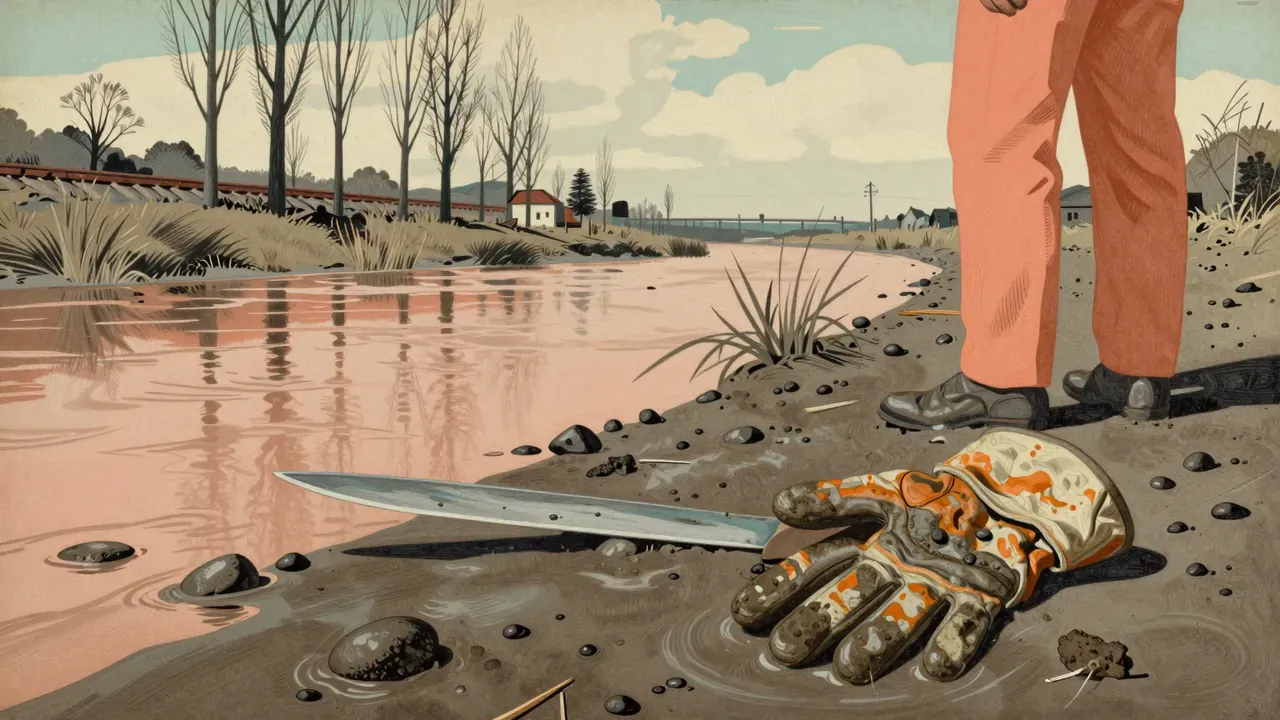
What lands is the cumulative weight of inevitability. The ghost town is not atmospheric backdrop but logical consequence: a place where economic abandonment has already dissolved social form. The miner’s dream of union membership in a next life lands because it is the only articulation of desire the film permits — and it is instantly negated by waking. The murder scene lands not through violence but through its banality: no music, no close-up on the knife, just a cut to the riverbank where the blade sinks into mud. The policeman’s rape of the shopkeeper — included despite crew resistance — lands as a brutal punctuation mark on the film’s thesis: law enforcement here does not uphold order but enforces erasure. The final image of the son running into distance lands precisely because it offers no catharsis, no destination — only motion away from a system that consumes fathers and frames ghosts as suspects. These moments do not persuade; they settle, like dust in an abandoned shaft.
What does not
What does not land is the film’s attempt to position the man in white as pure agent of abstraction. His motivations remain opaque not by design but by omission: there is no visual or textual anchor to his function beyond costume and repetition, and his motorcycle exit feels less like thematic closure than narrative exhaustion. The reporter (Kei Satō) appears without purpose and vanishes without consequence, a vestigial role that disrupts the film’s otherwise rigorous economy. Some transitions — particularly the shift from the miner’s ghost walking among other ghosts — rely on audience familiarity with Japanese Buddhist concepts of liminality, but the film offers no internal cues to orient viewers unfamiliar with such frameworks. The union politics, though rooted in the 1960 Anpo protests, are presented as cryptic factionalism rather than clarified stakes, risking opacity where clarity would sharpen the critique. These are not flaws of ambition, but of under-articulated scaffolding.
The themes that matter
The themes that matter are disposability, spectral labour and the violence of resemblance. The miner is killed not for who he is but for who he resembles — a literalisation of how capital reduces workers to interchangeable units. His ghost’s inability to be heard mirrors the silencing of dissent in industrial Japan, where union splits were weaponised by management and state alike. The white suit functions as uniform, not character: it signifies authority unmoored from accountability, a force that operates through misidentification and manufactured evidence. Mining here is not metaphor but material condition — the film was shot in Kyūshū, incorporates real disaster footage, and echoes Shōhei Imamura’s contemporaneous focus on the same region’s human cost. But Pitfall pushes further: it treats the mine not as workplace but as ontological trap — a pit from which even death offers no exit, only re-entry into the same cycle of blame and erasure.
Who should watch it
This film is for viewers who approach cinema as inquiry rather than entertainment — those accustomed to absorbing meaning through pattern, absence and structural repetition, not exposition or character arc. It rewards attention to composition, sound design and the political weight of silence. It is not for viewers who require narrative coherence, psychological motivation or emotional payoff; those expecting a thriller about a murder investigation will find its refusal to resolve the crime frustrating, even alienating. A viewer who values clarity of cause and effect, or who reads allegory as ornament rather than architecture, will likely disengage before the midpoint. The film assumes a baseline familiarity with postwar Japanese labour history — not as prerequisite knowledge, but as context that shapes its formal choices. Without that, some sequences read as arbitrary rather than intentional. That said, its power does not depend on expertise — only on willingness to sit with discomfort without demanding explanation.
Is it worth your evening
Yes, it is worth your evening — but only if you arrive prepared to meet it on its own terms: as a tightly wound, unsentimental machine of implication, not a story to be followed but a system to be perceived. Its ninety-seven minutes accumulate like sediment: each repeated motif, each withheld detail, each static frame deepens the sense of entrapment. It repays slow viewing, not passive consumption. Those who find value in films that resist interpretation while insisting on ethical engagement — like early Godard or late Bresson — will recognise its rigour. Others may find its austerity forbidding, its politics too embedded, its ending too bleak to sustain. That is not a failure of the film but a boundary: it does not seek consensus. If you demand narrative satisfaction or emotional release, Pitfall will disappoint. If you accept that some truths are best told in fragments, then this remains one of the most exacting Japanese dramas of its decade.