The shape of the heist
Le Cercle rouge is a French heist film from 1970, written and directed by Jean-Pierre Melville, built around a meticulously planned jewellery robbery in Paris. It does not seek to explain motivation or psychology in depth, nor does it offer moral commentary on crime. Instead, it constructs a closed world governed by ritual, silence, and professional codes — where actions follow logic internal to the frame, not external ethics. The film treats criminality as a discipline, like fencing or watchmaking: precise, rule-bound, indifferent to sentiment. Its ambition is structural and atmospheric: to hold attention through duration, restraint, and the weight of unspoken understanding between men who share no loyalty but competence. It assumes familiarity with Melville’s earlier work — particularly Le Samouraï — and extends its aesthetic into a broader ensemble piece, trading solitary fatalism for a tripartite geometry of fate. The epigraph, invented by Melville and citing a fictional Buddha, signals this: the red circle is not destiny as prophecy, but as convergence — an inevitable meeting point drawn by circumstance, not choice. Word count: 142
The look of it
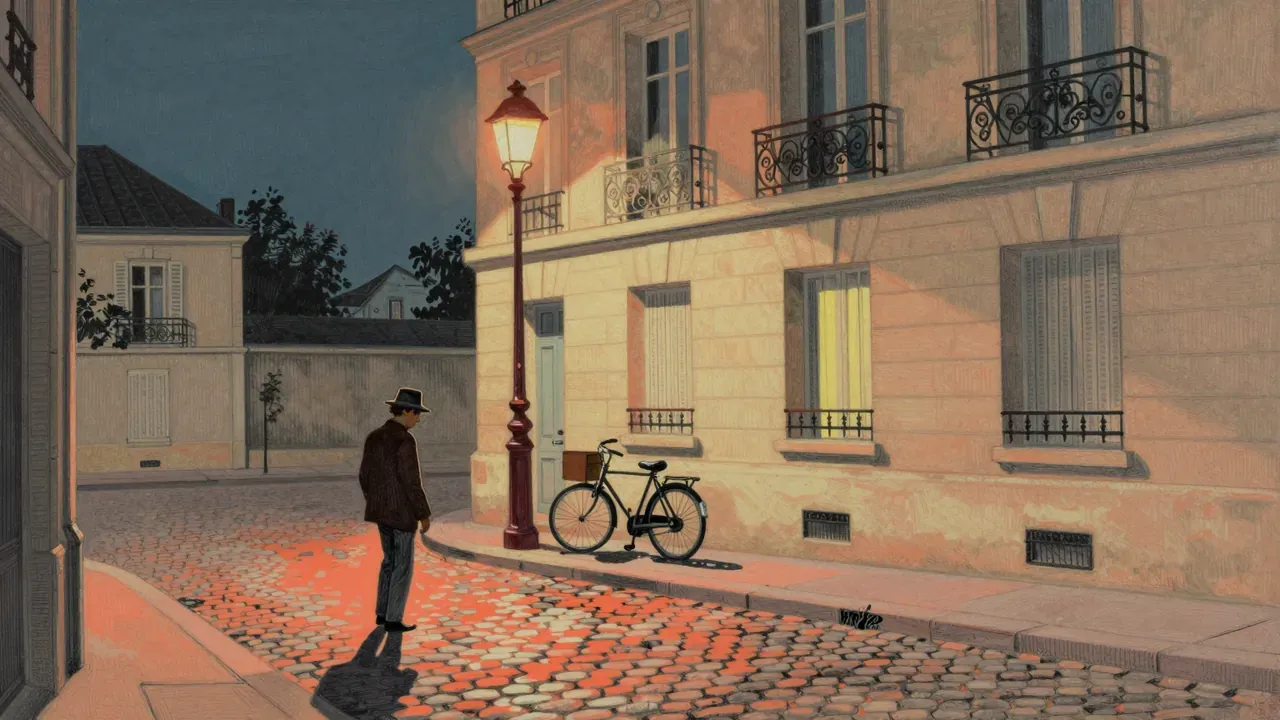
The story unfolds across three parallel trajectories — Corey’s release and journey north, Vogel’s escape and pursuit, and Mattei’s methodical manhunt — which intersect at a roadside grill before coalescing in Paris. Alain Delon, Gian Maria Volonté, and Yves Montand perform with minimal inflection: faces are still, voices low, gestures economical. Bourvil, as Inspector Mattei, avoids caricature; his authority rests in patience and procedural rigour, not bluster. Henri Decaë’s cinematography uses colour desaturated to near-monochrome, favouring deep shadows and long takes that resist cutting away from tension. Éric Demarsan’s score is sparse, often absent, letting ambient sound — rain, radio static, footsteps on gravel — carry rhythm. The thirty-minute heist sequence contains almost no dialogue, relying on precise framing and cross-cutting to sustain suspense without exposition. Melville’s script omits backstory, exposition, and emotional signposting: characters act, and their reasons remain implied, never narrated. Word count: 153
The weight of silence
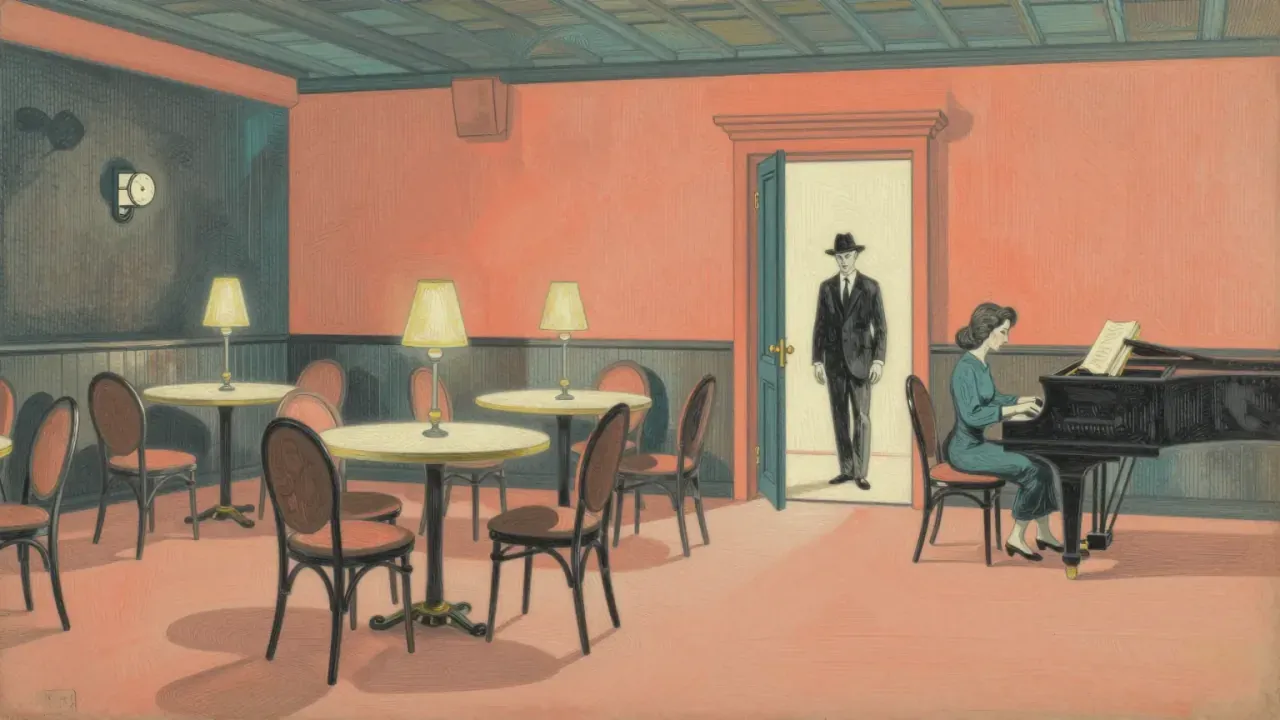
What lands is the film’s unwavering commitment to its own logic. The heist sequence works because it refuses to flinch: every movement is necessary, every prop functional, every silence deliberate. The confrontation between Corey and Vogel in the car boot establishes mutual recognition without words — two men reading each other’s posture, breath, and stillness. The final triple death — Jansen, Vogel, then Corey — carries weight not from tragedy but from inevitability: they have entered the red circle and cannot step out. Mattei’s presence is felt long before he appears, his influence shaping decisions from off-screen, making bureaucracy itself a character. The film’s pacing, often called slow, is in fact calibrated — each scene has duration enough to register consequence, not just action. Even minor roles, like the billiard hall watchman or the flower girl at Santi’s club, occupy space with quiet specificity. This is not atmosphere as mood, but as architecture: every element bears structural weight. Word count: 151
Where the logic bends
What does not land is the film’s refusal to engage with consequence beyond the immediate. The jewels themselves are never examined, valued, or even clearly seen — they function only as MacGuffin and catalyst. The fence’s refusal feels under-motivated, resting on Rico’s vague vengeance rather than concrete threat or institutional pressure. Mattei’s blackmail of Santi via his son’s marijuana arrest arrives abruptly, with no prior suggestion of paternal vulnerability or state overreach — it reads as plot necessity, not character logic. The epigraph, while elegant, remains decorative: it names a theme but does not inform structure or development. Some viewers will find the austerity alienating — no music swell at key moments, no close-up to signal revelation, no flashback to clarify motive. The film assumes the viewer shares its values: that precision matters more than explanation, that silence can be denser than speech, and that professionalism is its own morality. Word count: 149
The red circle
The themes that matter are professionalism as ritual, silence as language, and fate as geometry rather than force. The red circle is not mystical but spatial: a zone where paths converge because the world is small and choices narrow. Crime here is not rebellion but craft — a set of rules observed with monastic seriousness. The film treats law enforcement and theft as mirror disciplines: both require surveillance, timing, and control of environment. Mattei and Corey operate by the same logic — one enforces order, the other breaches it, but neither improvises. There is no redemption arc, no ideological critique of capitalism or policing; instead, a study of how systems produce their own counter-systems, each obeying internal consistency. The absence of women beyond functional roles — girlfriend, flower girl, cigarette girl — is not incidental but structural: this is a world of male-coded professionalism, where intimacy is expressed through shared risk, not affection. The film’s stoicism is not emotional denial but a form of discipline — one that excludes doubt, regret, or self-reflection. Word count: 148
Who walks inside it
This film is for viewers who value sustained attention, who find tension in stillness, and who accept that narrative propulsion need not come from plot twists but from accumulating detail. It rewards patience with texture: the grain of Decaë’s film stock, the cadence of Montand’s breathing during the heist, the way light falls across Bourvil’s hat brim in interrogation scenes. Those who require psychological exposition, moral resolution, or emotional catharsis will find it withholding. It is not for viewers who rely on exposition, who expect characters to verbalise motive, or who equate pace with editing speed. A viewer who found Rififi’s heist exhilarating but Le Samouraï’s isolation tedious may struggle here — it is less lonely than Le Samouraï but more impersonal than Rififi. Change the verdict? Only if Melville had chosen to show the jewels’ resale, or Mattei’s report to superiors — but those would break the circle. Word count: 147
Why it stays
Yes, it is worth your evening — provided you sit with it, not through it. Its 140 minutes demand presence, not distraction: no phone, no pause, no background noise. The reward is cumulative — not a single moment but the slow build of certainty that every shot, every line, every silence has been placed with intent. It is not entertainment in the transactional sense, but immersion in a fully realised system of cause and effect. Those who dislike it tend to cite its ‘coldness’, but that coldness is the point: it is the temperature of professionalism stripped of ego. It is not for casual viewing, but for return visits — each reveals new layers of composition, performance, or sound design. If you have watched it once and found it inert, try again with subtitles, in a dark room, after reading nothing about it first. The film does not ask for sympathy. It asks for observation. And it repays that attention with rare consistency. Word count: 149