What it is
Five Easy Pieces is a 1970 American drama about displacement, not rebellion — a film that traces the slow erosion of self rather than its heroic assertion. It follows Bobby Dupea, a man who has deliberately shed his classical training and upper-middle-class origins to live as a blue-collar labourer in California, only to find neither identity fits. The film does not aim to explain him, nor to resolve his contradictions; it observes how he moves through worlds — oil fields, diners, recording studios, Pacific Northwest estates — without ever settling into one. Its ambition is structural and psychological: to hold still long enough for discomfort to accumulate, to let silences carry weight, and to treat class not as backdrop but as physical texture — in posture, diction, gesture, even the way a plate is set down. It refuses catharsis, avoids exposition, and declines to moralise his retreats or returns. What it tries to do is register the cost of sustained disavowal — of talent, family, feeling — without recourse to judgment or redemption.
How it works
The story unfolds with minimal incident but maximum friction: a road trip, a visit home, a few conversations, a diner argument, a sexual encounter, a departure. Jack Nicholson’s performance anchors this by refusing charisma — his Bobby is sullen, impatient, physically closed, yet never opaque. Karen Black matches him in restraint, her Rayette unvarnished but not pitiable; Lois Smith and Ralph Waite ground the family scenes in quiet, unperformed gravity. László Kovács’ cinematography avoids flourish: natural light, shallow focus, medium shots held just past comfort, interiors shot with the dimness of lived-in rooms. The editing, by Richard A. Harris, favours duration over rhythm — takes run long, pauses linger, reactions are given space. Music is deployed with surgical precision: Chopin and Mozart appear only when Bobby plays or hears them, their presence underscoring absence more than skill. Tammy Wynette’s songs are heard on radios and jukeboxes, ambient markers of cultural distance, not ironic counterpoint. Every craft choice serves the film’s central discipline: withholding, not embellishing.
What lands
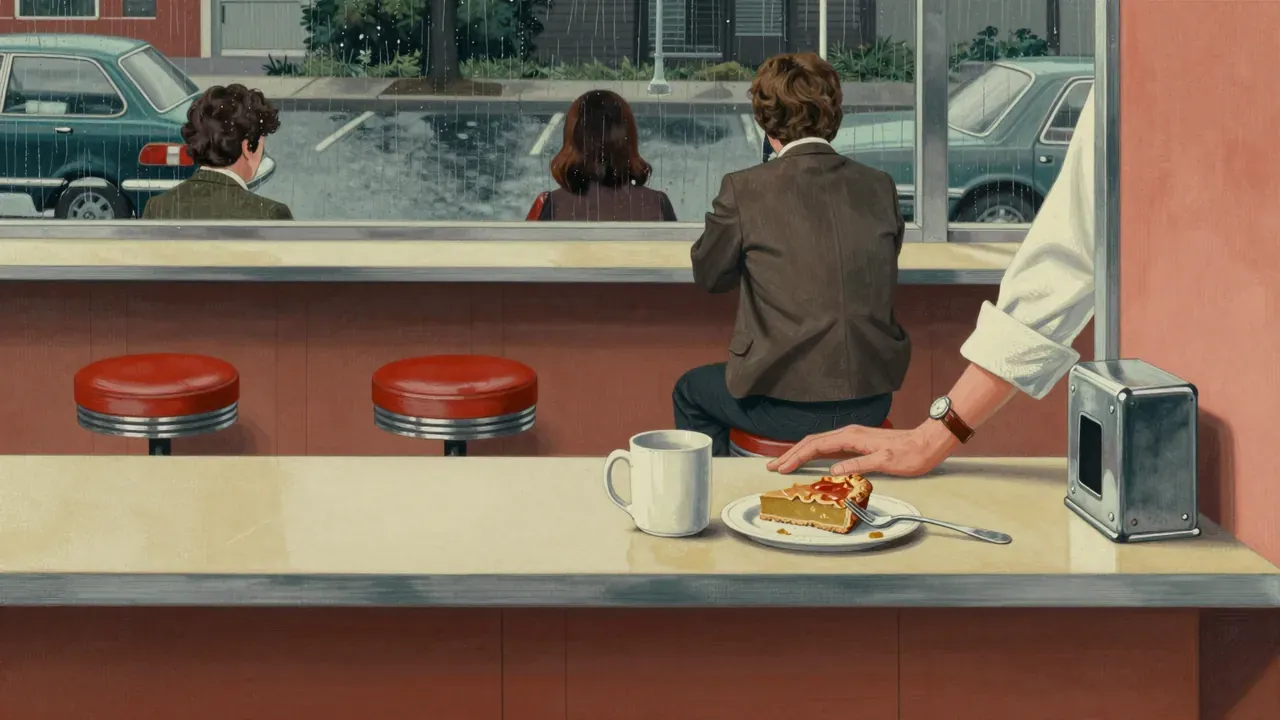
What lands is the cumulative pressure of incompatibility — between Bobby and Rayette, Bobby and his family, Bobby and himself. The diner scene works because it is not a climax but a release valve: the waitress’s refusal to substitute toast for potatoes becomes the last permissible friction before something snaps, and the audience feels the absurdity and exhaustion in equal measure. Catherine’s quiet dismissal — that he cannot ask for love when he loves nothing — lands because it is spoken without heat, delivered as observation rather than indictment. The final image — Bobby vanishing from Rayette’s view, hitching a ride north without explanation — lands because it offers no closure, only continuity of motion. These moments succeed not through dramatic escalation but through fidelity to behavioural truth: the way people actually deflect, withdraw, misread, and misfire. The film trusts its actors to inhabit hesitation, and trusts the audience to sit with it.
What does not
What does not land is the film’s occasional drift into schematic abstraction — particularly the monologue by Palm, the woman hitchhiking north, whose speech on consumerism arrives fully formed and unmoored from character or context. It reads less like dialogue and more like a footnote from a different film, one concerned with ideology over psychology. Similarly, the subplot involving Samia Glavia’s ridicule of Rayette feels underdeveloped, its function unclear: is it satire? exposition? provocation? It lands with a thud, not a ripple. The film’s resistance to exposition also works against itself in places — Bobby’s estrangement from his father is stated, not dramatised in flashback or memory, leaving his grief at the end emotionally precise but historically thin. And while the film’s refusal to explain Rayette’s pregnancy or Bobby’s piano abandonment is consistent with its ethos, it risks making those choices feel like narrative omissions rather than deliberate silences.
The themes that matter
The themes that matter are not generational or political in the usual sense, but ontological: how identity is maintained, abandoned, or performed across class lines; how competence — musical, emotional, social — can become a source of shame rather than pride; how silence functions as both defence and erasure. The film treats class not as economics but as embodied grammar — the way Bobby holds his hands, the way Partita adjusts her collar, the way Rayette laughs too loudly in a room full of pianos. It explores alienation not as loneliness but as chronic misalignment: between what one knows, what one does, and what one is permitted to express. There is no nostalgia for lost privilege, nor romanticism about manual labour; instead, there is a steady gaze at the cost of constant translation — of self, of speech, of desire — across incompatible registers. The film’s enduring resonance lies in this unsentimental anatomy of refusal.
Who should watch it
This film is for viewers who value behavioural precision over plot momentum, who find tension in withheld information and meaning in unspoken glances. It rewards patience, attention to vocal timbre and body language, and tolerance for unresolved endings. It is not for those who require narrative propulsion, clear moral framing, or characters who articulate their motives. Anyone expecting a ‘70s countercultural romp or a tidy character study will find it withholding and unsatisfying. Those who dislike films where major decisions happen off-screen — Bobby’s departure from the oil rig, his break with music, his final hitch — may read the structure as evasion. But the verdict changes if one accepts that the film’s form is its argument: that some lives are defined by exits, not arrivals, and that the most consequential moments are often the ones no one witnesses.
Is it worth your evening
Yes, it is worth your evening — provided you watch it without expectation of resolution or reward. Its ninety-six minutes unfold with the unhurried weight of lived time, not edited time, and its power accumulates slowly, like sediment. It repays close attention, not passive viewing: the shift in Bobby’s posture when he first enters the family home, the way Rayette’s voice tightens when she says ‘I’ll kill myself’, the exact moment Catherine stops believing him — these are the film’s anchors. It is not ‘entertaining’ in the conventional sense, but it is deeply absorbing, and its emotional honesty remains uncommon. Some will find it cold or inert; others, particularly those familiar with the textures of class transition or artistic renunciation, will recognise its precision as rare. Its value lies not in what it gives, but in what it refuses to give — and why.