The setting
Secret Honor is a filmed stage monologue, adapted from Donald Freed and Arnold M. Stone’s play, and directed by Robert Altman in 1984. It presents no narrative action beyond one man speaking alone for ninety minutes in a single room. Its aim is not to reconstruct Nixon’s biography but to inhabit his voice — speculative, self-justifying, paranoid, intermittently lucid — as if the tapes had never been edited, the defences never rehearsed, the rage never contained. It treats Nixon not as a historical subject for analysis but as a psychological and rhetorical case study: a man attempting to reassemble himself from fragments of memory, grievance and half-remembered policy. The film does not argue Nixon’s innocence or guilt; it dramatises how he might have spoken to himself, unobserved, after resignation, when no audience remained but his own conscience — if he still had one. There are no flashbacks, no cutaways, no supporting characters on screen. The only external presence is the unseen transcriber ‘Roberto’, invoked only as a structural device to mark digressions and restarts. This is not history as record, but history as echo chamber.
The performance
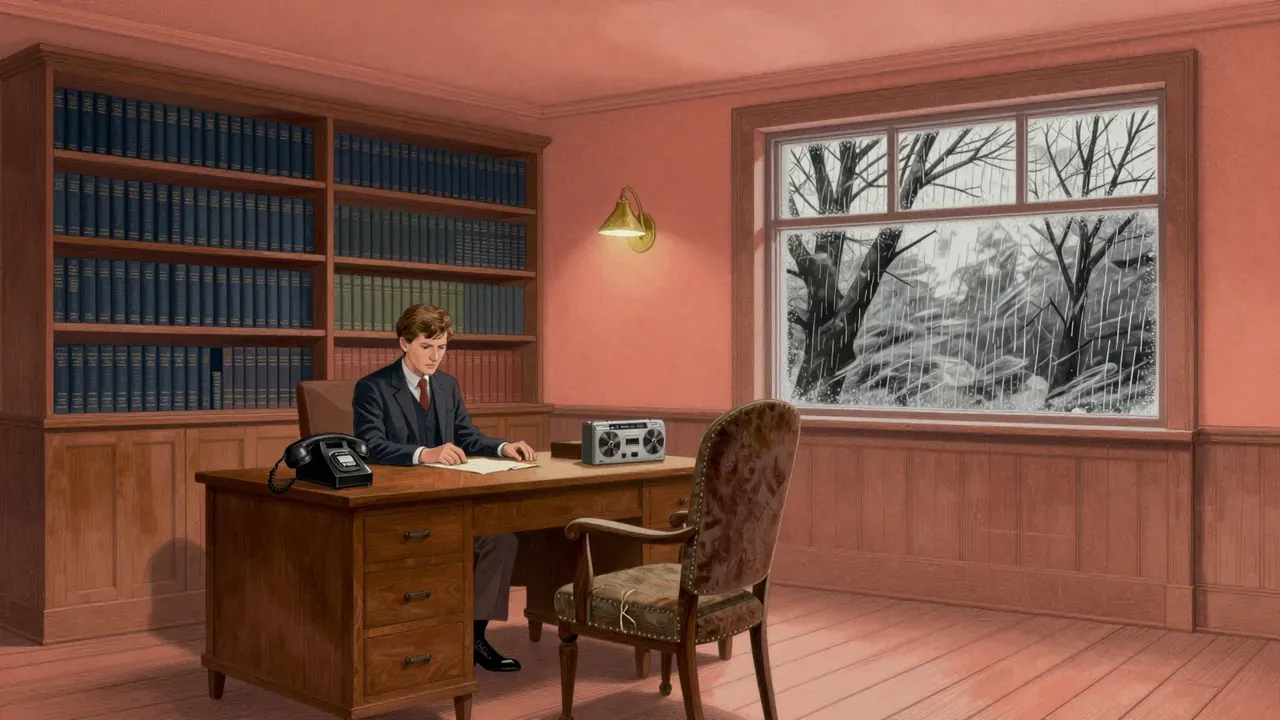
The film works through absolute concentration on Philip Baker Hall’s performance and Pierre Mignot’s restrained cinematography. Hall remains almost constantly in motion — pacing, slumping, gripping the desk, raising the revolver — while delivering a script that shifts between clipped bureaucratic recollection, conspiratorial whisper, drunken rant and sudden, brittle tenderness. His Nixon is physically precise without mimicry: the hunched shoulders, the staccato breath, the way his hands twist when lying. Mignot keeps the camera at medium distance, mostly static, letting Hall’s face and posture carry weight; the Red Room’s wood panelling and dim lighting suggest both sanctuary and cell. George Burt’s score is sparse, often absent, leaving silence and the scrape of chair legs or clink of glass as punctuation. Altman avoids theatrical framing — no dramatic close-ups, no musical swells — trusting the writing and performance to sustain attention. The tape recorder, the closed-circuit monitors, the bottle and gun are props with functional weight, not symbols. Their presence is literal, not metaphorical. The rhythm comes from Hall’s control of pace: when Nixon stumbles, it feels like real loss of control, not scripted breakdown.
The sound
What lands is the cumulative force of sustained, unbroken address. Hall’s command of tone — shifting from weary confession to venomous accusation in a single sentence — makes the monologue feel less like acting and more like overhearing a mind at work. The film’s refusal to offer counterpoint or context forces the viewer into uncomfortable complicity: there is no narrator to correct Nixon, no archive footage to contradict him, no moral anchor outside his own logic. That discomfort is intentional and effective. The final fist-pump, frozen mid-air across multiple monitors as chants swell and distort, lands not as triumph but as exhausted, defiant repetition — a gesture stripped of meaning by its own looping. The film also lands its sense of place: the Saddle River study feels lived-in and claustrophobic, its decor neither opulent nor shabby, but precisely middle-American, quietly oppressive. Nixon’s relationship to objects — the Scotch, the gun, the tape machine — feels psychologically exact. Nothing here feels staged for effect; everything feels chosen because it would be there, used that way, by that man, at that hour.
The look of it
What does not land is the conspiracy framework — the Bohemian Grove, the Committee of 100, the heroin trade — which sits uneasily between satire and earnest claim. Freed and Stone’s script introduces these elements with rhetorical confidence, but they lack internal consistency or grounding in Nixon’s known preoccupations. They read less like plausible delusion and more like late-1970s radical theatre tropes grafted onto the character. When Nixon pivots from family memory to global narcotics trafficking, the shift jars rather than deepens. Similarly, the film’s insistence on Watergate as self-sabotage — a staged exit to avoid complicity in war profiteering — strains credibility without offering psychological justification beyond convenience. These passages feel like ideological scaffolding, not organic thought. The structure also falters in its second half: repetitions of ‘edit out this part’ begin to blur, and the monologue’s circularity starts to feel procedural rather than revelatory. Without variation in setting, sound design or visual texture, the ninety minutes test stamina more than insight in places where the script itself runs thin.
The ideas
The themes that matter are self-deception as survival mechanism, the erosion of language under pressure, and the American myth of redemption through suffering. Nixon repeatedly casts himself as the wronged striver — the boy from Yorba Linda who earned power through grit, only to be undone by elites and hypocrites. His version of democracy is transactional, his morality situational, his empathy conditional on utility. The film traces how ideology collapses into personal grievance, and how grievance hardens into paranoia. It also examines the physicality of power: how posture, voice, and gesture become tools of persuasion — and then weapons of self-defence. Nixon’s body betrays what his words deny: the tremor in his hand, the sweat on his brow, the way he touches his throat when lying. The closed-circuit cameras are not surveillance but narcissism made visible — a man watching himself watch himself, trying to confirm his own reality. The film’s deepest theme is not Nixon’s guilt or innocence, but the exhaustion of maintaining a self when no one is left to believe in it — except, perhaps, the person holding the gun.
The experience
This film is for viewers who value linguistic precision, psychological endurance, and performances that refuse catharsis. It suits those accustomed to arthouse pacing, monodrama traditions, and politically charged fiction that resists resolution. It is not for viewers seeking narrative propulsion, historical clarity, or moral closure. Those who require exposition, visual variety, or emotional release will find it punishing. Some historians may reject its liberties; some political audiences may find its portrait too sympathetic, others too vicious — but the film does not seek balance. It seeks intensity. A viewer who values realism over accuracy, voice over event, and ambiguity over verdict will engage deeply. Someone expecting a biopic or a Watergate procedural will leave frustrated. The film assumes patience, attention, and tolerance for discomfort — not as a flaw, but as a condition of its form. It asks for time, not sympathy.
The finish
Yes, it is worth your evening — provided you approach it as a vocal and physical event, not a story. Ninety minutes is its exact duration, not a suggestion: it gives nothing extra, takes nothing back. Its value lies in Hall’s unbroken commitment and Altman’s refusal to soften the material with cinematic relief. It rewards close listening, not passive viewing. Those who dislike monologues, distrust political fiction, or need narrative progression will not find compensation in its craft. But for anyone interested in how language fractures under pressure, or how performance can embody contradiction without explanation, it remains singular. It has aged well because it was never about timeliness — it is about voice, and voice does not expire. Its power is narrow but deep, and it does not ask to be liked, only heard.