The shape of it
The Beast is a French-Canadian science fiction film that uses time-looped reincarnation as a structural device to interrogate emotional life under AI governance. It attempts to transpose Henry James’s psychological novella The Beast in the Jungle — a study of paralysing anticipation and withheld love — into a tripartite chronology: 1910 Paris, 2014 Los Angeles, and 2044, where artificial intelligence has mandated emotional ‘purification’ for workforce eligibility. Bertrand Bonello treats each era not as period recreation but as tonal register: Belle Époque restraint, incel-era digital alienation, and near-future bureaucratic dehumanisation. The film’s central proposition is that love and fear are structurally identical — both hinge on projection, repetition, and failure to act — and that neither survives algorithmic optimisation. Its ambition lies less in speculative worldbuilding than in sustaining a mood of recursive melancholy across centuries, using memory not as exposition but as physiological residue. It does not argue for or against AI; it dramatises what happens when feeling is recast as error-correction.
The rhythm of it
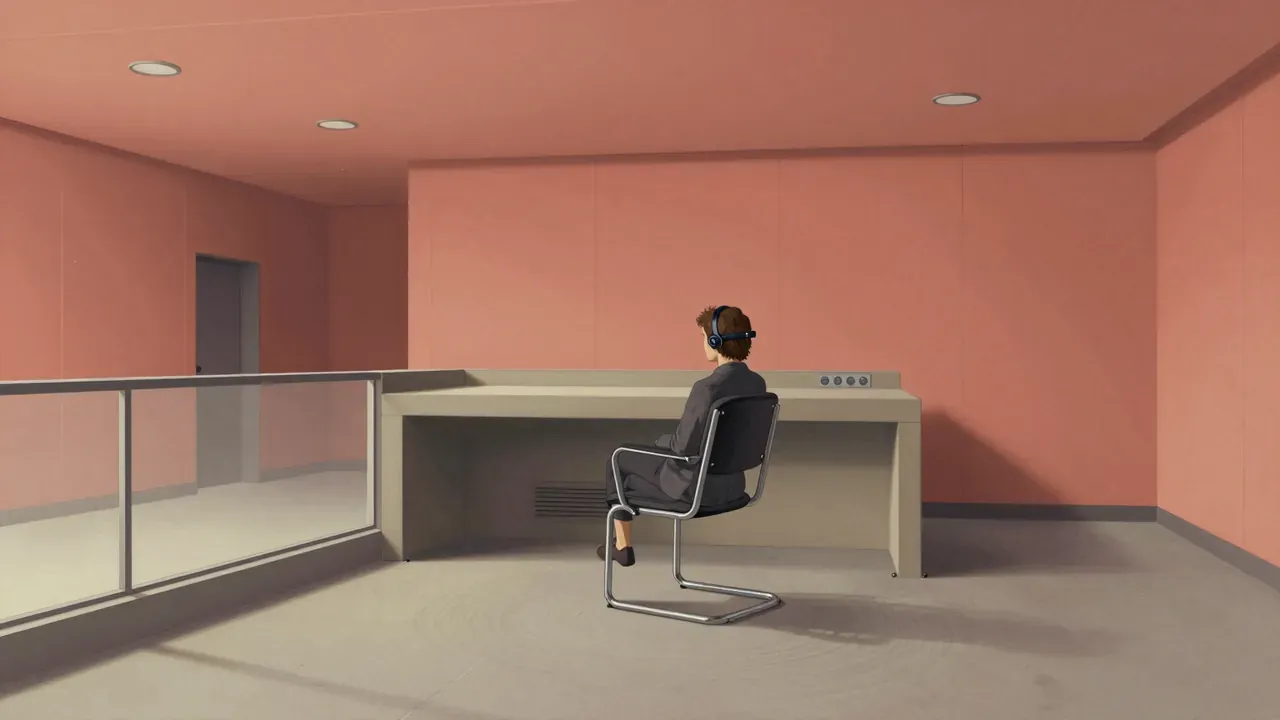
The story unfolds through Gabrielle’s three purification sessions, each reframing her relationship with Louis across lifetimes. Léa Seydoux holds the film’s emotional centre with minimal inflection — her face registers recognition before comprehension, hesitation before surrender. George MacKay modulates his performance across incarnations: a restrained 1910 suitor, a trembling 2014 stalker, then a hollowed-out 2044 functionary. Josée Deshaies’s cinematography avoids futurist gloss: 2044 interiors are flat-lit and beige, 1910 scenes use shallow focus and candlelight diffusion, while 2014 is shot handheld, grainy, and slightly oversaturated. Bertrand Bonello’s score is sparse — piano motifs recur like neural pathways, dissolving into synth drones as the timeline advances. Editing by Marion Monnier tightens temporal disjunction: cuts between eras land on shared gestures — a hand reaching, a door opening, a tear falling — rather than plot logic. The nightclub sequences, shifting decades via lighting and costume, function as liminal interludes, not set pieces. Dialogue remains deliberately unexplanatory; exposition is withheld, not buried.
The weight of it
What lands is the film’s cumulative sense of emotional exhaustion. The repetition of Gabrielle’s fear — not of death, but of catastrophe deferred — gains weight across timelines, becoming less a character trait than a biological constant. The 1910 flood and fire sequence works not as spectacle but as slow-motion inevitability: water rises, dolls swell and ignite, and the couple drown without struggle, as if yielding to gravity. In 2014, the bathroom confrontation avoids catharsis; Louis’s hesitation reads as neurological friction, not moral choice. The final dance to ‘Evergreen’ lands precisely because it is undercut: the song triggers memory, but the embrace is empty — Louis’s smile is polite, not tender. The QR code at the end, replacing credits with a silent scroll, functions as formal punctuation: no authorship, no closure, only data. These moments succeed because they refuse interpretation. They present emotion as pattern, not psychology — a tremor in the wrist, a pause before speech, a breath held too long. The film trusts its repetitions to accumulate meaning without explanation.
The friction in it
What does not land is the 2014 incel narrative’s grounding in real-world violence. The film names no specific killings, but the context — drawn from public reporting on Elliot Rodger — sits uneasily beside the rest of the film’s abstraction. Where 1910 operates through metaphor and 2044 through system logic, 2014 imports documentary weight without integrating it: Louis’s pistol feels less like a symbolic extension of his fear and more like an unassimilated citation. The medium’s reappearance as a pop-up ad is conceptually neat but tonally jarring — it breaks the film’s visual grammar without compensating in rhythm or resonance. Likewise, the nightclub’s decade-hopping lacks internal rules; its shifts feel curatorial rather than necessary, a stylistic flourish that dilutes the claustrophobia elsewhere. Xavier Dolan’s casting as a producer adds no discernible texture to the film’s construction, nor does the bilingual script adjustment after MacKay’s casting yield meaningful linguistic tension — English and French remain functionally interchangeable within scenes, not dialectically opposed.
The idea in it
The themes that matter are free will as habit, love as misrecognised fear, and memory as somatic echo rather than narrative resource. The film treats emotional life not as interior drama but as behavioural residue: Gabrielle’s dread recurs across lifetimes not because she is haunted, but because her nervous system defaults to the same prediction. AI does not erase humanity here — it merely formalises what was already happening: humans outsourcing decision-making to anxiety, deferring intimacy until catastrophe arrives, mistaking vigilance for agency. The purification process is less sci-fi premise than diagnostic tool: it reveals that ‘emotion’ is not the obstacle to rationality, but the substrate of all choice. The film’s quietest theme is silence — not absence of sound, but the space between stimulus and response, which shrinks across timelines until, in 2044, it vanishes. That erosion is presented without moralising: the Ministry of Justice job is real, the salary is adequate, the dance is technically correct. The horror is procedural, not spectacular.
The audience for it
This is for viewers who tolerate ambiguity as structure, not deficiency — those accustomed to films where narrative propulsion yields to rhythmic accumulation, and where character motivation matters less than physiological consistency. It suits audiences familiar with Bonello’s earlier work, or with the slow cinema of Philippe Garrel or Claire Denis, where duration is expressive, not decorative. It is not for viewers who require causal clarity, emotional payoff, or even consistent genre signposting: the shift from romantic drama to domestic thriller to bureaucratic satire is deliberate, not confused, but demands surrender to its logic. Those who expect science fiction to prioritise worldbuilding over affect, or romance to resolve in reciprocity, will find it withholding. A viewer who values thematic precision over plot momentum, and who reads silence as articulation, will engage deeply. Someone who needs the film to declare its position on AI ethics — or to condemn incel ideology outright — will leave unsatisfied, because the film refuses polemic in favour of recurrence.
The time it takes
Yes, it is worth your evening — provided you accept its terms: two hours and twenty-five minutes spent inside a single, looping nervous system. It repays attention not with revelation but with recalibration: after watching, minor anxieties feel less personal, more ancestral; routine choices feel less rational, more rehearsed. Its value lies in how thoroughly it sustains a single emotional frequency across centuries, making dread feel structural rather than situational. Those who dislike it tend to cite its refusal to explain — but that is its method, not its flaw. A viewer who prefers narrative efficiency or moral resolution would reasonably reject it; their verdict would change only if the film abandoned its central conceit. Its length is not indulgence but necessity: the repetitions must land with weight, not irony. To watch it impatiently is to misunderstand its contract. It asks for time, and gives back a different sense of duration — one measured in heartbeats, not plot points.