What it is trying to do
Pierrot le Fou is Jean-Luc Godard’s ninth feature and a pivot point in his early work: a romantic crime road film that abandons narrative fidelity to Lionel White’s novel Obsession in favour of a self-reflexive, colour-saturated meditation on love, language, and political exhaustion. It tries to hold two things at once — the emotional gravity of a failing relationship and the formal exhilaration of dismantling cinema itself. The film does not seek coherence but collision: between literary allusion and advertising slogans, between Mediterranean light and violent edits, between Ferdinand’s yearning for poetic authenticity and Marianne’s slippery, performative identity. Its ambition is structural as much as thematic: to make the viewer feel the disintegration of meaning through rhythm, hue, and rupture rather than exposition. It treats romance not as genre convention but as historical condition — the last gasp of a certain European idealism, already fraying under the weight of Algeria’s war, Vietnam, and consumerist banality. This is not a story told; it is a sensibility enacted, frame by frame.
How it works
The story follows Ferdinand Griffon — a disillusioned ex-advertising man — who abandons his family and bourgeois life to flee Paris with Marianne, a woman entangled with OAS hitmen. Their journey south unravels into episodic encounters: a desert island, a dwarf’s murder, waterboarding, reunion, betrayal, and suicide. Jean-Paul Belmondo grounds the chaos with physical presence and weary intelligence; Anna Karina moves through the film like a flickering icon — elusive, ironic, emotionally opaque. Raoul Coutard’s cinematography favours saturated primaries, abrupt zooms, and handheld immediacy; Antoine Duhamel and Serge Rezvani’s score alternates jazz motifs with sudden silence or dissonant stings. Françoise Collin’s editing inserts non-sequiturs — fireworks, text cards, blank frames — to fracture continuity. Dialogue often veers into essayistic monologue or pop-cultural pastiche. Scenes were frequently improvised, especially after the first week of shooting, when Godard scrapped early plans. The Ford Galaxie sinking into the sea is real; the blue face paint is Yves Klein blue; the dynamite is literal. Craft here serves provocation, not polish.
What lands
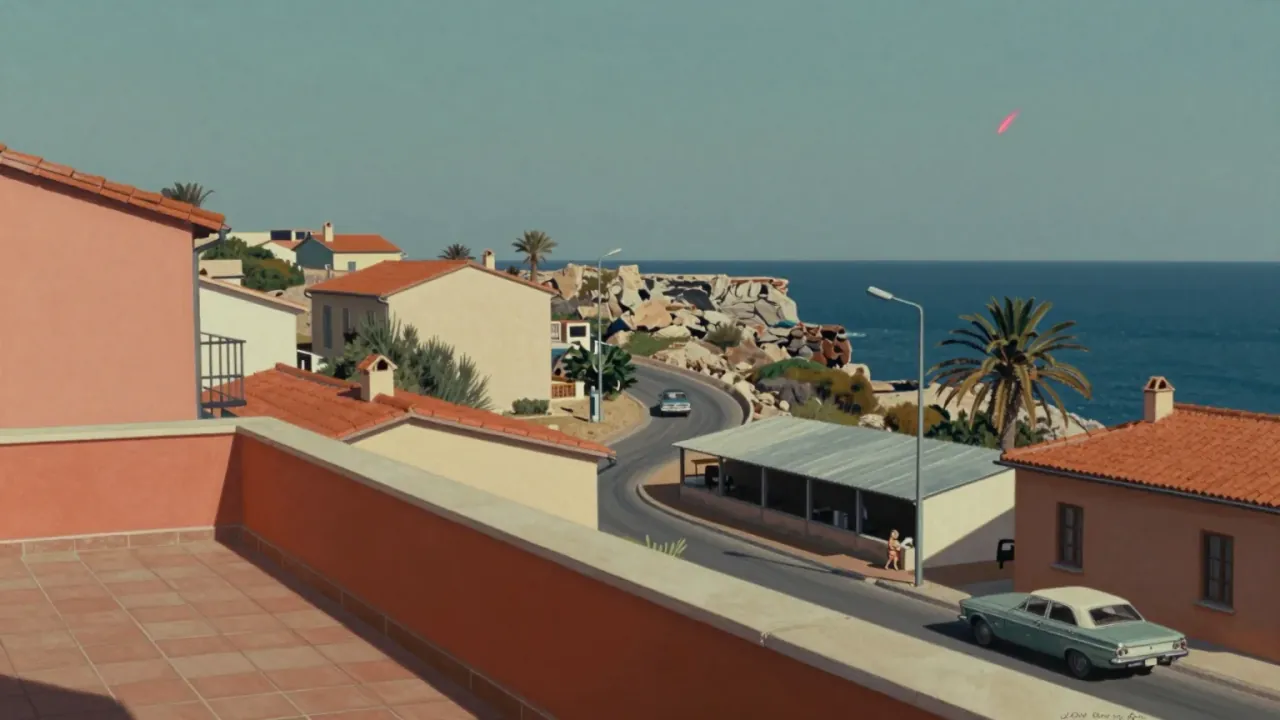
What lands most decisively is the film’s chromatic intensity and its refusal to resolve feeling into plot. The opening party scene — shallow talk, cake thrown, firework cut — establishes tone without explanation. Ferdinand’s notebook entries, scrawled over images, land as genuine intellectual yearning, not affectation. The Mediterranean sequences shimmer with tangible heat and idleness, making their later collapse feel earned. Karina’s performance holds ambiguity without collapsing into mystique: her laughter, glances, and silences carry weight because they are never framed as exposition. The final suicide — blue face, red-and-yellow dynamite — lands not as nihilism but as exhausted syntax: the only sentence left when language has been stripped of trust. Even minor figures register: Raymond Devos’s deadpan delivery, Samuel Fuller’s cameo as an American director, the dwarf’s brief, brutal presence. These moments do not advance the story but thicken its texture — evidence that Godard treats every frame as a site of choice, not obligation.
What does not
What does not land is the film’s attempt to sustain philosophical density across its full runtime. Some monologues — particularly Ferdinand’s ruminations on painting, literature, or politics — feel stranded, neither dramatised nor integrated into action. The OAS subplot remains underdeveloped: its political urgency is asserted but not dramatised beyond chase logic, leaving its stakes abstract rather than visceral. The shift from Parisian satire to Riviera reverie creates a tonal lull midway, where pacing slackens without compensating tension. Certain improvisations — especially late in the film — risk arbitrariness, as if energy wanes and invention substitutes for intention. The casting decision to pair Belmondo and Karina, while generative, also produces a mismatch in register: his grounded physicality contrasts with her stylised detachment in ways that occasionally undermine shared emotional stakes. And though the film declares itself ‘about France’, its national critique remains gestural — evoked through colour, music, and location rather than sustained argument.
The themes that matter
The themes that matter are not those announced in interviews but those embedded in repetition and contrast: the violence of naming (‘Pierrot’ as insult, ‘Marianne’ as cipher), the exhaustion of romantic myth in a mediated age, the friction between artistic aspiration and lived compromise. Colour functions thematically — blue as melancholy and transcendence, red as danger and artifice, yellow as warning and absurdity. Language is treated as both weapon and wound: Ferdinand writes to reclaim voice; Marianne speaks in fragments, lies, and borrowed phrases. The film interrogates authorship — whose story is being told, whose desire is legible, whose death concludes the sentence. It also traces the erosion of private feeling under public pressure: Ferdinand’s diary becomes increasingly unreadable, his face increasingly painted over. The Mediterranean is not escape but mirage — a space where freedom reveals its limits. These are not ideas illustrated but sensations accumulated: loneliness in wide shots, claustrophobia in close-ups, confusion in jump cuts.
Who should watch it, and who should not
This film is for viewers who treat cinema as a field of inquiry rather than entertainment — those comfortable sitting with unresolved metaphors, trusting image over exposition, and finding rhythm more persuasive than resolution. It rewards attention to texture: the grain of film, the weight of a pause, the shock of a primary hue. It is not for viewers who require causal clarity, emotional anchoring in character psychology, or narrative momentum as a baseline condition. Those who expect romance to deliver catharsis or crime to yield suspense will find neither. A viewer seeking political analysis with historical specificity may leave frustrated; the film gestures toward Algeria and Vietnam but refuses documentary grounding. Someone who values craft as service to story — rather than as counterpoint to it — will likely resist its methods. Its demands are aesthetic and ethical: to watch without assuming you are meant to understand, only to witness.
Is it worth your evening
Yes, it is worth your evening — provided you approach it as a singular event in film history, not as a story to be followed. Its 110 minutes remain urgent not because they explain anything, but because they enact a crisis of representation that still echoes: how to speak truthfully when language is compromised, how to love when identity is performed, how to end when endings are theatrical. It repays rewatching not for hidden clues but for shifting emphasis — a glance, a colour, a cut that lands differently each time. Those who dismiss it as pretentious miss how deliberately it courts misunderstanding. Those who call it ‘difficult’ mistake its resistance to comfort for obscurity. Its value lies in its refusal to simplify — a stance that feels less like dogma and more like honesty. To skip it is to miss one of the clearest demonstrations of how cinema can think aloud, in colour, in motion, in fragments.