A first film, not a first attempt
Pather Panchali is a debut feature by Satyajit Ray, adapted from Bibhutibhushan Bandyopadhyay’s 1929 novel, and the first of a trilogy following Apu’s life from childhood to adulthood. It sets out to render rural Bengali poverty not as social indictment nor exotic tableau, but as lived texture — where hunger, joy, loss and curiosity coexist without hierarchy. The film avoids narrative propulsion in favour of episodic accumulation: a stolen fruit, a monsoon downpour, a train’s distant whistle, an old woman’s death, a sister’s illness, a family’s departure. Ray’s intention, evident in his notes and interviews, was to preserve the ‘loitering impression’ of the source — its rambling, unforced rhythm — as a formal analogue to authenticity. There are no villains, no speeches, no moral pivot points; instead, the film treats daily life in Boral village as worthy of sustained attention on its own terms. It assumes no prior knowledge of Bengal or Indian cinema, yet refuses to translate its world into familiar Western dramatic shorthand. Its ambition is quiet, structural: to make time itself felt, not filled.
The look of it
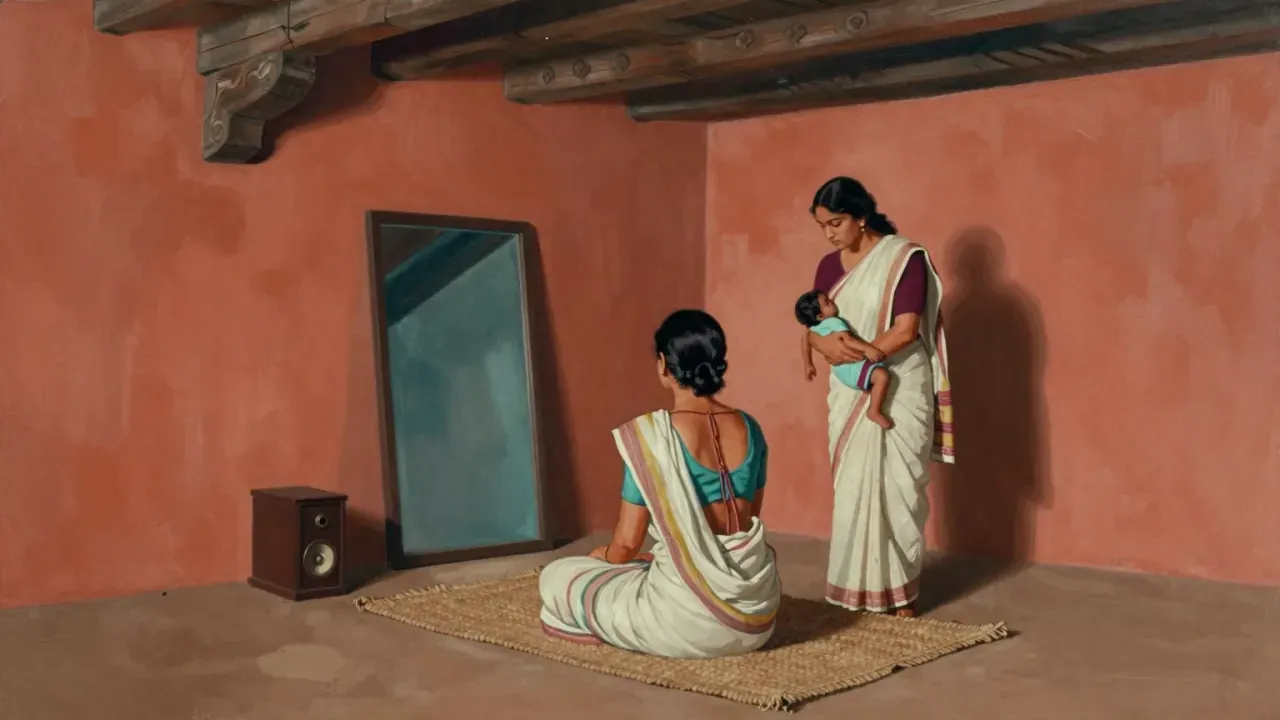
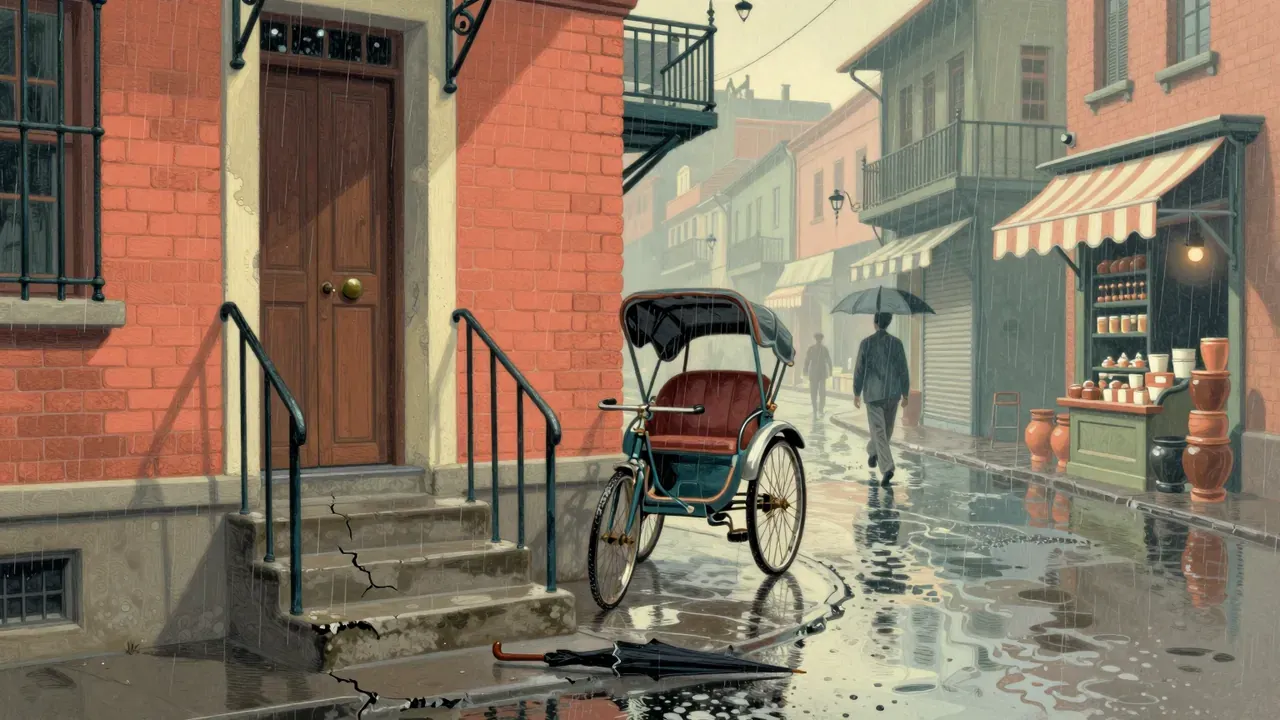
The story unfolds across twelve months in the life of Harihar’s family — his wife Sarbajaya, daughter Durga, son Apu, and the elderly Indir — in a crumbling ancestral home outside Calcutta. Subir Banerjee, aged five at filming, delivers Apu with unselfconscious physicality: blinking into sunlight, trailing behind his sister, recoiling from thunder. Chunibala Devi, a retired stage actress found in a Calcutta lane, gives Indir a presence that lingers beyond her screen time — stooped, weathered, speaking in proverbs that land like stones in still water. Kanu and Karuna Banerjee ground the parents in weary dignity, never sentimentalised. Subrata Mitra’s cinematography uses available light and shallow focus to soften edges without softening truth; interiors are dim but legible, exteriors drenched in monsoon haze or late-afternoon gold. Ravi Shankar’s score deploys ragas sparingly — a sitar phrase marking transition, silence holding longer than music. Dulal Dutta’s editing sustains duration: shots linger past narrative necessity, trusting the viewer to absorb gesture, pause, dust motes in sunbeams. There are no close-ups for emphasis, no cuts to underscore emotion — only observation, held.
What stays with you
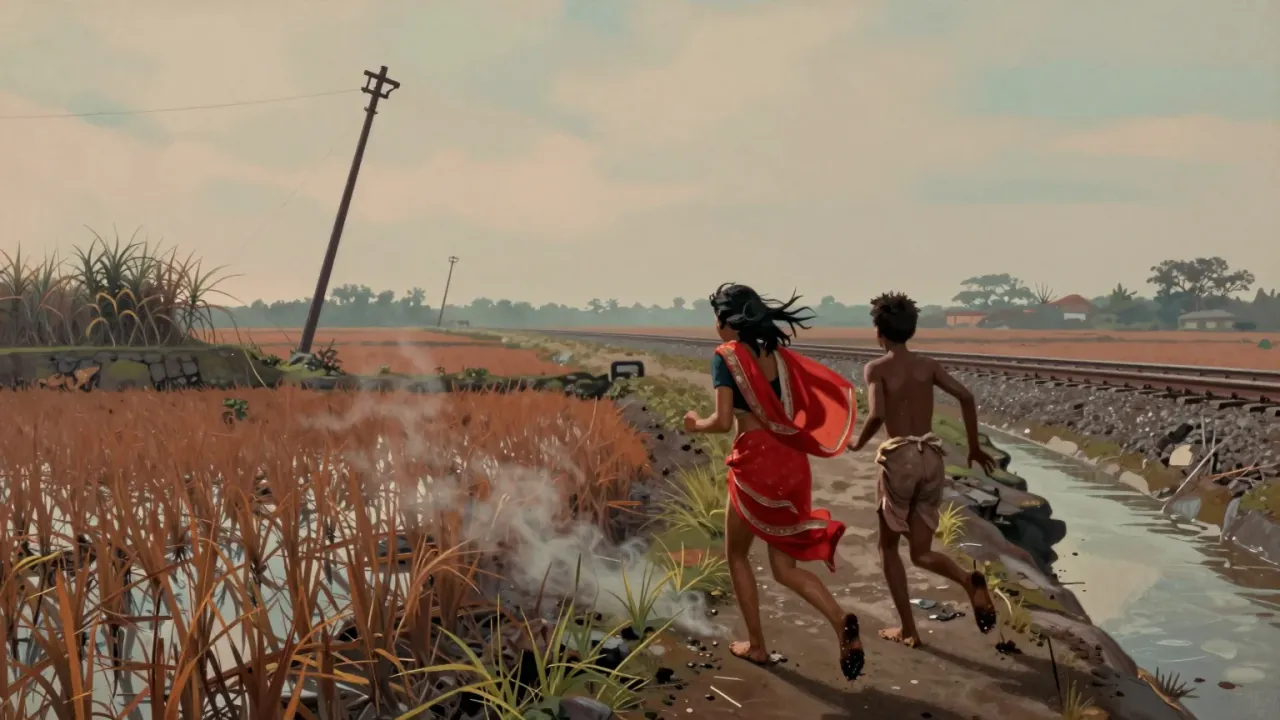
What lands is the film’s fidelity to small-scale consequence. A broken clay cup matters because it is the only one. Durga’s theft of fruit carries weight not as transgression but as hunger made visible — her shame, her mother’s exhaustion, the neighbour’s quiet reproach, all registered in glances and posture, not dialogue. The train sequence works because it is not spectacle but revelation: two children running barefoot across fields, breathless, arriving too late — yet the sight of iron rails vanishing into heat-haze becomes mythic through sheer persistence of gaze. Indir’s death in the open air, discovered by Apu and Durga, lands with physical shock: her body half-hidden in tall grass, limbs stiff, flies already settling. There is no music, no slow motion — just the children’s silence, then their slow retreat. The final departure from the village lands not as triumph or tragedy but as quiet erasure: belongings bundled, the house left empty, the path receding behind them. These moments succeed because they are built from accumulated detail — the weight of a sari fold, the sound of rain on tin, the way light falls across a sleeping face — rather than narrative function.
Where it resists
What does not land is the film’s refusal to accommodate conventional pacing or exposition. Viewers accustomed to causal plotting may find the structure diffuse: events occur without clear setup or payoff, and characters appear or vanish without introduction. The absence of a score during key emotional beats — such as Durga’s fever or Harihar’s return with news — can feel withholding rather than restrained, especially on first viewing. Some sequences, like the extended monsoon sequence or the long walk to the railway station, test patience not through ambiguity but sheer duration, with little variation in rhythm or framing. The amateur cast, while authentic, occasionally lacks vocal projection or timing that would clarify subtext for non-Bengali speakers relying on subtitles. The lack of context for village hierarchies — why Indir lives apart, how land tenure works, what Harihar’s priesthood entails — may leave international viewers grasping for social scaffolding the film deliberately omits. This is not carelessness but choice; yet the choice demands more from the viewer than many contemporary films do.
What it is about
The themes that matter are childhood as perception before interpretation, poverty as condition not crisis, and memory as accumulation rather than arc. Apu’s world is defined by sensory immediacy — the taste of mango, the sting of rain, the vibration of train rails — not abstract understanding. The film treats material lack not as deprivation but as shaping force: space is measured in steps between rooms, time in seasons and festivals, value in objects repaired or repurposed. There is no nostalgia for tradition nor critique of modernity — both exist side by side, unexamined. The recurring motif of thresholds — doorways, windows, railway lines — signals transition not as rupture but as gentle displacement. Grief is rendered as silence, not weeping; resilience as routine, not resolve. Ray avoids allegory: the train is not progress, the monsoon is not fate, the village is not India — each remains itself, particular and untranslatable. What endures is the idea that meaning resides not in event but in attention: the film asks us to notice what is usually passed over — the curve of a spine, the pattern of cracks in mud, the way light changes at three o’clock.
Who it is for
This film is for viewers who trust duration as meaning, who find resonance in restraint, and who accept that emotional impact need not be signalled. It rewards patience, rewatching, and willingness to sit with ambiguity — particularly those familiar with neorealist or Japanese post-war cinema, or readers of Chekhov or early Woolf. It is not for those who require narrative momentum, psychological exposition, or clear moral orientation. Detractors often cite its pace as lethargy rather than deliberation; others find its lack of commentary on caste or colonialism a political omission. That view holds if one expects the film to serve as sociological document — but Ray’s project is phenomenological, not diagnostic. A viewer who approaches it as ethnography will leave unsatisfied; one who meets it as poetry may find it indispensable. Nothing in the film changes if you disagree — but your experience of it will be fundamentally different.
Whether it is worth your evening
Yes, it is worth your evening — provided you set aside expectation of plot, allow the film its time, and watch it whole, without interruption. Its 120 minutes are not filled but inhabited: every shot asks for presence, not consumption. It repays attention with cumulative emotional precision — the kind that settles in the chest, not the mind. Those who find it slow are not wrong; they are responding honestly to its resistance to acceleration. But slowness here is structural integrity, not deficiency. It would become less valuable if shortened, scored more heavily, or dramatised more overtly — its power lies precisely in what it refuses. To skip it is to miss a foundational grammar of cinematic realism, one that reshaped how poverty, childhood and place could be filmed without condescension. It is not entertainment, but it is deeply humane — and that distinction matters. One viewing is rarely enough; the film reveals itself in layers, like the village it portrays.