The look of it
The Great Beauty is a portrait of Rome as a stage for spiritual exhaustion, not a documentary of the city nor a satire of its elite. Paolo Sorrentino and Umberto Contarello construct a deliberately unmoored narrative around Jep Gambardella, a 65-year-old journalist who has spent decades observing but not engaging — a man whose sole published book, The Human Apparatus, remains his only act of creation. The film’s ambition is structural and philosophical: to hold beauty and emptiness in the same frame, to let opulence coexist with silence, to treat decadence not as moral failure but as atmospheric condition. It does not argue for change or diagnose causes; it lingers in the afterglow of meaning, where ritual replaces belief and spectacle substitutes for substance. Its reference points are literary (Céline’s Journey to the End of the Night) and cinematic (Fellini’s La Dolce Vita), but it refuses homage as imitation. Instead, it builds its own syntax of slow pans, abrupt cuts, and sustained stillness — a visual grammar calibrated to the rhythm of deferred reckoning. It is not about Rome’s politics or economy, but about how a life shaped by aesthetic privilege begins to feel like a long rehearsal for nothing.
The weight of the frame
Luca Bigazzi’s cinematography moves through Rome like a reluctant pilgrim: interiors glow with amber haze, exteriors shimmer under midday glare, and crowds are filmed at a remove that feels less observational than elegiac. Toni Servillo carries Jep with contained gravity — no grand gestures, only micro-shifts in posture and gaze that register decades of self-cancellation. Supporting performances avoid caricature: Carlo Verdone’s Romano is weary rather than foolish, Sabrina Ferilli’s Stefania brittle rather than vicious, Galatea Ranzi’s Viola hollowed out by grief before she departs for Africa. Lele Marchitelli’s score avoids melody in favour of suspended strings and low brass pulses, reinforcing the sense of suspension. Cristiano Travaglioli’s editing favours duration over momentum — scenes end not when resolved but when their emotional weight settles. Dialogue is sparse and often elliptical; exposition is withheld, not concealed. The film’s craft does not serve realism but a heightened, almost liturgical realism: every composition, every pause, every cut insists on the weight of what is unsaid, not the urgency of what happens next.
What stays in the frame
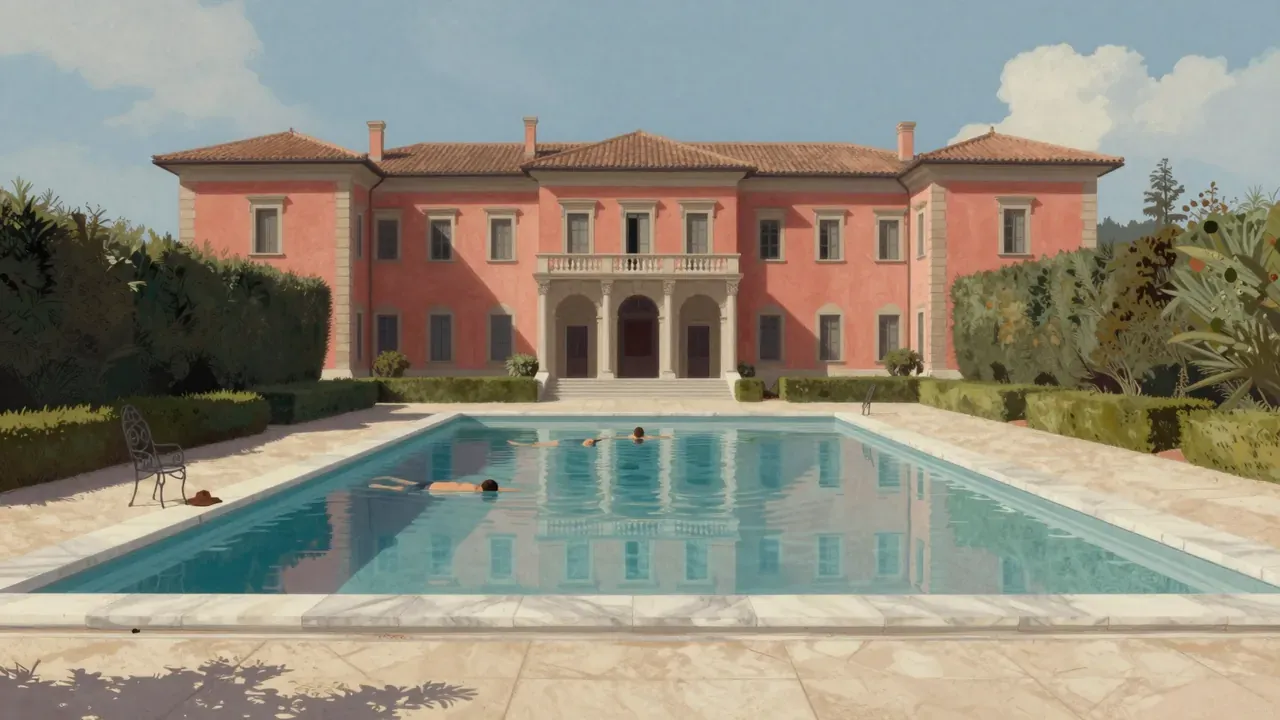
What lands is the cumulative effect of sustained tonal control: the way a shot of Jep standing alone on the Ponte Sant’Angelo at dusk holds longer than necessary, until the light itself seems to exhale; the quiet horror of Ramona’s death, rendered not in tears but in the sudden absence of her presence from the frame; the precision with which Sorrentino films wealth not as excess but as insulation — marble floors that absorb sound, gardens so manicured they feel airless, conversations that circle without landing. The film’s central paradox — that beauty can be both nourishing and paralysing — registers not through argument but through accumulation: the repeated image of Jep watching others live while he remains still, the recurring motif of water (the Tiber, the sea off Giglio, the swimming pool where bodies float motionless), the contrast between the physical decay of Rome’s ancient stones and the cosmetic preservation of its inhabitants. These are not symbols imposed from outside but textures absorbed into the film’s breathing rhythm. The final sequence, where Jep walks away from the camera along a beach, does not resolve but releases — a gesture that lands because everything before it has earned its ambiguity.
Who fades from view
What does not land is the film’s reliance on a certain kind of cultural shorthand — the assumption that viewers will recognise the specific flavour of Roman social decay without needing its mechanics explained. Some character arcs dissolve without consequence: Dadina the dwarf editor appears and vanishes without narrative function beyond serving as a plot device to send Jep to Giglio Island. The cardinal’s culinary preoccupations feel like a sketch rather than a developed counterpoint to Jep’s spiritual drift. Several supporting figures — Lello the toy seller, Franco Graziosi’s elderly aristocrat — remain decorative, their presence more atmospheric than consequential. The film’s refusal of causality occasionally tips into opacity: Elisa’s diary arrives without context, Ramona’s illness unfolds off-screen, Viola’s missionary turn follows no visible catalyst. This is not accidental minimalism but a stylistic choice that risks alienating viewers who expect psychological continuity. The film assumes familiarity with a particular Italian intellectual tradition — Céline, Pasolini, even Moravia — and without that anchor, some passages read as ornamental rather than essential.
The shape of time
The themes that matter are not Italian identity or national decline, but the relationship between attention and meaning: how long one can look at beauty before it stops revealing and starts concealing; how memory functions not as record but as selective theatre; how ritual — whether Catholic mass, nightclub performance, or journalistic deadline — persists even when belief evaporates. Ageing here is not biological but existential: Jep’s block is not writer’s block but the erosion of the self as a site of action. The film treats time not as linear progression but as layered sediment — the Colosseum and the Costa Concordia wreck occupy the same psychic space. Mortality is not dramatised through illness or accident but through repetition: the same parties, the same conversations, the same faces returning older, thinner, quieter. What matters most is the film’s refusal to separate aesthetic experience from moral consequence — every beautiful shot is also a moral question. It asks not what Rome has become, but what happens to a person who spends sixty-five years mistaking observation for participation, and whether recognition — however late — constitutes a beginning or merely an epilogue.
Who walks with it
This film is for viewers who tolerate long silences, who find emotional resonance in composition and pacing rather than dialogue or plot, and who accept that a film may pose questions without supplying answers. It suits those familiar with post-war Italian cinema or European art-house traditions where atmosphere carries narrative weight. It is not for viewers who require clear cause-and-effect, psychological exposition, or resolution — those who expect characters to change decisively or plots to conclude will find it withholding. It is also unlikely to satisfy audiences seeking social critique with analytical rigour; Sorrentino offers diagnosis without prescription, mood without manifesto. Critics who faulted it for ‘elegant vagabondage’ (as Gianni Riotta wrote) would disagree with this verdict — but their objection stems from expecting documentary fidelity or political utility, not from any failure in the film’s own terms. A viewer who values formal control over narrative clarity will find it rich; one who prioritises story propulsion will find it inert.
The silence after
Yes, it is worth your evening — if you approach it as a sustained sensory and philosophical immersion rather than a story to be followed. Its 142 minutes unfold at a pace that demands surrender to its rhythm, not impatience with its slowness. Those who resist its tempo will not warm to it on repeat viewings; its power lies in accumulation, not revelation. It rewards attention but does not flatter it — there are no easy pay-offs, no cathartic releases, no character arcs that click into place. What changes the verdict is expectation: if you come for narrative propulsion or sociological insight, it will disappoint. If you come for a meticulously orchestrated meditation on beauty, time, and the weight of unspent life, it delivers with unwavering consistency. It is not a film to watch while distracted, nor one to consume quickly — but for those willing to meet it on its own terms, it occupies the mind long after the credits end.