The shape of a life
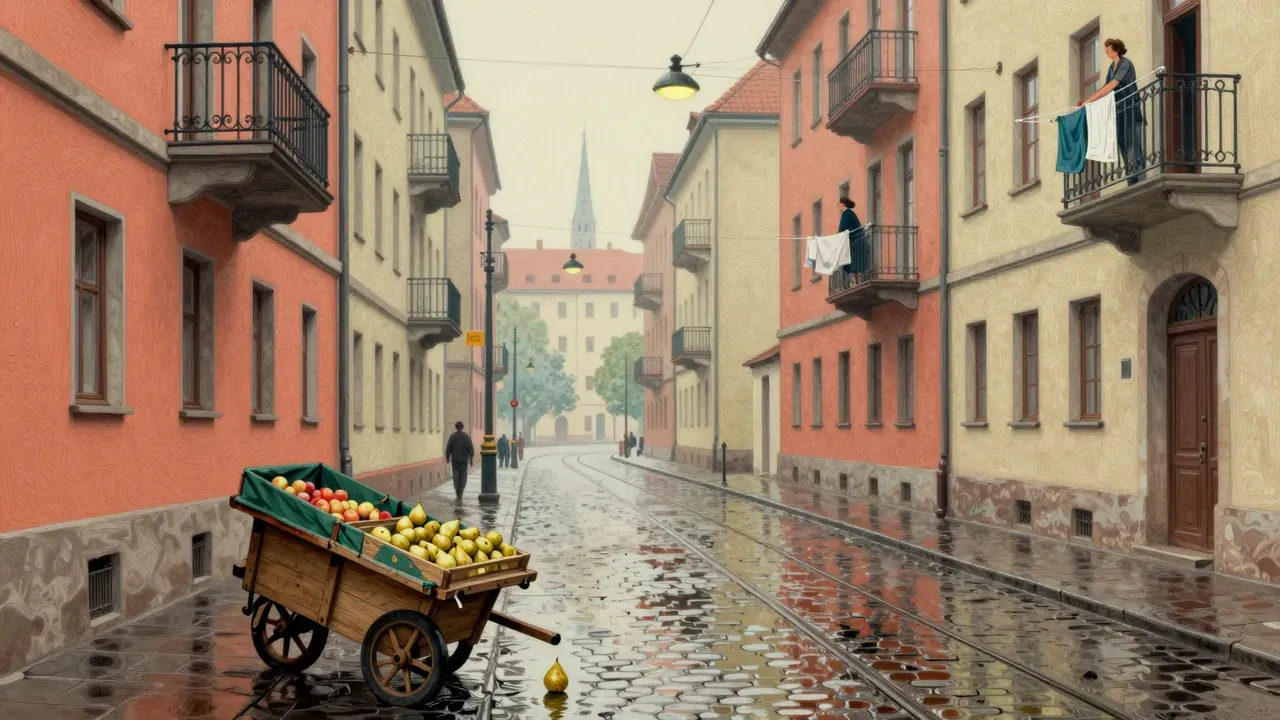
The Merchant of Four Seasons is a West German drama from 1972, written and directed by Rainer Werner Fassbinder, set in Munich during the 1950s. It follows Hans Epp, a fruit peddler whose life unravels under the weight of class contempt, marital strain, physical limitation, and self-loathing. The film does not aim to explain or redeem him, nor does it offer narrative catharsis; instead, it observes his slow, unremarkable collapse with clinical precision. Its purpose is structural and sociological: to map how respectability, family loyalty, and economic viability are withheld from men like Hans—not because he is monstrous, but because he is ordinary, unpolished, and insufficiently aspirational. The title, borrowed from the French term for a greengrocer, signals this quiet irony: a man who sells the seasons is denied any season of his own. Fassbinder treats the domestic sphere as a site of accumulated micro-aggressions, where love is transactional, care conditional, and dignity revoked daily. There is no villain beyond the unspoken consensus that Hans does not belong.
The look of it
The story unfolds in episodic, unsentimental blocks, each reinforcing Hans’s diminishing agency: his return from the Foreign Legion, his marriage, his dismissal from the police, his heart attack, his replacement by Harry. Dietrich Lohmann’s cinematography keeps the frame tight and grounded—interiors lit with flat, even light, exteriors shot on real Munich streets without flourish. Hans Hirschmüller plays Hans with minimal inflection, letting posture and silence carry exhaustion rather than pathos. Irm Hermann’s Irmgard avoids caricature; her resentment is practical, not hysterical. Hanna Schygulla’s Anna registers as the only person who sees Hans clearly, yet even her sympathy is passive, never interventionist. Rocco Granata’s score uses accordion-led waltzes and sentimental pop motifs ironically, underscoring emotional vacancy rather than warmth. Thea Eymèsz’s editing avoids dramatic cuts; scenes bleed into one another like tired breaths. No performance seeks empathy—each actor treats their role as a social function, not a psychological portrait.
What sticks
What lands is the cumulative weight of small humiliations: Hans’s mother dismissing his grief over a dead friend, his wife’s laughter at his height during sex, the way Anzell’s firing is staged not as betrayal but as bureaucratic inevitability. The film’s refusal to moralise makes its observations stick—the doctor’s warning about alcohol is delivered without urgency, and Hans’s final binge feels less like tragedy than quiet resignation. The bar scenes, filmed with static medium shots and naturalistic sound, convey the hollow rhythm of routine self-erasure. Even the Foreign Legion flashback—brief, unexplained, shot in grainy monochrome—is effective not for its exoticism but for its banality: torture here is less spectacle than punctuation, another failed escape. The ending does not shock; it confirms. When Harry takes Hans’s place at the table and with Irmgard, there is no irony underlined—just continuity. This consistency of tone, this avoidance of rhetorical emphasis, gives the film its durability. It lands because it refuses to ask for pity, and so earns attention instead.
Where it thins
What does not land is the film’s occasional reliance on exposition that feels schematic rather than lived. The backstory of Hans’s police dismissal—recounted in a single bar monologue—is narratively efficient but emotionally thin; it tells us what happened without embedding us in its consequence. Similarly, the character of Ingrid Caven’s ‘great love’ appears twice, both times undressing for Hans without dialogue or hesitation, which flattens her into a symbolic object rather than a person with motive or contradiction. The subplot involving Anna’s academic ambitions is introduced but never deepened; her brief screen time suggests thematic potential that remains unexplored. Some supporting characters—Kurt Raab’s brother-in-law, Gusti Kreissl’s mother—are drawn with such consistent disdain that they verge on allegory, losing texture. These moments do not break the film, but they narrow its field: where the central relationship feels dense with unspoken history, some secondary interactions feel like placeholders for class critique rather than fully realised human exchanges.
What it’s really about
The themes that matter are not abstract but embodied: the violence of middle-class expectation, the gendered division of emotional labour, the way economic precarity corrodes intimacy, and the quiet lethality of being deemed unworthy of investment—by family, by medicine, by love. Class is not discussed; it is enforced through seating arrangements, speech patterns, and who gets to leave a room first. Masculinity is shown not as ideology but as habit: Hans’s outbursts, his drinking, his need to assert control over a cart or a woman—all are reactions to having been stripped of authority elsewhere. Mental health is treated as physiological fact, not psychological drama: his heart condition is medical, his despair behavioural, his death clinical. The film also insists on the ordinariness of failure—not spectacular ruin, but the slow leak of dignity, the way a man can vanish while still standing in his own kitchen. These themes cohere because they are anchored in action, not speech: Irmgard’s decision to sleep with Harry is not framed as revenge or desire, but as recalibration—a pragmatic shift in survival strategy.
Who it’s for
This film is for viewers who value formal rigour over emotional reward, who find insight in restraint, and who are comfortable watching people fail without being guided toward judgment or mercy. It suits those familiar with Fassbinder’s early work or with post-war German cinema’s preoccupation with moral ambiguity and social determinism. It is not for viewers who require narrative momentum, character redemption, or tonal relief; those seeking warmth, wit, or stylistic flamboyance will find it austere, even withholding. Some critics praise its compassion, but that reading depends on interpreting austerity as empathy—an interpretation others reject. A viewer who values psychological realism over sociological framing may find Hans too passive, too opaque. The film would gain accessibility with clearer motivation for certain choices—say, Irmgard’s affair—but that clarity would compromise its method. Its value lies precisely in what it refuses to explain.
Is it worth your evening
Yes, it is worth your evening—if you accept that an evening’s worth is not measured in pleasure but in density of observation. At eighty-nine minutes, it moves deliberately but never wastes time; every scene advances its thesis about how systems wear down individuals. It repays attention not with revelation but with recalibration: after watching, minor slights feel heavier, domestic routines more charged, silence more consequential. Those who dislike films that withhold catharsis, avoid interior monologue, or treat suffering as ambient rather than exceptional may find it unrewarding. But for anyone willing to sit with discomfort without resolution, it offers rare precision. Its power is cumulative, not climactic—less a story told than a condition documented. It does not argue for Hans; it shows what happens when no one argues for him. That is its achievement—and its demand.