The opening frame
Schizopolis is a self-aware, low-budget experiment in narrative fracture and linguistic play, made by Steven Soderbergh as a deliberate break from the conventions of mainstream comedy and linear storytelling. It does not aim to entertain through character or plot but to test how far a film can go in dismantling communication itself — replacing dialogue with nonsense syllables, swapping protagonists mid-scene, and cycling through three overlapping perspectives that contradict rather than clarify one another. The film’s structure is architectural: it begins with a faux-DeMille prologue and ends with Soderbergh addressing an empty auditorium, framing the whole as a staged provocation rather than a story to be followed. Its ambition lies not in coherence but in exposure — of how much meaning we project onto arbitrary patterns, how easily social scripts replace real exchange, and how thin the membrane is between satire and collapse. It is less a film about schizophrenia than about the schism between language and intent, between performance and person, between intention and reception. Word count: 148
The triple perspective
The film works through strict formal repetition and radical simplification: same locations, same actors playing doubles, same props recontextualised across timelines. Soderbergh performs both Fletcher Munson and Dr. Korchek, his delivery flat and affectless, leaning into monotony as a comic and conceptual tool. Betsy Brantley, as Mrs. Munson and Attractive Woman #2, shifts register without shifting pitch — her line readings are precise, dry, uninflected. David Jensen’s Elmo Oxygen moves through scenes like a cipher, speaking in invented phonemes while photographing his own genitals with found cameras. Cliff Martinez’s score is sparse, tonal, and deliberately unanchoring — no leitmotif, no resolution. Soderbergh’s cinematography avoids flourish: static frames, shallow focus, natural light, no camera movement beyond what’s needed to follow a walk down a suburban street. Editing is rhythmic but not explanatory; cuts land on silence or non-sequitur, never on revelation. The craft is anti-virtuosic by design — every choice serves the principle of subtraction. Word count: 152
The nonsense dialogue
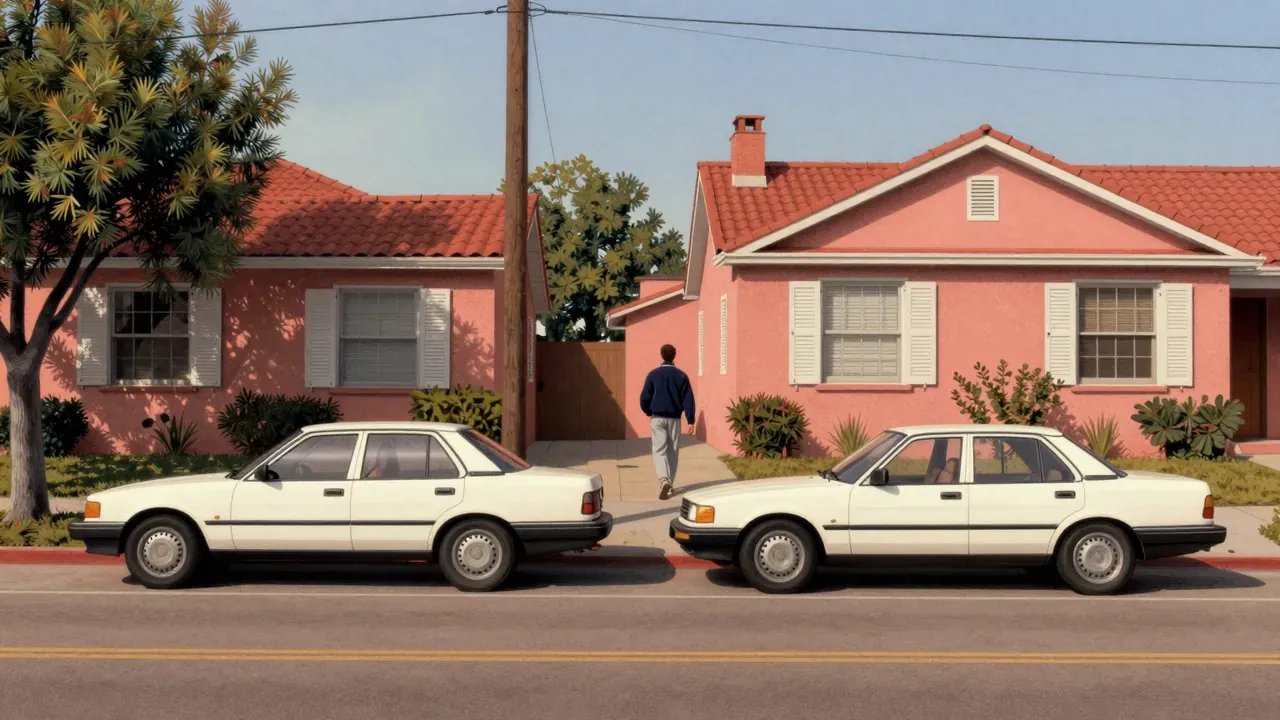
What lands is the cumulative effect of repetition turned absurd: the ‘Generic greeting!’ exchanges, the identical cars parked side by side, the jogging-suit dentist who falls in love with a woman he’s just met and then loses her before breakfast. The film’s humour is structural, not situational — it comes from watching logic strain and snap under its own weight. The doppelgänger device works because it is literal, not metaphorical: when Fletcher closes his eyes and becomes Korchek, the switch is enacted without transition, trusting the audience to absorb the substitution as fact, not trick. The mall monologue near the end lands with quiet force — not because it explains anything, but because it’s the first moment where time feels linear and speech feels personal, however briefly. Even the fake copyright disclaimer flashing for a single frame lands as a punchline: a bureaucratic gesture stripped of function, left only as a signifier of authorship and artifice. Word count: 149
The flat performances
What does not land is any sustained emotional investment in the characters’ fates. Fletcher’s detachment is the point, but it also prevents empathy; Korchek’s sudden romantic confession feels arbitrary, not earned; Mrs. Munson’s reconciliation arrives without psychological scaffolding. The linguistic games grow wearying after forty minutes — the nonsense dialogue, while conceptually sound, lacks variation in rhythm or escalation, so its novelty flattens into tedium. The film’s refusal to anchor itself in tone means moments meant to sting — like the funeral eulogy’s ‘Lester Richards is dead, and aren’t you glad it wasn’t you?’ — land with the same weight as a grocery list. Some viewers will find the self-interview commentary track clever; others will hear it as defensiveness masquerading as irony. The film’s rigour is undeniable, but its patience for the viewer’s attention is not reciprocated. Word count: 150
The Eventualist world
The themes that matter are all rooted in failure of language: not miscommunication, but the impossibility of communication as commonly practised. Social scripts — greetings, condolences, workplace directives — are exposed as hollow vessels, repeated until they lose semantic purchase. The film treats identity as unstable not through psychology but through casting: Brantley plays two women who are physically identical but narratively distinct; Soderbergh plays two men whose lives intersect only through spatial coincidence. There is no interiority granted to anyone — motivation is withheld, backstory omitted, emotion flattened. Even addiction (Korchek’s brother) and desire (Elmo’s conquests) are presented as behavioural loops, not human conditions. The film’s critique is not of individuals but of systems: Eventualism as corporate mysticism, dentistry as ritualised control, extermination as domestic intrusion disguised as service. Its politics are implicit, not declamatory — it shows the machinery of alienation, then refuses to name the operator. Word count: 147
The ending that refuses closure
This film is for viewers who treat cinema as a site of formal inquiry — those who read film criticism not for verdicts but for propositions, who watch avant-garde shorts before features, who value precision of idea over warmth of execution. It rewards attention to pattern, tolerance for repetition, and willingness to sit with unresolved tension. It is not for viewers who require narrative momentum, emotional continuity, or even consistent tone — those who leave a film asking ‘What happened?’ rather than ‘What was being tested?’ will feel stranded. Anyone expecting the wit of Soderbergh’s later work, or the accessibility of his early indie peers, will be disappointed. A change in verdict would come only if the viewer values conceptual rigour above all else — if they find pleasure in architecture more than atmosphere, in syntax more than sense. Word count: 144
The blank screen
It is worth your evening only if you arrive prepared to engage it as a diagram, not a drama — a schematic of breakdown rather than a story of recovery. Its ninety-six minutes pass without urgency, but also without filler; every shot serves the central proposition. That said, it demands more from the viewer than it gives back in conventional reward: no catharsis, no insight disguised as revelation, no character arc that resolves. Those who admire it tend to do so retrospectively, after time has clarified its logic; those who reject it often do so within the first twenty minutes, and rightly so. Its value lies not in entertainment but in demonstration — of how little narrative scaffolding a film needs to hold attention, and how much meaning can be generated by withholding it. Word count: 146