The look of it
Judex is a 1963 French crime film that remakes Louis Feuillade’s 1916 serial not as revival but as stylistic archaeology. Georges Franju does not seek fidelity to plot or character so much as to the tactile grammar of early French cinema: masked costume balls, silent-era pacing, theatrical lighting, and a deliberate avoidance of psychological exposition. The film treats its pulp source as a set of formal constraints — animal masks, leotard-clad villains, rooftop duels in near-silence — rather than narrative material to be modernised. Franju’s stated disinterest in Judex as a character (“the only film of Feuillade that isn’t good Feuillade”) signals his priority: not homage as nostalgia, but reconstruction as critical practice. He builds a world where justice is staged like magic, morality wears colour-coded costumes, and moral agency resides less with the titular figure than with women who move through shadows and rooftops unburdened by his symbolic weight. This is not a detective story about solving crime, but a study in how genre conventions encode power, gender, and spectacle. Word count: 142
Who carries it
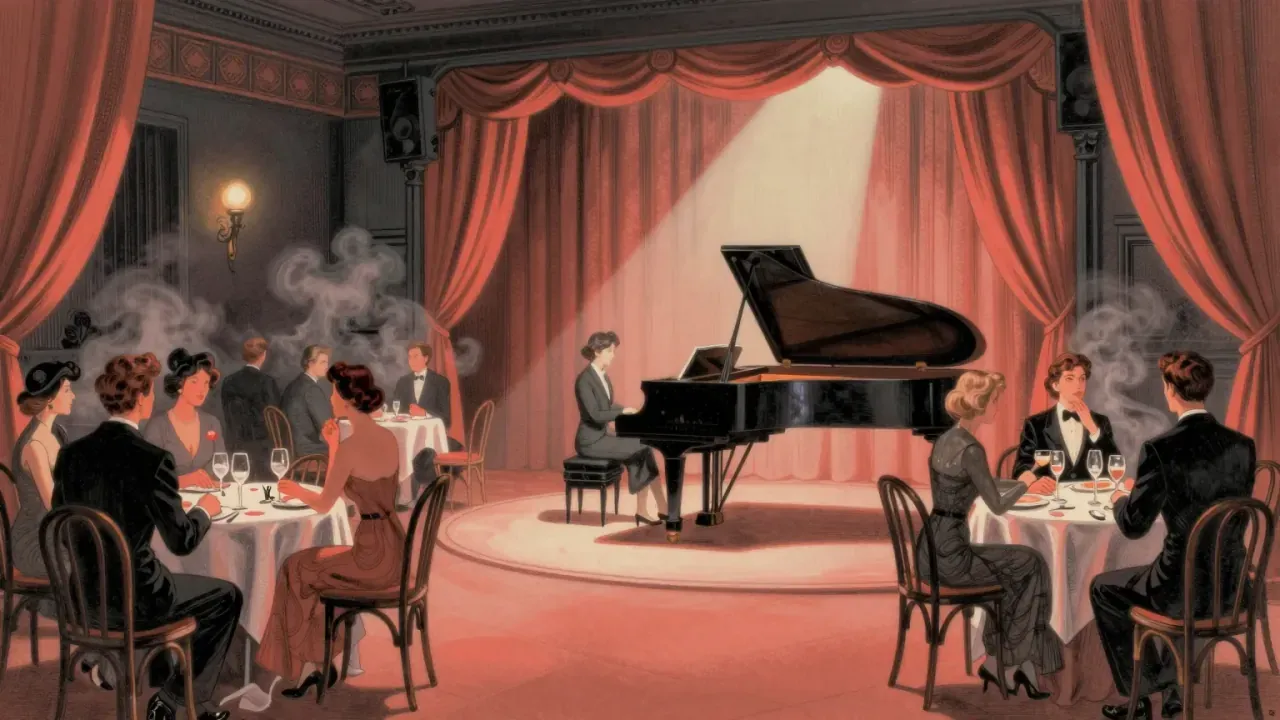
The story follows banker Favraux’s downfall after receiving a letter from the masked vigilante Judex, but Franju disperses narrative focus across three women: Jacqueline, the grieving daughter; Diana Monti, the black-leotarded cat burglar posing as a governess; and Daisy, the white-costumed acrobat who defeats her. Théophanis Lamboukas plays Judex with minimal dialogue and no interiority — he appears mostly as silhouette, gesture, or magician’s flourish. Francine Bergé’s Diana moves with feline precision, lit by Marcel Fradetal in high-contrast chiaroscuro; Édith Scob’s Jacqueline is quieter, often framed in stillness or half-shadow. Maurice Jarre’s score avoids melodrama, favouring sparse strings and ambient pulses. Gilbert Natot’s editing sustains long takes and rhythmic pauses, refusing urgency even during chases or confrontations. The costume ball opening — all animal masks drawn from Grandville — establishes tone before plot begins. Every frame feels composed for texture over exposition: fabric, lightfall, posture, silence. Word count: 153
What holds the eye
What lands most securely is the film’s visual syntax: the black-and-white costuming as moral shorthand, the rooftop duel’s near-silence punctuated only by breath and string harmonics, the way Diana’s silver dagger catches light like a shard of intention. Franju’s refusal to let Judex dominate screen time pays off in structural irony — the film’s title figure is less protagonist than motif, a mask worn by others’ agency. The casting of Bergé works precisely because she is never asked to explain Diana; her menace emerges from movement, gaze, and costume alone. Scob’s Jacqueline gains gravity through restraint: her grief is registered in stillness, not monologue. The production design — ornate interiors, theatrical staircases, fog-draped gardens — feels lived-in, not illustrative. Even the magic tricks are functional: they establish Judex as illusionist first, avenger second. These choices cohere into something rare: a genre film whose style is its substance, where every aesthetic decision serves the central question of who gets to embody justice, and how that embodiment is performed. Word count: 150
Where it slips
What does not land is the attempt to sustain ambiguity around Judex’s moral standing without granting him sufficient presence or contradiction to make it compelling. His plan to murder Favraux is stated but never dramatised with consequence; his failure to subdue Diana feels less like thematic necessity and more like narrative deferral. The film’s pacing, while deliberate, occasionally stalls without compensating tension — scenes linger not because they accrue meaning, but because they emulate silence without its weight. Some performances suffer from this: Jacques Jouanneau’s Cocantin remains sketch-like, and several supporting roles lack the textural specificity given to Diana or Jacqueline. The script’s debt to Feuillade means it assumes familiarity with serial rhythms that modern viewers may not share, and Franju’s resistance to exposition leaves key motivations underdeveloped — not as mystery, but as omission. The film’s elegance risks becoming detachment: when characters do not speak, it is not always clear whether they are withholding or simply absent. Word count: 152
What it keeps returning to
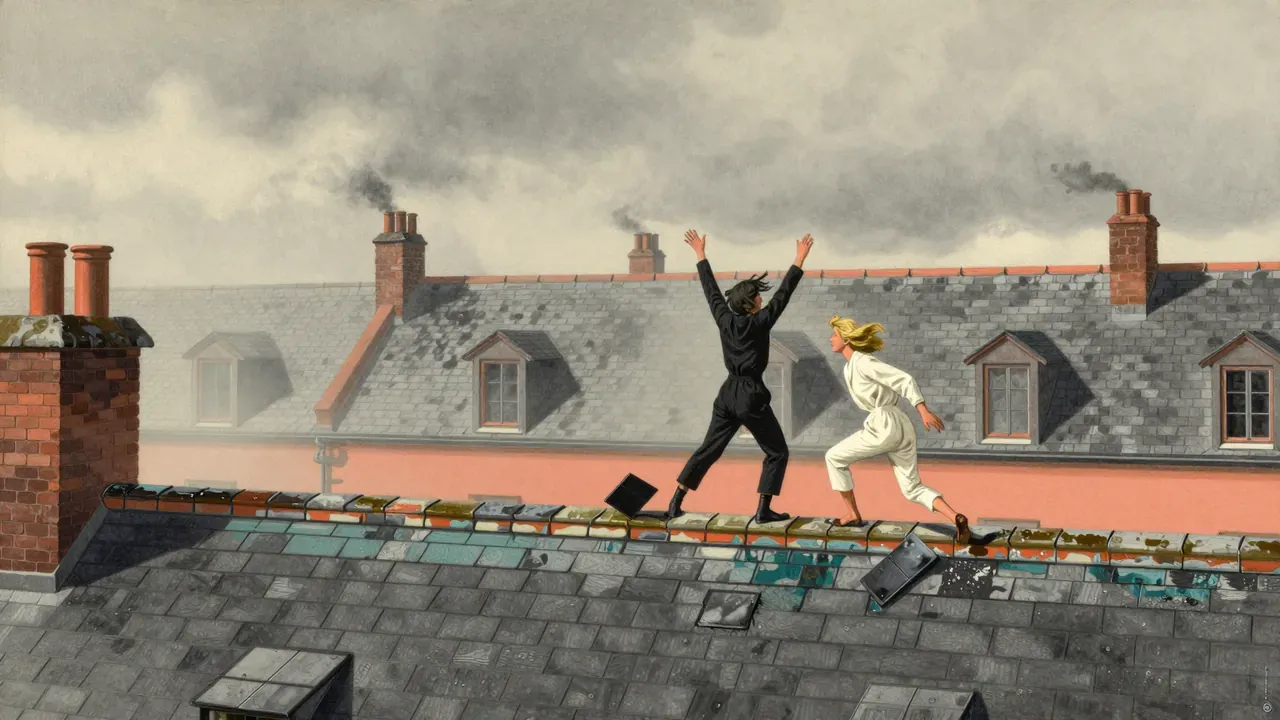
The themes that matter are not justice or vengeance but performance, visibility, and the erotics of opposition. Diana and Daisy fight not as archetypes but as embodiments: black leotard versus white acrobat suit, brunette versus blonde, predatory grace versus disciplined agility. Their rooftop duel is choreographed as ballet, not brawl — its sensuality arises from contrast, proximity, and control, not violence. Franju treats morality as costume, not conviction: Favraux’s wealth is built on fraud, Judex’s authority on disguise, Diana’s power on misdirection. The recurring motif of masks — animal-headed at the ball, faceless in Judex’s lair — suggests identity as role, not essence. Childhood recurs too: the boy Benjamin Boda watches events with fascination, not judgment, mirroring the viewer’s position — invited to observe spectacle, not resolve ethics. Justice here is not delivered but deferred, performed, and ultimately displaced onto women who act while Judex watches. The film’s real subject is not crime, but how moral categories are staged, lit, and dressed. Word count: 149
Who it’s for
This film is for viewers who value composition over exposition, who find pleasure in sustained mood and deliberate pacing, and who approach genre not as formula but as material for formal experiment. It rewards attention to costume, light, and spatial rhythm more than plot resolution. It is not for those who require clear motivation, psychological realism, or narrative propulsion — viewers expecting a conventional crime thriller or superhero origin story will find Judex frustratingly elliptical. Those who disliked Franju’s Eyes Without a Face for its clinical detachment may feel similarly here. A viewer who values strong female agency within stylised frameworks will respond well; one who needs moral clarity or cathartic confrontation will not. Its appeal narrows with each stylistic choice, but deepens for those willing to sit inside its silences. Word count: 144
Whether it stays with you
Yes, it is worth your evening — provided you watch it as an object of craft, not a story to be solved. Its 103 minutes unfold with unhurried certainty, each shot calibrated for tonal resonance rather than narrative efficiency. You will not leave with answers, but with impressions: the gleam of a dagger, the rustle of tights on roof tiles, the weight of a bird mask held in gloved hands. Those who demand forward momentum or emotional payoff will feel short-changed; those open to cinema as tactile memory will find it rich. It is not a film to consume, but to inhabit — best viewed late, alone, with sound up and expectations down. Its value lies not in what it says, but in how insistently it refuses to say too much. Word count: 142