The shape of the chase
The Naked Prey is a stripped-down survival chase set in the South African veldt, built around a single premise: a white safari guide stripped naked and released to run for his life after his expedition insults and kills members of a local tribe. It makes no claim to historical fidelity or ethnographic accuracy, nor does it attempt psychological portraiture or moral exposition. Its aim is structural and kinetic — to sustain tension through pursuit, evasion, and physical endurance across landscape, not character arcs or dialogue. Cornel Wilde conceived it as a visual and rhythmic study of motion, threat, and terrain, borrowing loosely from John Colter’s escape but discarding narrative convention in favour of repetition, silence, and the weight of geography. The film avoids exposition, backstory, and even names; its protagonist remains ‘Man’, its antagonists ‘Warriors’, its setting unmarked by colonial maps or dates. It tries to be elemental: heat, thirst, thorn, spear, river, drum, breath. Word count: 142
The weight of silence
The story unfolds in three phases: violation, pursuit, and return — each governed by physical logic rather than dramatic irony. Wilde’s performance is minimal, relying on posture, gait, and reaction rather than expression; Ken Gampu’s tribal leader conveys authority through stillness and gaze, not speech. H. A. R. Thomson’s cinematography uses wide, static compositions to emphasise scale and vulnerability, with long takes that follow movement without cutting away. Edwin Astley’s score is sparse — mostly tribal chants recorded on location, with natural sound dominating over music. The editing avoids punctuation: no close-ups to signal emotion, no cuts to relieve tension. Dialogue is scarce and functional; English is spoken only by the Europeans, while Nguni languages carry ritual weight without translation. The film’s craft is documentary in texture but mythic in rhythm — less concerned with how people speak than how bodies move across land under sun and threat. Word count: 156
The shock of the spear
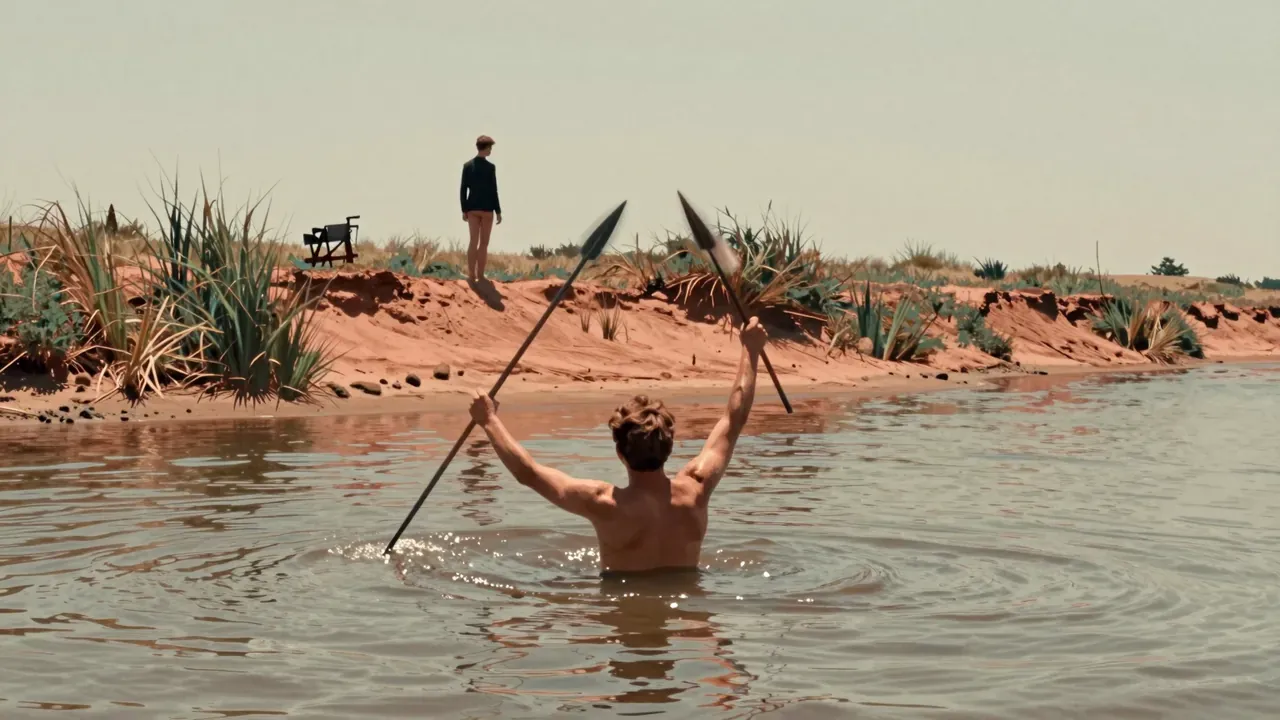
What lands is the relentlessness of the chase itself — the way time dilates in long shots of running, the tactile discomfort of bare feet on rock and thorn, the sudden violence of spear-throwing rendered without flourish. The river sequence, the waterfall fall, the thorn-ditch ambush: these moments work because they are anchored in cause-and-effect physics, not stunt choreography. The relationship between the guide and the girl feels earned not through dialogue but through shared silence, gesture, and song — her language untranslated, his drinking tune equally unexplained. The final salute between guide and warrior lands precisely because it arrives without sentimentality, as a mutual acknowledgment of effort completed. The film’s austerity becomes its strength: when a spear misses, you feel the air it cut; when a man stumbles, you register the weight of exhaustion before the camera tells you. Word count: 152
The indifference of the veldt
What does not land is the film’s framing of colonial encounter as a neutral test of individual endurance. The opening insult — the investor knocking down the tribal leader — is presented as a breach of etiquette, not of sovereignty or power, and the warriors’ response reads more like ritual retribution than political resistance. The film never questions the safari’s right to be there, nor interrogates the elephant hunting as exploitation. Patrick Mynhardt’s triple role (overseer, slaver, soldier) gestures at systemic violence but collapses it into caricature. The girl’s rescue feels narratively convenient rather than ethically grounded; her agency ends where the guide’s need for shelter begins. Some viewers will find the absence of context alienating — not because the film is silent, but because its silence omits the very structures that make the chase possible. Word count: 150
The stripping of layers
The themes that matter are endurance as ritual, landscape as antagonist and ally, and the instability of civilisation when stripped of tools and status. The film treats clothing, weapons, and language not as markers of culture but as removable layers — the guide sheds them one by one, and each loss recalibrates his relation to the world. His survival depends less on knowledge than on attention: to wind, to animal tracks, to the angle of light on water. The veldt is neither benevolent nor hostile — it simply is, indifferent and exacting. Colonial hierarchy dissolves not through critique but through exposure: when the guide runs naked, he is no longer employer or expert, only body in space. The salute at the end is not reconciliation but recognition — two men who have measured each other by distance covered, not by titles held. Word count: 148
The final nod
This film is for viewers who value formal discipline over exposition, who respond to rhythm and terrain as narrative engines, and who accept that some silences are structural, not evasive. It suits those accustomed to arthouse pacing, non-professional acting, and soundscapes where wind carries more meaning than speech. It is not for viewers who require moral scaffolding, psychological motivation, or cultural context — those expecting a postcolonial reckoning will find the film’s neutrality frustrating, not austere. Critics like Roger Ebert dismissed its fantasy of white endurance; others find that fantasy precisely the point — a myth laid bare, not endorsed. A different verdict would follow if the film engaged directly with land dispossession or racial hierarchy, but it does not. Word count: 149
The terms of watching
Yes, it is worth your evening — not as entertainment but as an exercise in sustained attention. Its ninety-one minutes pass without filler, without digression, without apology. You will not forget the sound of bare feet on dry earth, or the way the camera holds on a distant figure shrinking against horizon. It rewards patience with precision: every shot serves the logic of pursuit, every edit tightens the coil. Those who dislike it tend to cite its moral reticence or perceived exoticism — valid objections, but ones the film never invites. Its worth lies in what it refuses: explanation, justification, relief. If you seek a film that trusts landscape, silence, and stamina to carry meaning, this delivers. If you need clarity of intent or ethical resolution, look elsewhere. Word count: 150