The shape of the room
The Bitter Tears of Petra von Kant is a chamber drama confined to a single apartment in Bremen, built from Rainer Werner Fassbinder’s own 1971 stage play and filmed with deliberate theatrical rigour. It attempts no realism of location or time: the set is a stylised, mirrored interior, its surfaces reflective, its furniture arranged like props in a tableau. The film seeks to anatomise emotional dependency through sustained psychological exposure — not by revealing backstory gradually, but by holding it under steady, unblinking light. Its method is structural as much as thematic: six women move within fixed spatial limits while power shifts between them like weight redistributed on a balance beam. There are no exterior shots, no cutaways, no narrative digressions. Fassbinder treats the apartment not as a home but as a pressure chamber, where language, gesture and silence are calibrated to expose how love becomes indistinguishable from domination when reciprocity is absent. The film does not ask for empathy so much as scrutiny — of Petra’s self-mythology, of Karin’s strategic passivity, of Marlene’s silent accumulation of grievance. It is an exercise in dramatic concentration, not catharsis.
The look of it
The story unfolds across three temporal blocks — initial infatuation, six-month entanglement, and final collapse — each marked by Petra’s changing wigs and vocal register. Margit Carstensen performs Petra as a figure both commanding and brittle, her physicality coiled tight beneath couture; Hanna Schygulla’s Karin moves with studied nonchalance, her stillness more unsettling than any outburst. Irm Hermann’s Marlene speaks only twice, yet her presence dominates the frame’s lower thirds, often seated just outside focus while others perform above her. Michael Ballhaus’s camera remains largely static, favouring medium two-shots and frontal compositions that flatten depth and amplify confrontation. The Poussin reproduction hangs behind Petra like a moral witness, its mythic allegory echoing the film’s transactional eros. Editing by Thea Eymèsz sustains long takes without indulgence — pauses are held until they ache, but never longer than the scene’s internal logic permits. Verdi’s music appears only in diegetic form: a record player in the background, its operatic swell muffled, distant, ornamental rather than explanatory.
The weight of silence
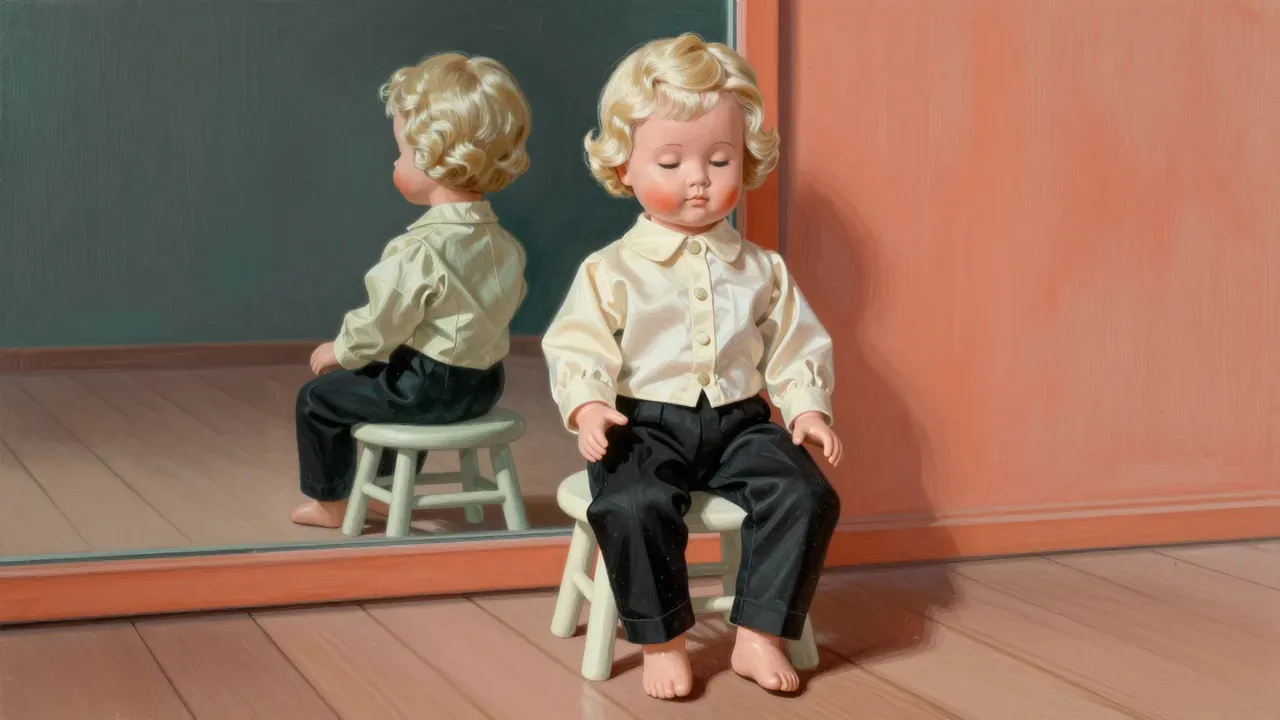
What lands is the suffocating precision of its emotional arithmetic. Every line of dialogue functions as both revelation and evasion; every glance carries accumulated history. The film’s claustrophobia is productive, not oppressive — it forces attention onto micro-shifts in posture, intonation, and eye contact that would vanish in a looser frame. Carstensen’s performance holds without slipping into caricature: Petra’s arrogance is tethered to palpable fear, her cruelty laced with exhaustion. The staging of domestic space — the way Sidonie enters through one door while Marlene exits another, or how Gaby sits silently at the edge of the frame during Petra’s breakdown — communicates hierarchy and exclusion without exposition. The doll given on Petra’s birthday lands with quiet devastation: a symbol not of affection but of erasure, of Karin reduced to hairstyle and silhouette. Even the pistol Marlene packs at the end arrives without fanfare, its presence felt in the weight of her suitcase, not its contents. Nothing is underlined. Everything is earned.
The cost of stillness
What does not land is the film’s occasional reliance on exposition-as-therapy. Petra’s monologues about her childhood, her daughter, her dead husband, risk flattening character into case history — especially when delivered directly to camera or in voiceover, as in the opening sequence. Some viewers may find the pacing unyielding: the absence of cuts or camera movement can feel like resistance rather than restraint, particularly in scenes where Karin’s passivity borders on opacity. The film assumes fluency in its dramaturgy — it offers no handholds for those unfamiliar with Fassbinder’s syntax of repetition and escalation. A viewer expecting psychological realism may balk at the stylisation; someone seeking narrative propulsion will find none. The ending, while coherent, offers no release — Petra’s apology to Marlene is met with departure, not reconciliation, and her final line to Karin is courteous, not redemptive. This refusal of closure is intentional, but it denies even the minor satisfaction of catharsis that many dramas offer as structural punctuation.
The grammar of possession
The themes that matter are possession disguised as love, the architecture of silence, and the violence of care. Petra does not desire Karin — she desires to be desired, to be the centre of another’s orbit, to replicate the intensity of her first marriage without its mutuality. Marlene’s silence is not acquiescence but conservation: she hoards dignity like currency, spending it only when she leaves. The film treats interiors as moral landscapes: mirrors reflect not faces but roles; the doll stands in for Karin’s erased subjectivity; the broken china signals not rage alone but the shattering of Petra’s self-image as curator of beauty. Class operates obliquely — Karin’s father was a toolmaker, Petra’s family owned textile mills — but the film refuses to make this a driver of plot. Instead, it shows how economic privilege enables emotional parasitism: Petra funds Karin’s reinvention while demanding total submission to her aesthetic and emotional regime. The film’s feminism is forensic, not declarative: it charts how women reproduce patriarchal structures among themselves when power is unequally distributed, not because they choose to, but because no other model is available.
Who it is for
This film is for viewers who value sustained formal discipline over narrative convenience, who find tension in stillness and meaning in repetition. It rewards attention to framing, rhythm, and subtext — people accustomed to slow cinema, theatre, or literary fiction will likely respond to its density. It is not for those who require plot momentum, emotional resolution, or psychological explanation. Anyone needing warmth, levity, or moral clarity will leave unsettled, perhaps alienated. Those who dislike theatrical staging, static camerawork, or dialogue-heavy scenes without visual variation may find it inert. A viewer who values character growth over character exposure may reject its circular structure. Someone drawn to Fassbinder’s broader filmography but unfamiliar with his theatrical works might misread its rigour as austerity. Its worth depends not on whether it pleases, but on whether it compels scrutiny — and that compulsion demands patience, not passive reception.
What it costs you
Yes, it is worth your evening — if you are prepared to meet it on its terms. Its 124 minutes pass without hurry, but never waste time: every shot advances the emotional calculus, every pause deepens the unease. It is not entertainment in the conventional sense, nor is it meant to be. Its value lies in its unflinching dissection of relational asymmetry — a study in how intimacy curdles when consent is assumed rather than negotiated. Those who dismiss it as ‘cold’ or ‘static’ are not wrong about its surface, but miss how its stillness serves its purpose: to hold a mirror to patterns we usually look away from. A viewer who prefers ambiguity resolved, pain soothed, or power made legible may find it unrewarding. But for anyone willing to sit with discomfort as data, not distraction, it repays close attention. Its endurance is earned, not imposed.