The shape of it
Good Morning is a colour comedy by Yasujirō Ozu, made in 1959 for Shochiku, and structured as a gentle, domestic reworking of his own 1932 silent I Was Born, But… It sets out to observe the friction between children’s blunt honesty and adult ritual — not as moral drama, but as behavioural comedy. The film watches how language, silence, and rumour circulate in a Tokyo suburb, treating social convention not as backdrop but as mechanism: the ‘good morning’ greeting becomes both punchline and pressure point. Ozu and co-writer Kōgo Noda do not mock the adults outright, nor idealise the children; instead, they hold both in steady, level focus, using repetition, framing, and pacing to expose the quiet absurdity of consensus. The film’s ambition is modest in scale but precise in aim: to show how meaning is made, mislaid, and remade in the ordinary transactions of family and neighbourhood. It is not satire in the biting sense, nor farce in the frantic one — it is comedy as taxonomy.
The look of it
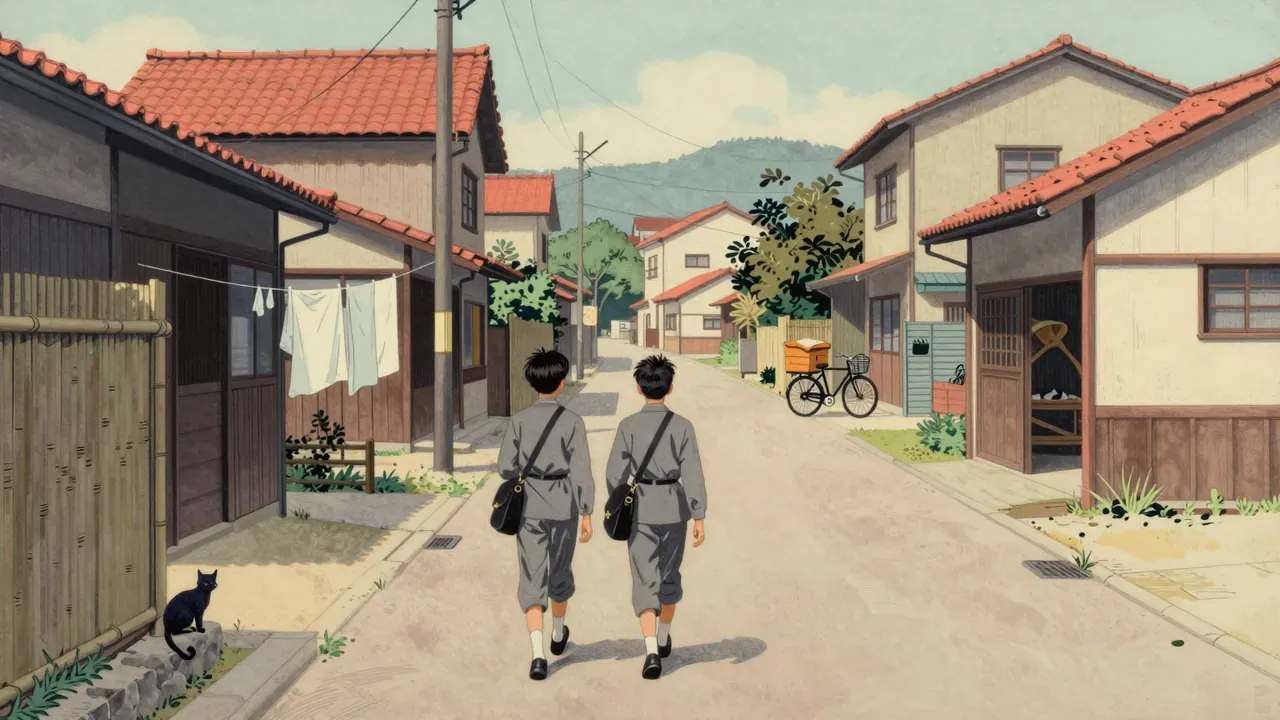
The story unfolds across a single suburban block, its episodes linked by shared spaces — verandas, tatami rooms, school corridors — all shot by Yūharu Atsuta with Ozu’s signature low-angle stillness. Chishū Ryū plays the father with unflustered gravity; Keiji Sada and Yoshiko Kuga give measured, unshowy performances as the parents caught between duty and desire. The child actors avoid precocity: their silence feels stubborn rather than symbolic, their tantrums physically tiring, not theatrical. Toshiro Mayuzumi’s score is light, melodic, and sparing — strings and woodwind sketch mood without underlining it. Editing follows Ozu’s axial cuts and pillow shots, giving breath to pauses, letting a kettle steam or a washing machine hum fill time that dialogue would otherwise occupy. The colour is soft but deliberate: pale greens, washed greys, the warm yellow of a television screen in a shop window — not lush, but materially present. Every composition serves duration, not revelation.
What sticks
What lands most cleanly is the film’s calibration of tone: it sustains a wry, unhurried amusement without slipping into condescension or sentiment. The flatulence jokes — introduced early, never repeated for shock — work because they are treated as matter-of-fact childhood discoveries, not transgressions. The women’s gossip about the missing dues gains weight from its banality: no villain emerges, only miscommunication compounded by assumptions about class, age, and memory. Mrs. Haraguchi’s realisation — that her mother forgot the money — lands not as plot twist but as quiet correction, a small restoration of order. The boys’ silence, too, lands because it is neither heroic nor futile: it is simply what children do when words fail them, and the adults around them respond not with insight but with projection. Even the ending — the TV arrives not as reward but as neighbourly obligation — avoids triumph, settling instead on a mild, communal sigh.
What slips
What does not land is the English tutor subplot, which remains underdeveloped and tonally adrift. His courtship of the aunt is sketched in glances and weather talk, but the film gives no anchor for his motivation beyond narrative convenience, and the aunt’s character stays indistinct. Their final exchange at the station feels less like thematic echo and more like structural afterthought — a second layer of silence grafted onto the first without deepening it. Likewise, the bohemian neighbours with the television are named only in context; their lifestyle is described but never shown, making their exclusion feel abstract rather than lived. The film’s refusal to dramatise their world leaves a gap where contrast might have sharpened the Hayashis’ conservatism. These omissions do not break the film, but they leave certain threads loose — not unresolved in an intentional way, but simply untied.
The quiet things
The themes that matter are silence as resistance and as failure, the labour of maintaining appearances, and the quiet violence of collective assumption. Ozu treats language not as tool but as habit — something repeated until it hollows out, then revived only when withheld. The film’s central irony is that the children’s refusal to say ‘good morning’ makes adults speak more, not less — but always about each other, never to each other. Ageing appears not as decline but as cognitive drift: Mrs. Haraguchi’s mother forgets the dues not because she is diminished, but because memory itself is fallible infrastructure. Class surfaces in objects — the washing machine, the television — not as markers of aspiration but as nodes in a network of envy, rumour, and obligation. There is no grand critique of Westernisation here, only the grain of daily life adjusting, slightly, to new appliances and new phrases.
Who it’s for
This film is for viewers who tolerate stillness, who find rhythm in repetition, and who do not require narrative escalation to feel engaged. It suits those familiar with Ozu’s style, but also those new to Japanese post-war cinema who want a low-threshold entry point — its humour is physical, its pacing generous, its stakes domestic. It is not for viewers who need clear cause-and-effect plotting, rapid dialogue, or emotional crescendos. Those expecting satire with bite or social realism with grit will find it too restrained; those who read silence as emptiness, not density, may mistake its patience for passivity. A viewer who values exposition over implication, or catharsis over accumulation, will leave unmoored. The film asks for attention to texture, not event — and that demand, though mild, is non-negotiable.
The time it takes
Yes, it is worth your evening — provided you watch it as it is made to be watched: without hurry, without expectation of payoff, and with willingness to sit inside its silences. Its 94 minutes unfold like a weekday afternoon: unremarkable until you notice how much is happening beneath the surface. It rewards attention to posture, to off-screen sound, to the weight of a pause after ‘good morning’. Some will call it slight; others, especially those accustomed to faster, louder comedies, may find its tempo alienating. But its slightness is deliberate, its slowness structural — not a flaw, but the condition of its clarity. To dismiss it as minor is to miss how precisely it measures the distance between what is said and what is meant, and how often that distance is crossed not by speech, but by a shared glance, a kettle’s whistle, or a television flickering in a shop window.


