The shape of the choice
The Soft Skin is a French New Wave drama from 1964 that observes the slow, unglamorous unravelling of a middle-aged man’s double life. François Truffaut does not frame Pierre Lachenay’s affair with Nicole as transgression or liberation, but as a series of small, plausible choices — a delayed flight, a misdirected phone call, a hotel key glimpsed in an elevator — each nudging him further from his marriage without clear intention. The film avoids moralising; it declines to treat infidelity as either tragedy or farce. Instead, it treats the domestic and professional surfaces of bourgeois life — lecture halls, airport lounges, Parisian apartments — as sites where emotional erosion happens quietly, almost bureaucratically. Truffaut co-wrote the script with Jean-Louis Richard, adapting no source material, and builds the narrative around duration and repetition: return trips, repeated gestures, overlapping routines. Its ambition is structural and behavioural: to show how habit, convenience and silence corrode fidelity long before passion does. It is not about love or lust, but about the weight of unspoken compromises. (158 words)
The look of it
Raoul Coutard’s cinematography moves with deliberate restraint: long takes hold on faces during silences, tracking shots follow Pierre through corridors and terminals without commentary, and interiors are lit with the flat, even tone of midday office light. Françoise Dorléac plays Nicole with unvarnished physicality — her laughter is loud, her posture relaxed, her boredom palpable when left waiting in Reims. Jean Desailly gives Pierre a quiet, watchful weariness; he rarely raises his voice, and his lies are delivered with the same calm as his lectures. Maurice Garrel appears briefly as Clément, his affability sharpening Pierre’s guilt by contrast. The editing avoids emphasis: scenes end not with punctuation but with drift — a car pulling away, a door closing, a pause before a phone rings. Georges Delerue’s score is sparse, often absent; when Haydn appears, it is diegetic, played on a hotel piano. Sound design favours ambient noise — airport announcements, distant traffic, the hum of lifts — reinforcing the film’s grounding in lived, unromantic space. There are no flashbacks, no voiceover, no symbolic objects. Everything is present-tense, observable, unembellished. (159 words)
Where it holds
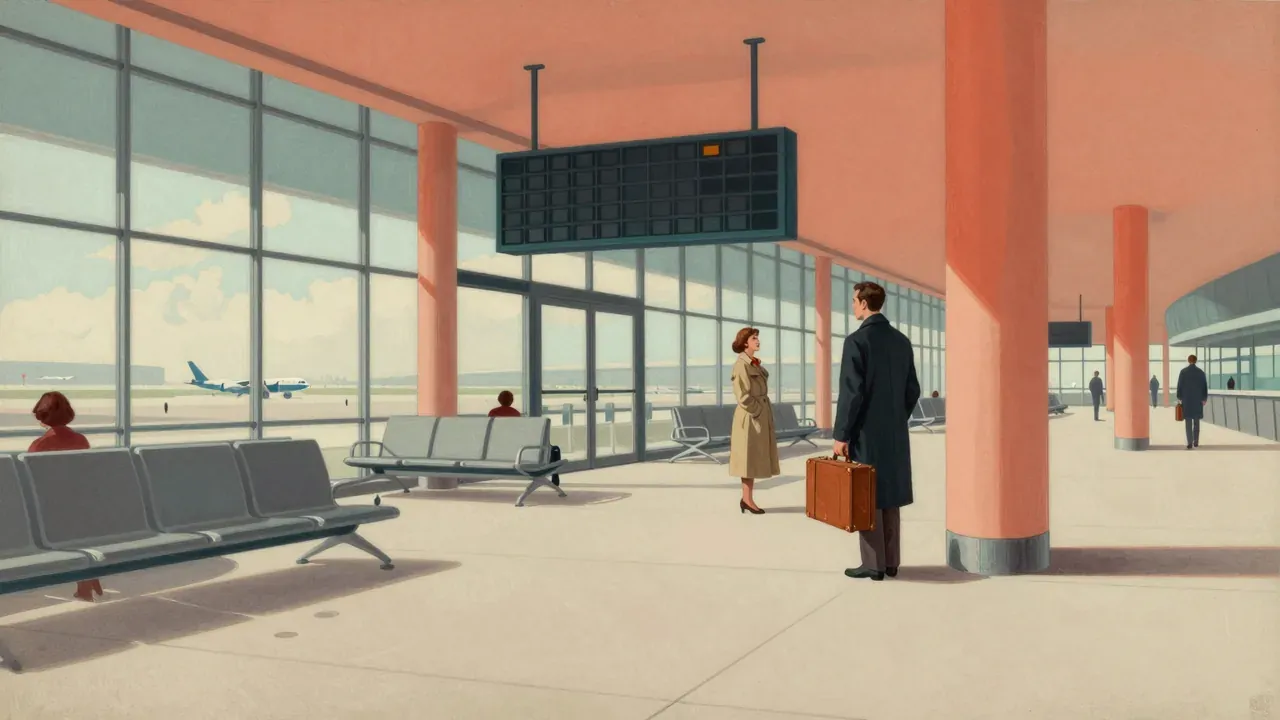
What lands is the accumulation of minor dissonances: the way Pierre’s wife Franca folds laundry while delivering a line about separation; the awkwardness of Nicole’s laugh in a restaurant, followed immediately by Pierre’s flinch; the precise, uninflected timing of Franca’s final act — not a scream, not a sob, but a smile after the shotgun fires. These moments gain force because they are never framed for effect. The film trusts the viewer to register discomfort in the gap between what characters say and what their bodies do — a hesitation before answering, a glance held too long, a hand tightening on a glass. The Lisbon and Reims locations are used without flourish: Orly Airport is functional, not atmospheric; the Reims hotel room is drab, its wallpaper slightly peeling. Even the countryside inn feels provisional, not idyllic. This refusal to aestheticise makes the collapse feel inevitable, not sensational. The film’s power resides in its patience: it watches Pierre make the same small evasion three times before the consequences arrive, and lets the audience feel the fatigue of that repetition. Nothing is underlined; everything is allowed to settle. (157 words)
Where it slips
What does not land is the film’s final turn into violence. Franca’s shooting of Pierre arrives without psychological preparation — not because it is sudden in story terms, but because the film has spent 105 minutes avoiding interiority, then delivers a climax that demands it. Her earlier distress is shown in fragments — a slammed drawer, a thrown pill bottle — but these remain external, and the shift to lethal action feels less like consequence than rupture. The screenplay gives her no soliloquy, no confiding scene, no moment where her despair becomes legible as motive rather than symptom. Similarly, Nicole’s decision to end the affair lacks texture: her reasons are stated plainly, without the layered ambiguity the film otherwise sustains. There is no flashback to her childhood, no conversation with a friend, no gesture that deepens her choice beyond practicality. The film’s commitment to surface leaves some emotional pivots underdeveloped, particularly Franca’s arc from resignation to rage. Critics who found the ending ‘melodramatic’ were responding to this imbalance: the film’s methodical realism cannot quite absorb its own climax. It is not implausible, but it is tonally unprepared. (156 words)
What it’s really about
The themes that matter are time, visibility and the cost of maintenance. Time here is not measured in years but in intervals — the gap between flights, the duration of a lie before it must be extended, the minutes between Franca spotting a receipt and confronting Pierre. Visibility is equally precise: who sees whom, when, and under what conditions — the photographer at Orly, the landlady outside Nicole’s flat, Odile catching Franca’s breakdown. These glances constitute a quiet surveillance system, one built not by institutions but by proximity and routine. The film also examines maintenance — of reputation, of schedule, of appearances — as labour indistinguishable from emotional work. Pierre edits a literary magazine, delivers polished lectures, keeps two diaries; Franca manages the household, hosts friends, hides pills. Their efforts are parallel, exhausting, and ultimately unsustainable. There is no grand ideology at stake, only the daily friction of sustaining selves across overlapping roles. The film refuses to locate blame in character or class, instead showing how systems of expectation — professional, marital, gendered — produce exhaustion before they produce crisis. (159 words)
Who it’s for
This film is for viewers who value precision over propulsion, who find tension in stillness and meaning in repetition. It rewards attention to gesture, to rhythm, to the weight of ordinary objects — a key, a receipt, a hotel register. It suits those familiar with Truffaut’s earlier work but willing to sit with its quieter register, and those who respond to films where plot serves psychology rather than the reverse. It is not for viewers who require narrative escalation, moral clarity or emotional exposition. Those expecting the lyricism of Jules and Jim or the structural playfulness of Shoot the Piano Player will find The Soft Skin withholding, even stubborn. Its pacing assumes patience; its silences assume willingness to interpret. A viewer who needs motivation spelled out, or who reads ambiguity as evasion, will leave frustrated. The film’s stature has grown over decades precisely because it resists easy consumption — it was never made for broad appeal, and remains indifferent to whether it pleases. Its audience is narrow but enduring: those who trust that a glance can carry more than a monologue. (158 words)
Why it stays
Yes, it is worth your evening — provided you watch it without expectation of resolution or reward. Its 113 minutes unfold with the quiet insistence of a clock ticking inside a wall: audible, steady, impossible to ignore once you notice it. It repays close viewing not with revelation but with recalibration — a subtle shift in how you read a pause, a look, a missed connection. Those who dislike it tend to cite its lack of catharsis or its ‘coldness’, and they are not wrong: it offers no comfort, no judgement, no explanation. But its value lies in that refusal. It is not a film about affairs, but about the infrastructure of concealment — and that infrastructure is still recognisable. To dismiss it as dated is to miss how thoroughly it maps the mechanics of modern compromise. It works best when viewed alone, without distraction, and discussed only afterwards — if at all. Its power is cumulative, not immediate, and its rewards are retrospective, not visceral. (159 words)