The shape of time
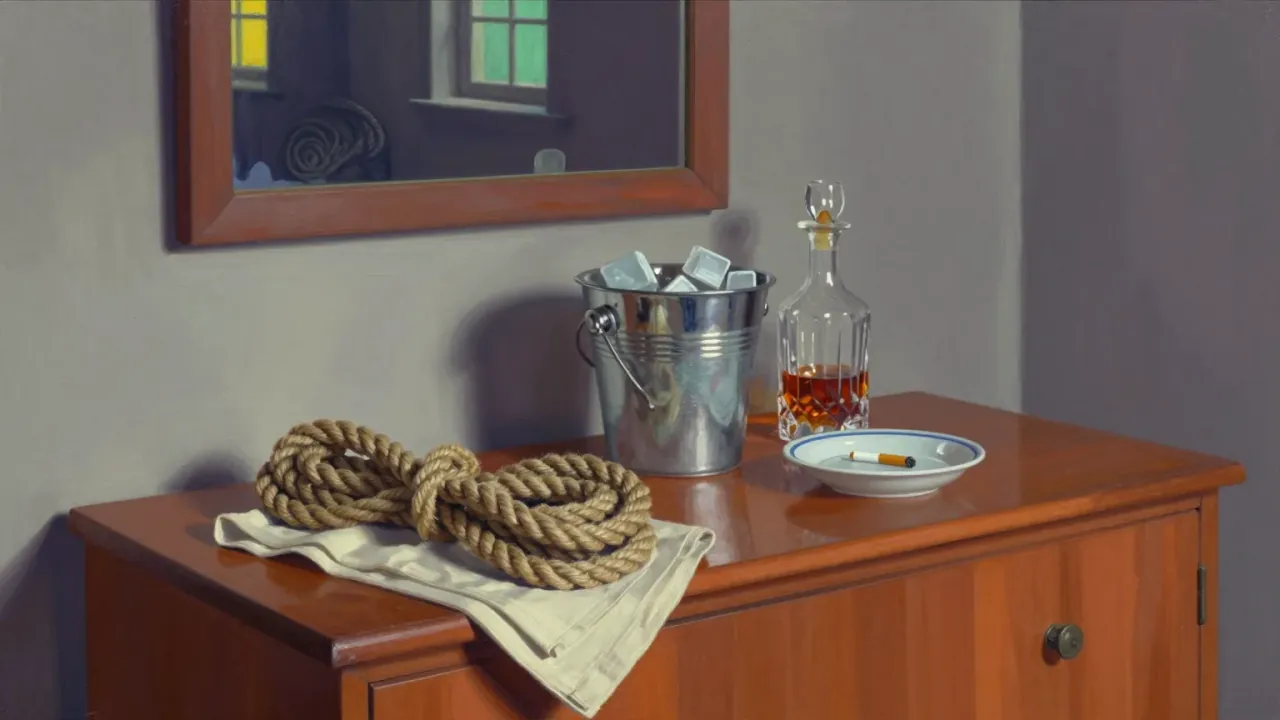
Rope is a 1948 American psychological crime thriller, Hitchcock’s first Technicolor film and the inaugural production of Transatlantic Pictures. It attempts a sustained formal experiment: to present its entire narrative — a post-murder dinner party in a Manhattan penthouse — as if filmed in real time and in continuous takes. The film adapts Patrick Hamilton’s 1929 stage play, retaining its claustrophobic single-set structure and intellectual premise: two men commit murder not for gain or passion but as an aesthetic and philosophical assertion of superiority. Hitchcock and his collaborators sought to collapse cinematic time and space — using long, choreographed camera movements, movable walls, and hidden cuts — to generate tension through constraint rather than editing rhythm. The ambition is structural as much as dramatic: to make form inseparable from theme, so that the unbroken surface mirrors the characters’ suppressed guilt and the illusion of control. It is not a naturalistic thriller but a chamber piece built on theatrical discipline and technical audacity — a deliberate provocation to film grammar itself. (158 words)
The weight of speech
The story unfolds over eighty minutes in one apartment, with dialogue driving revelation rather than action. James Stewart plays Rupert Cadell, the former schoolmaster whose Nietzschean musings seeded the killers’ ideology; John Dall and Farley Granger embody Brandon and Phillip with tightly calibrated contrast — one voluble and performative, the other fraying under drink and conscience. Joseph A. Valentine and William V. Skall’s cinematography sustains the illusion of continuity through precisely timed pans, dollies, and recessive focus shifts, while Perry Ferguson’s art direction constructs a credible, detailed New York skyline behind cycloramic backdrops that shift imperceptibly across the evening. David Buttolph’s score remains sparse, mostly underscoring silence or punctuating pauses. William H. Ziegler’s editing hides cuts by pushing into jackets or furniture, though four visible reel-change transitions remain unmasked. The performances are restrained, even muted — Stewart’s Rupert arrives late and observes more than intervenes, while Dall and Granger sustain their roles within tight physical parameters. There is no chase, no confrontation until the final minutes; tension accrues in glances, hesitations, and the slow dimming of light. (159 words)
The slow dimming
What lands is the oppressive intimacy of the setting and the unnerving precision of the staging. The camera’s refusal to cut creates a sense of inescapability — not just for the characters, but for the viewer, who cannot look away or reframe. The penthouse feels lived-in and watchful: ashtrays fill, glasses empty and refill, light bleeds from gold to violet, and city windows darken one by one. Brandon’s arrogance and Phillip’s disintegration gain weight because they unfold without editorial relief — no close-up to signal significance, no cut to release pressure. The cyclical return to the cassone — the chest holding the body — becomes a quiet, inevitable motif, reinforced each time the camera circles back to it. Hitchcock’s use of colour is subdued but deliberate: the warm amber of early evening gives way to cooler tones as moral exposure advances. Even the neon cameo — flashing Hitchcock’s profile in the background — works not as a joke but as a sly punctuation mark, a reminder of authorial presence in a film otherwise obsessed with concealment. The experiment succeeds where it sustains unease through duration, not shock. (157 words)
The hollow centre
What does not land is the emotional resonance of the central relationship between Brandon and Phillip. Their dynamic lacks the psychological texture needed to carry the film’s weight: their bond reads more as rhetorical convenience than lived reality. The script gives them few private moments, and the long-take format leaves little room for subtextual leakage — everything must be spoken, signalled, or physically enacted within tight spatial limits. James Stewart’s Rupert, though compelling, enters too late and speaks too abstractly to anchor the moral pivot; his final intervention feels less like catharsis and more like exposition delivered on cue. The film’s real-time conceit also strains credulity: the sunset progresses too rapidly, the dinner lasts implausibly short, and the guests’ tolerance for Brandon’s provocations borders on passive complicity. Some viewers find the technique distancing rather than immersive — the camera’s mechanical fluency can overshadow character vulnerability. And while the homosexual subtext is legible in gesture and implication, it remains structurally muffled: the censorship constraints of 1948 prevent it from shaping motive, consequence, or resolution. The result is thematic suggestion without dramatic integration. (159 words)
The logic of exception
The themes that matter are control, performance, and the violence of intellectual certainty. Rope treats murder not as pathology but as logical endpoint — a demonstration of will over morality, reason over empathy. Brandon’s belief in his own exceptionality echoes interwar elitism and pre-war fascist rhetoric, refracted through American academic privilege. The penthouse is both stage and cage: every guest is an audience member, every conversation a rehearsal, every silence a withheld truth. The film interrogates how ideas circulate — how a teacher’s offhand remark, repeated and misapplied, can curdle into atrocity. It also explores the limits of perception: Rupert sees enough to suspect, but not enough to act decisively until it is too late; the others see nothing, distracted by manners and small talk. The cyclorama outside — shifting clouds, blinking lights, smoke rising — functions as ironic counterpoint: a vast, indifferent world continuing while four people enact a miniature tragedy indoors. Time itself becomes a theme: compressed, manipulated, and ultimately unreliable — a reminder that ‘real time’ is always a construct, whether on screen or in thought. (158 words)
Who stays in the room
This film is for viewers who value formal rigour over emotional immediacy — those interested in mid-century studio craft, Hitchcock’s technical evolution, or the history of cinematic constraint. It rewards attention to movement, lighting shifts, and compositional recurrence. Students of adaptation, theatre-to-film translation, or 1940s censorship will find it richly instructive. It is not for viewers seeking narrative propulsion, psychological depth, or moral clarity: the characters remain archetypes, the stakes intellectual rather than visceral, and the resolution perfunctory. Those who dislike static framing, minimal scoring, or dialogue-driven tension may find it inert. Some critics argue the experiment overshadows the drama — a view shared by Stewart himself, who later called it ‘worth trying’ but ‘didn’t work’. Others contend its austerity is precisely its strength. What would change the verdict? A tighter script that deepens Phillip’s interiority, or a bolder handling of the subtext — neither of which the Production Code would have permitted in 1948. Its limitations are historical, not incidental. (159 words)
Why it endures
Yes, it is worth your evening — but only if you approach it as a document of cinematic thinking, not as entertainment. Its eighty minutes pass with deliberation, not urgency; its rewards are architectural, not emotional. You will not gasp, but you may pause to watch how a chair is moved aside, how a curtain falls into shadow, how light bleeds across a wall. It repays slow viewing, ideally with awareness of its constraints: the ten-minute magazine limit, the rolling walls, the unspoken rules of 1940s Hollywood. Those expecting suspense in the conventional sense — chases, reveals, crescendos — will leave unsatisfied. But if you are curious about how film language conveys unease without music or cutting, or how ideology manifests in posture and pacing, then Rope holds quiet, enduring power. Its flaws are baked into its ambition — and its endurance proves that ambition mattered. It is not flawless, but it is unmistakably, rigorously itself. (159 words)