The premise
Black Sun is a 1964 Nikkatsu drama that attempts to fuse postwar Japanese social realism with existential allegory, using the encounter between a young Japanese thief and a fugitive African-American soldier as its central axis. It does not aim for historical fidelity or procedural accuracy but instead treats the Occupation-era setting as a charged, liminal space where nationality, race, and language collapse into raw, unmediated human contact. The film builds on Kurahara’s earlier work—particularly The Warped Ones—but shifts from juvenile delinquency as rebellion to delinquency as drift: Akira is less defiant than dislocated, moving through ruined churches, junk shops, and empty streets without institutional anchor. Its ambition lies in rendering political violence as ambient pressure rather than plot engine, and in treating jazz—not as cultural export but as shared sonic vulnerability—as both bridge and barrier between two men who cannot speak each other’s language. It tries, deliberately, to hold contradiction: intimacy without understanding, solidarity without resolution, hope without deliverance.
The structure
The story unfolds in tight, episodic units: theft, discovery, flight, companionship, confrontation, ascent, release. Tatsuya Fuji plays Akira with minimal inflection—his face rarely opens beyond watchfulness or fatigue—and Hideji Ōtaki’s Old Man of the Junk Shop appears only twice, each time delivering a line that lands like a stone dropped into still water. Tamio Kawachi’s Akira is more physically reactive, his gestures abrupt, his silences thick with suspicion; Chico Roland’s Gill moves with a contained physicality that reads less as performance than endurance. Gordon Willis did not shoot this film—Tadashi Iimura did—and the cinematography favours high-contrast monochrome, with deep shadows pooling under eaves and across rubble. Toshiro Mayuzumi’s score is sparse, often absent; Max Roach’s drumming appears only diegetically, on the record player, then again as vocalised lament. Editing avoids continuity logic: cuts land on duration, not cause. A shot of Monk the dog lying dead lasts twelve seconds. No music swells. No close-up follows. The craft insists on withholding interpretation.
The performances
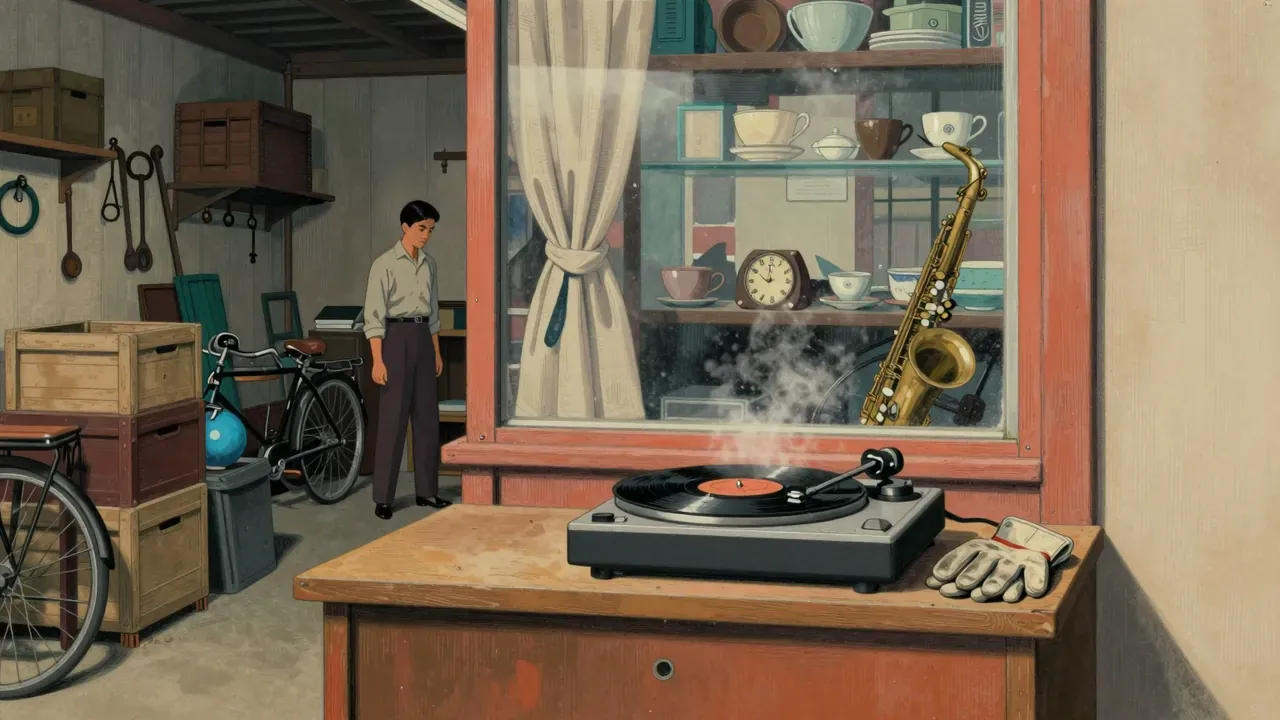
What lands is the weight of silence between the two men—not as absence, but as active, negotiated space. Their walk toward the sea is filmed at mid-distance, no dialogue, no score, just wind noise and uneven footsteps on broken asphalt; it feels less like a journey than a slow convergence of rhythms. The balloon sequence works because it refuses spectacle: the rigging is visible, the rope frays visibly before Akira cuts it, and Gill’s final posture is neither heroic nor resigned but matter-of-fact, almost bureaucratic. The film’s treatment of jazz also lands: ‘Six Bits Blues’ is heard three times—first as bright vinyl crackle, second as violent interruption, third as guttural, off-key singing—and each iteration recalibrates the emotional register without explanation. The church interior, half-collapsed, functions as both shelter and sarcophagus; its geometry frames characters in ways that suggest containment rather than sanctuary. These are not flourishes but structural choices, repeated and sustained. The film earns its austerity by never mistaking emptiness for meaning—it fills negative space with implication, not metaphor.
The music
What does not land is the framing device of civil insurrection. The riots appear abruptly, without context or consequence: no slogans, no faces in crowd, no aftermath beyond a single burned-out car. They serve only as pretext, not pressure, and their political indeterminacy drains them of urgency. Similarly, the American soldier’s injury—a bullet wound that never bleeds, never festers, never impedes movement—functions as narrative convenience, not bodily truth. The film avoids medical realism so thoroughly that the wound begins to read as symbolic shorthand, but the symbolism is never anchored: we do not know if it was self-inflicted, accidental, or inflicted by someone else, and the film declines to clarify. The MP encounter at the end arrives without buildup or geography—no uniforms, no radios, no sense of chain of command—making their appearance feel like a theatrical curtain drop rather than dramatic culmination. These are not omissions but evasions, and they leave thematic threads dangling without tension.
The ending
The themes that matter are translation as failure, not deficit; loyalty as improvisation, not allegiance; and freedom as vertical escape, not horizontal movement. The film treats language not as a tool to be mastered but as a surface across which meaning skids, sometimes catching, sometimes not. Akira’s attempt to communicate via jazz record is not naïve—it is the only medium he possesses that carries affect without syntax. The balloon is not fantasy but literalisation: when grounded speech fails, ascent becomes the only remaining grammar. Race enters not as identity politics but as phenomenological difference—the way Gill’s skin registers light differently in the same frame, the way his voice occupies acoustic space with different resonance. Time is treated as non-linear: the ruined church holds past and present simultaneously; the record player spins forward while the characters move backward, then sideways, then upward. There is no nostalgia here, no mourning for lost order—only attention to how bodies persist, adapt, and briefly align in spaces abandoned by authority.
The audience
This film is for viewers who value sustained tonal discipline over narrative payoff, who find emotional resonance in withheld gesture and deliberate pacing, and who are comfortable sitting with ambiguity that never resolves into irony or catharsis. It rewards attention to texture—the grain of film stock, the rust on metal, the way light falls on concrete—and assumes familiarity with Japanese New Wave conventions: elliptical plotting, anti-psychological characterisation, rejection of moral binaries. It is not for those seeking exposition, psychological motivation, or closure. Anyone expecting a war film, a buddy drama, or a racial parable will find it withholding. Those who prefer narrative propulsion over atmospheric accumulation will grow restless by the thirty-minute mark. A viewer who values clarity of intent over density of implication would reasonably reject it—not as flawed, but as misaligned. Change the editing rhythm or add voiceover narration, and the film’s central proposition—that meaning resides in what is not said—would collapse.
The viewing
Yes, it is worth your evening—if you approach it as a study in restraint, not a story to be followed. Its ninety-five minutes pass without hurry, but never without purpose: every shot serves the film’s quiet insistence that connection need not require comprehension. It repays rewatching not for hidden clues but for subtle shifts in posture, lighting, or sound placement—details that accrue significance only in retrospect. Those who dislike it tend to cite its refusal to explain itself, but that refusal is its method, not its flaw. To call it ‘slow’ mistakes economy for inertia; to call it ‘obscure’ mistakes precision for vagueness. It is not for casual viewing, but it is for attentive viewing—and there is a growing scarcity of films that trust the audience to sit with silence, to accept uncertainty as atmosphere rather than problem. If your evening demands resolution, momentum, or affirmation, this will disappoint. If it permits contemplation, then Black Sun offers something rare: a film that treats humanity as a condition, not a conflict.