What the Baron stands for
The Adventures of Baron Munchausen is a late-1980s fantasy film that adapts the 18th-century tall tales of Hieronymus von Münchhausen—not as period satire or literary pastiche, but as a self-conscious argument for storytelling as resistance. It positions the Baron not as a fraud to be unmasked, but as a necessary counterweight to bureaucratic literalism: his lies are tools of survival, weapons against entropy and authority. Terry Gilliam and Charles McKeown structure the film around an elderly Baron whose credibility has collapsed in a besieged city; when reality becomes too rigid to bear, he must reassemble his old crew—Moon, Death, Venus—to stage a rescue mission across impossible geographies. The film’s ambition is structural as much as thematic: it builds a world where physics yields to narrative logic, where visual invention replaces exposition, and where the act of telling a story is itself the plot’s engine. It belongs to Gilliam’s ‘Trilogy of Imagination’, but unlike Time Bandits or Brazil, it locates wonder not in childhood or midlife escape, but in senescence—where memory, myth and mortality blur into one sustained, ornate gesture. (158 words)
The look of it
The story unfolds in episodic, loosely connected set-pieces: a voyage inside a cannonball, a descent into the Moon’s crater, a confrontation with the personified forces of Reason and War. John Neville plays the Baron with weary authority, his voice a dry instrument of conviction; Sarah Polley, aged nine, gives a performance of startling physical commitment as Sally, the sceptical child who becomes the film’s reluctant anchor to plausibility. Eric Idle, Jonathan Pryce and Oliver Reed inhabit their roles with theatrical precision, never winking at the audience but playing each absurdity straight. Giuseppe Rotunno’s cinematography favours deep focus and painterly composition—interiors glow with candlelight and dust motes, exteriors tilt and recede like stage flats. Dante Ferretti’s production design layers baroque detail without clutter: every prop feels hand-carved, every costume stitched with purpose. Michael Kamen’s score avoids leitmotif in favour of shifting orchestral textures—brass swells into chaos, strings fray at the edges. The craft is cumulative: no single element dominates, but together they sustain a world where disbelief is not suspended so much as politely excused. (159 words)
Where it holds true
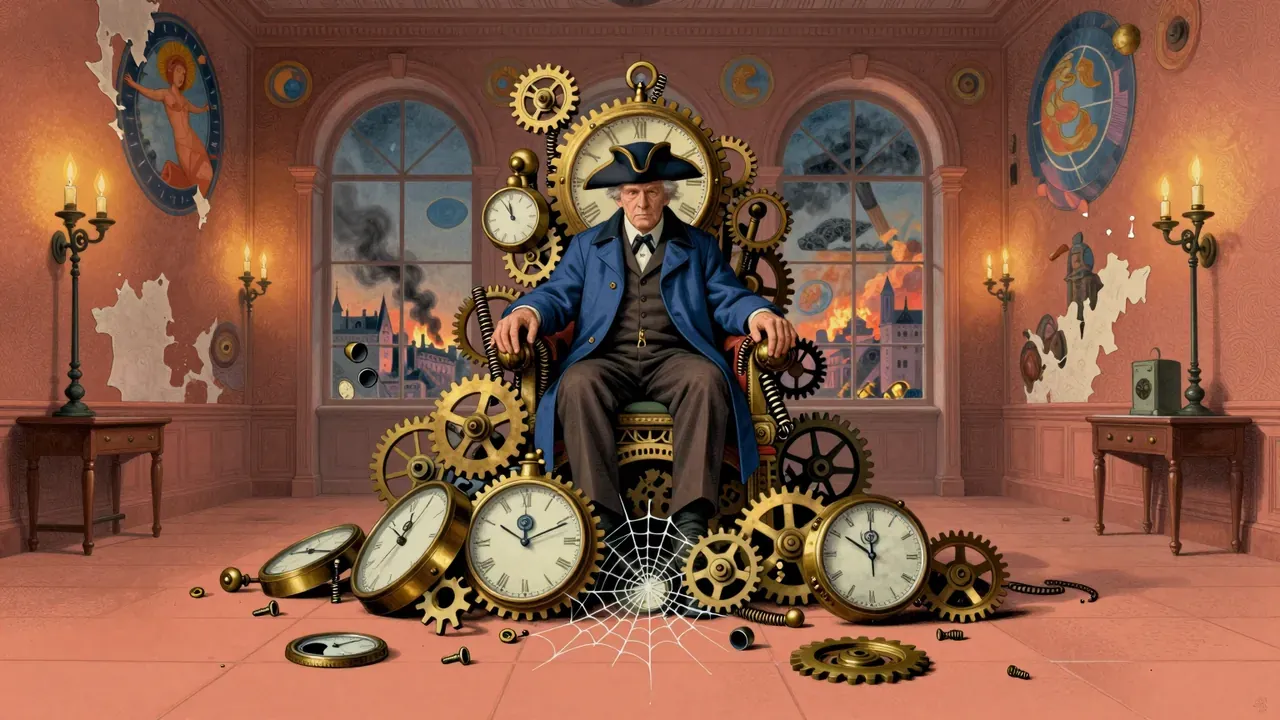
What lands most firmly is the film’s tactile conviction—the sense that every frame was built, not rendered. The Moon sequence, with its chalky, weightless surfaces and silent, floating figures, remains singular in mainstream fantasy cinema: it does not simulate zero gravity so much as invent a new grammar for it. The siege of the city works not as action but as allegory—cannon fire arrives with the dull thud of bureaucracy, not spectacle. The Baron’s final speech to the Council of Reason, delivered while seated on a throne of broken clocks, lands with quiet force because it refuses irony: it is both sincere and knowingly theatrical. The film’s best moments hinge on scale shifts—Sally shrinking to enter a pocket watch, the Baron stepping out of a painting—each executed with practical effects that retain their handmade imperfection. These are not nostalgic choices but formal ones: the visible seam between matte painting and live action becomes part of the film’s argument about artifice. Even the casting of Robin Williams as the King of the Moon—a role cut from the final release but present in early versions—suggests a deliberate refusal of star power in favour of tonal consistency. What endures is not spectacle, but syntax: how the film constructs meaning through juxtaposition, texture and stubborn physicality. (157 words)
Where it slips
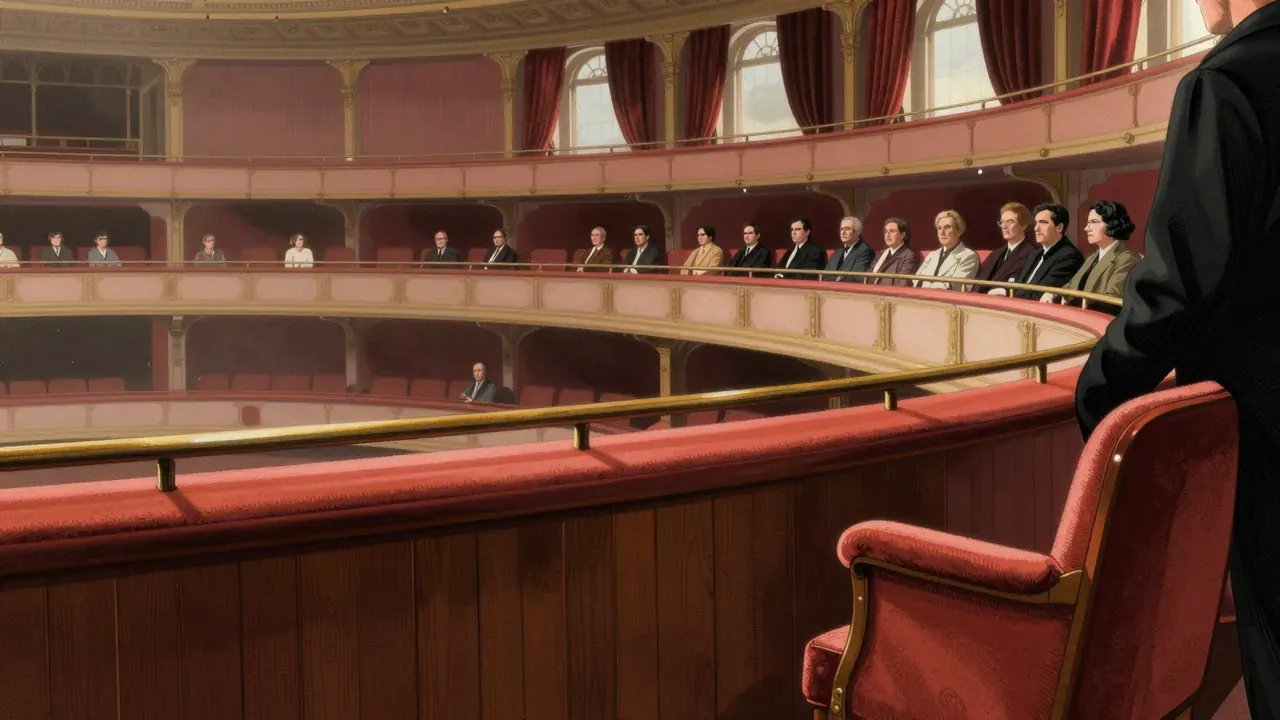
What does not land is the film’s middle third: the journey through the Underworld feels structurally adrift, its transitions abrupt and its stakes diffuse. The character of Vulcan, played by Sting, exists more as a visual motif than a functional presence—his forge scenes add texture but no narrative traction. Uma Thurman’s Venus, though luminous, remains underwritten; her function is symbolic rather than dramatic, and the film offers no space for her to accrue agency beyond her iconographic role. The satire of Enlightenment rationalism—embodied by Pryce’s pompous narrator—lacks the bite of Brazil’s Ministry of Information: it gestures toward critique without developing it into coherent opposition. Some performances suffer from the production’s documented exhaustion: Oliver Reed’s scenes carry a palpable fatigue that reads less as character and more as attrition. The film’s refusal of conventional pacing also works against it in places—the long static shot of the Baron recounting a tale, while formally bold, tests attention without yielding new insight. Most damagingly, the film’s insistence on its own mythic status occasionally tips into self-regard: the framing device of the storyteller in the theatre feels less like a structural echo and more like a hedge against interpretation. It wants to be both fable and anti-fable, and in trying to hold both positions, it loosens its grip on either. (158 words)
What it says about time
The themes that matter are not those of adventure or whimsy, but of narrative sovereignty and temporal resistance. The film treats time not as linear progression but as a contested terrain: clocks are dismantled, calendars ignored, histories rewritten mid-sentence. Ageing is neither sentimentalised nor pathologised—it is presented as a form of accumulated knowledge that society dismisses as delusion. The Baron’s stories are not lies in the moral sense, but acts of epistemic defiance: each tale asserts that reality can be remade through assertion alone. This sits alongside a quieter meditation on care—Sally’s loyalty is not earned through heroism but through shared vulnerability, and the Baron’s dependence on her is never disguised as paternalism. The film also engages with colonial fantasy, but obliquely: the Ottoman siege is backdrop, not subject, and the Baron’s exploits against them are framed as theatrical bravado, not conquest. Its real political concern is institutional inertia—the way systems calcify language, suppress ambiguity, and punish deviation. That makes it less a children’s film than a gerontological one: it speaks to those who have lived long enough to see their truths dismissed as nostalgia, and who still insist on telling them anyway. (156 words)
Who it is for
This film is for viewers who value world-building over plot propulsion, who find pleasure in the weight of a prop, the grain of a painted backdrop, the rhythm of a deliberately paced dissolve. It rewards patience with density: repeated viewings reveal new layers of visual reference, from Piranesi to Bosch to early cinema trickery. It is not for those who require narrative clarity, emotional shorthand or psychological realism—its characters are archetypes first, people second. Those put off by slow pacing, unresolved subplots or overt theatricality will find little purchase here. Some critics and audiences have rejected it precisely for its refusal of accessibility, mistaking its formal rigour for indulgence. A viewer who values tight plotting over textural richness would reasonably dislike it; a preference for digital polish over practical artifice would also make it alienating. But none of this changes its coherence on its own terms: it is not flawed because it is difficult, but difficult because it insists on its own logic. (159 words)
Is it worth your evening?
Yes, it is worth your evening—but only if you approach it as a crafted object, not a story to be consumed. Its 126 minutes unfold with the deliberation of a clockmaker assembling a chronometer: every gear must mesh, every spring be wound to tension. To watch it expecting momentum is to misunderstand its architecture. It repays attention not with revelation but with accumulation—the gradual recognition of how light falls on plaster, how a costume’s embroidery echoes a mural’s pattern, how silence functions as punctuation. Those who find joy in such details will leave with a heightened sense of how films construct belief. Others may feel stranded in its ornate corridors. Its value does not lie in universality but in specificity: it is a singular statement about imagination as labour, not escape. No amount of restoration or reissue could make it ‘easier’ without hollowing it out—and that is its strength, not its failing. (159 words)