The look of it
Boy Meets Girl is Leos Carax’s first feature, a black-and-white French drama set in a heat-hazed Paris of cramped apartments, street-level eavesdropping, and stalled young lives. It tries to map the emotional topography of post-adolescent disillusionment—not through plot mechanics but through accumulation: glances held too long, tape-deck hiss bleeding into silence, conversations overheard then misread. Carax treats romantic longing as a physical condition, something that alters posture, slows footsteps, distorts time. The film does not aim for narrative resolution but for tonal fidelity—to the weight of unreturned love, the absurdity of military conscription looming over a life with no fixed address or occupation. Its ambition is stylistic and atmospheric: to render interior states visible without exposition, using composition, sound design, and performance rhythm as primary tools. It assumes familiarity with the grammar of French New Wave cinema—not as homage but as inherited syntax. This is not a story about meeting; it is about mishearing, mistaking, misplacing hope across thin walls and thinner connections. (158 words)
The sound of it
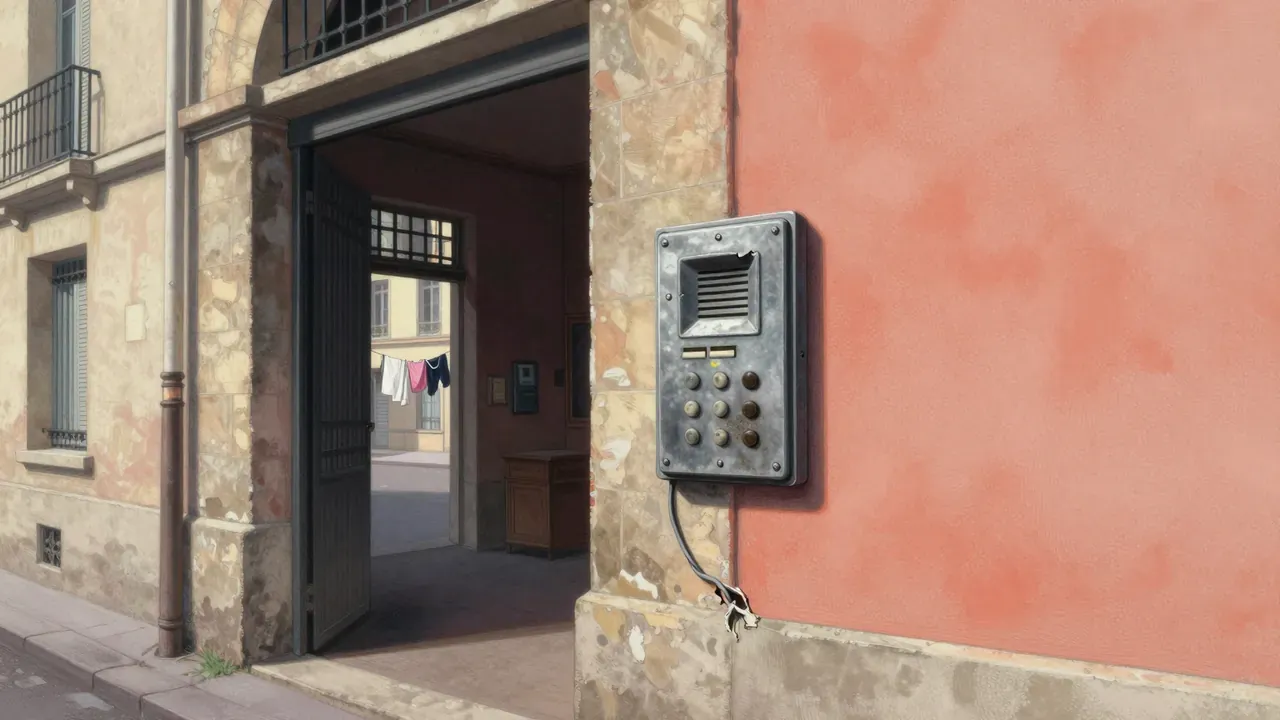
The story follows Alex, a man adrift after abandonment, and Mireille, a woman rehearsing self-erasure. Their paths cross via architectural accident—shared stairwells, intercom static, a dropped invitation—and never quite align. Denis Lavant moves with coiled stillness, his face registering shifts in mood like light changing on concrete. Mireille Perrier’s performance is quieter but more structurally vital: her tap-dancing interlude, her monologue in the bathroom, her final collapse—all land because they are underplayed, not declaimed. Jean-Yves Escoffier’s cinematography keeps interiors dim and exteriors washed out, favouring shallow focus and tight framing that trap characters in corners of the frame. Editing by Nelly Meunier and Francine Sandberg uses abrupt cuts and extended takes in equal measure, refusing to smooth transitions between thought and action. Sound is sparse: diegetic tape recordings, distant traffic, the clink of cutlery at a funeral party. There is no score beyond what Alex carries in his Walkman. Every craft choice serves the film’s central tension: intimacy as proximity without access. (159 words)
The weight of it
What lands most firmly is the film’s texture of suspended time—the way a single afternoon can stretch across twenty minutes of pavement-walking, or how a whispered conversation through a door becomes more charged than any kiss. The apartment-block acoustics function as a character: voices bleed, intentions blur, privacy dissolves. Lavant’s physical presence anchors the film’s drifting logic; his slouch, his habit of staring just past people, his fumbling attempts at grand gestures—all feel lived-in rather than performed. Perrier’s late-night tap routine, shot in near-darkness with only her feet lit, lands precisely because it refuses to signify: it is neither catharsis nor breakdown, just movement as habit. The black-and-white photography avoids nostalgia; its grain feels tactile, immediate, like newsprint left in damp air. The film’s refusal to moralise Alex’s shoplifting or Mireille’s self-harm gives both acts weight without explanation. Even the ending—brutal, abrupt, unexplained in motive—lands because it follows from the film’s established logic: bodies fail when language and gesture have already failed. Nothing here is earned, only accumulated. (157 words)
The logic of it
What does not land is the film’s structural reliance on coincidence as narrative engine. The intercom eavesdropping, the dropped invitation, the unlocked apartment door—all hinge on chance so precise it strains credulity without irony or self-awareness. Carax does not treat these moments as absurd, nor does he undercut them; they simply happen, and the film expects the viewer to absorb them as inevitable. The military service subplot remains vague, its stakes undefined beyond bureaucratic inconvenience, making Alex’s evasion at the station feel unmotivated rather than defiant. Some performances falter under the weight of stylisation: Christian Cloarec’s Bernard reads as sketchy rather than enigmatic, and Hans Meyer’s brief appearance lacks sufficient grounding to register as anything but decorative. The Godardian monologues—especially Alex’s rambling declaration of love—risk sounding like notes toward a better script rather than fully realised speech. The film’s resistance to exposition works against itself in places: we never learn why Florence left Alex, or what Mireille’s ‘failed romance’ entailed, and the omission begins to feel like avoidance rather than restraint. (156 words)
The architecture of it
The themes that matter are not love or loss in the abstract, but the architecture of failure: how small spaces shape behaviour, how sound travels through brick, how ambition curdles when detached from means. The film treats memory as unreliable infrastructure—Alex’s farewell letter is written, delivered, and ignored; Mireille’s past is relayed in fragments that contradict one another. Military service stands in not for national duty but for institutional erasure: a system that demands presence while offering no role. The party commemorating a dead brother introduces telepathy as a failed ideal—communication without mediation, which the film repeatedly demonstrates is impossible. Tap-dancing, shoplifting, filmmaking-as-title-generation: all are forms of assertion without consequence, gestures made into voids. Even the film’s black-and-white palette functions thematically: it denies colour as metaphor, insisting instead on contrast, grain, surface. There is no psychological depth beneath the skin of things—only surfaces reflecting other surfaces, voices echoing down stairwells, scissors concealed beneath cloth. The film’s central concern is not what people feel, but how feeling becomes legible—or illegible—within shared, flawed structures. (159 words)
The rhythm of it
This film is for viewers who value texture over trajectory, who find resonance in duration rather than revelation, and who recognise that a film can be emotionally exact without being psychologically explanatory. It suits those familiar with early French New Wave pacing and willing to sit with ambiguity as a condition rather than a problem to solve. It is not for viewers who require causal clarity, narrative payoff, or character motivation spelled out. Those expecting romance as genre—meet-cute, conflict, resolution—will find its title bitterly ironic. Nor will it serve viewers allergic to stylistic homage: the film’s visual and rhythmic debt to Godard and Truffaut is structural, not decorative, and cannot be skimmed. A viewer who values strong plotting over atmosphere, or who finds prolonged silence oppressive rather than charged, should look elsewhere. The film’s power depends on patience with its rhythms; without that, it registers as inert rather than deliberate. Its appeal is narrow but deep—not a gateway film, but a touchstone for a specific sensibility. (158 words)
The end of it
Yes, it is worth your evening—if you approach it as a study in cinematic tone rather than a story to be followed. Its ninety minutes accumulate a quiet, persistent gravity: the weight of unspoken things, the fatigue of being perpetually misread. It repays attention to detail—the way light falls on a staircase railing, the timing of a cassette rewinding, the hesitation before a knock on a door. Those who dislike films where nothing much happens on the surface may leave frustrated, but the surface here is the substance. It is not for fans of conventional narrative propulsion, nor for those who need closure or catharsis. A viewer who values emotional precision over plot momentum, or who finds beauty in unresolved tension, will find it richly rewarding. Its endurance lies not in what it says, but in how insistently it holds a single, fragile mood—like holding breath underwater, knowing the surface is near but refusing to break. (157 words)