The length of the journey
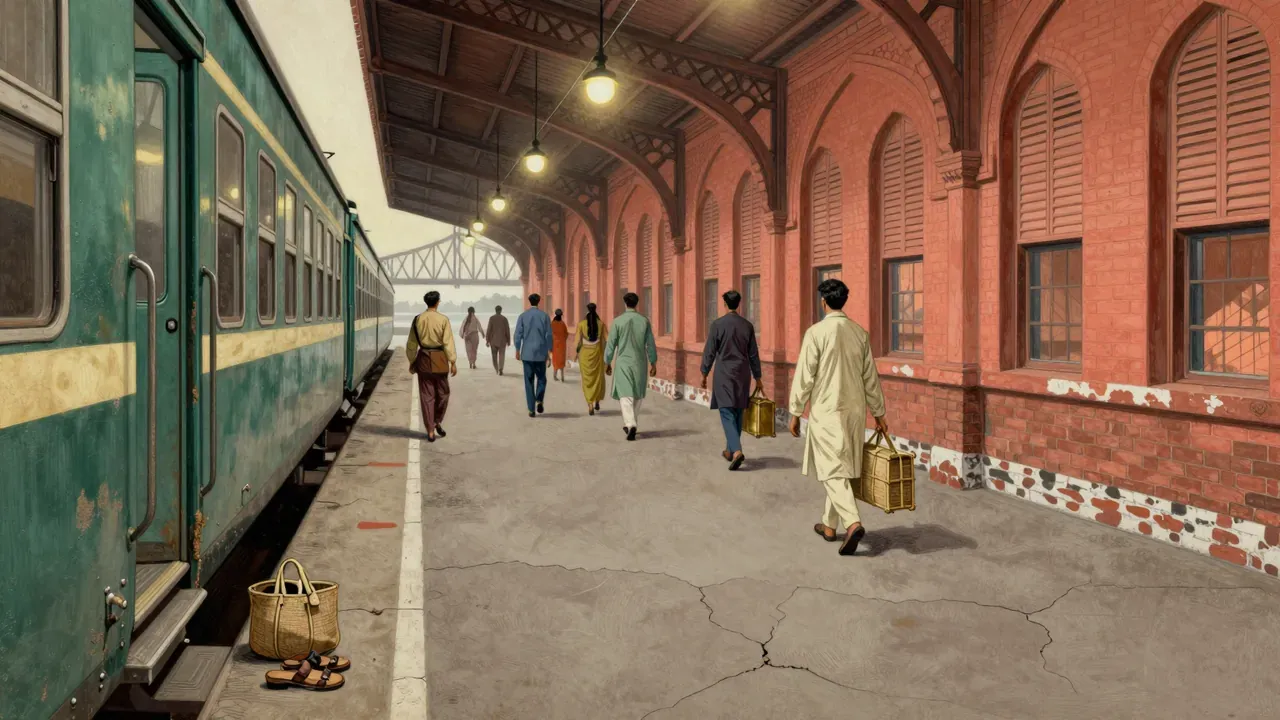
Nayak is a psychological portrait in real time: a matinee idol’s 24-hour train journey from Kolkata to Delhi, framed as a slow unspooling of self under scrutiny. Satyajit Ray wrote it as his second wholly original screenplay, after Kanchenjungha, and made it to explore how public persona and private failure coexist without resolution. The film does not seek to diagnose or redeem its protagonist; it refuses the arc of transformation. Instead, it holds space for contradiction — charm and cowardice, fame and isolation, control and collapse — all within the confined geography of a moving train. Ray built the narrative around duration and proximity: the enforced stillness of rail travel becomes the condition for honesty neither character expects nor fully controls. There is no plot device, no external threat, no third-act reversal. What happens is what is said, how it is said, and what remains unsaid between pauses. The film’s ambition is structural and ethical: to treat celebrity not as spectacle but as subject, and to ask whether empathy can arise without judgment — or even without understanding.
The weight of the pause
The story unfolds in three overlapping registers: Arindam’s monologues to Aditi, the peripheral lives of fellow passengers, and the physical texture of the train itself — its light, its sound, its sway. Uttam Kumar performs with granular restraint: no grand gestures, no theatrical breakdowns, just shifts in breath, posture, and eye contact that accumulate into something unmistakably vulnerable. Sharmila Tagore matches him with quiet precision — her Aditi is neither naive nor cynical, but observant enough to recognise when listening becomes complicity. Subrata Mitra’s cinematography keeps the frame tight and grounded: shallow focus on faces, long takes in the dining car, rear-projected landscapes that blur past like half-remembered dreams. Dulal Dutta’s editing avoids punctuation — scenes bleed rather than cut, preserving the rhythm of thought mid-flow. Satyajit Ray’s score is sparse, mostly piano motifs that recur like hesitant memories. The art direction — Bansi Chandragupta’s meticulously built train compartment — feels lived-in, not symbolic: every object, from the shaving brush Ray selected after sixty rejections to the water glass Kumar dips his pen into, exists at human scale, not allegorical weight.
The shape of confession
What lands is the cumulative weight of small admissions: Arindam’s refusal to help an old colleague, his guilt over abandoning theatre for film, his fear that his latest movie has failed. These are not confessions meant to elicit forgiveness, but fragments of self that gather force through repetition and context. The film’s emotional logic rests on the viewer’s willingness to sit with discomfort — not the discomfort of violence or suspense, but of recognition: how often we perform competence while privately doubting our own foundations. The parallel passenger stories — the executive with his sick daughter, the advertising man using his wife as leverage, the elderly letter-writer railing against cinema — do not resolve, but they anchor Arindam’s anxieties in a wider social fabric. The train itself lands as both setting and metaphor: a vessel moving forward while everyone inside remains suspended, unable to exit or arrive until the final station. Even the water-glass moment — improvised, uncorrected — lands not as quirk but as proof: this is acting as lived behaviour, not staged revelation.
The absence of catharsis
What does not land is any sense of catharsis or closure. The film resists the expectation that exposure leads to change. Arindam does not reform, Aditi does not publish her notes, and their bond dissolves at the platform without promise of continuation. Some viewers may find this withholding unsatisfying — particularly those accustomed to narrative payoffs or moral clarity. The pacing, too, will test patience: long silences, repeated glances, extended shots of hands or windows that offer no exposition. The film assumes attention, not explanation. It also assumes familiarity with the cultural weight of Uttam Kumar — not as actor, but as phenomenon — which non-Indian audiences may lack without context. Without that subtext, some of Arindam’s exhaustion may read as mere petulance rather than the fatigue of sustained performance. And while Ray’s refusal to romanticise celebrity is rigorous, it risks flattening Aditi’s agency: she listens, questions, hesitates, but her interior life remains deliberately opaque, a choice that serves the film’s focus but may leave some viewers wanting more reciprocity.
The grammar of detail
The themes that matter are self-deception, the labour of image-making, and the asymmetry of intimacy. Arindam’s monologues are not truth-telling so much as truth-testing: he tries out versions of himself to see which one sticks, which one might be believed. The film treats fame not as reward but as erosion — a slow wearing away of privacy, memory, and even grammar, as language becomes habit rather than expression. Class appears obliquely: in the way Arindam speaks to porters versus producers, in Aditi’s magazine’s modernist typography versus the elderly man’s handwritten letters to editors. Ageing is present not as decline but as accumulation — of regrets, of compromises, of roles adopted and discarded. Ambition surfaces not as drive but as residue: what remains after the applause fades and the next script arrives. And journalism — Aditi’s profession — is shown not as exposé but as encounter: the ethics of witnessing without exploiting, of holding space without claiming ownership. These are not abstract ideas; they are embedded in gesture, lighting, framing, and silence.
The condition of watching
This film is for viewers who value duration over delivery, who find tension in hesitation rather than action, and who trust that a face held in medium close-up for twenty seconds can carry more narrative weight than a chase sequence. It is for those familiar with Indian cinema’s history, or willing to learn it on the film’s terms. It is not for viewers who require clear stakes, resolved arcs, or explicit moral framing. Those who expect satire of celebrity will be disappointed; Nayak offers no mockery, only gravity. Those who need visual dynamism — rapid cuts, saturated colour, expressive camera movement — may find Mitra’s restrained compositions inert. And those unfamiliar with Bengali cultural context may miss the quiet significance of references to Shankar-da or the Rajdhani Express’s status in 1965. A viewer who values psychological realism over plot mechanics, and who accepts that some questions remain open-ended, will find Nayak richly rewarding. Anyone needing resolution will not.
The measure of an evening
Yes, it is worth your evening — provided you give it your full attention, not as background or multitasked viewing. Its 113 minutes unfold at the pace of thought, not event, and demand presence: the rustle of a newspaper, the clink of a spoon, the shift of weight in a seat are all part of the film’s architecture. It rewards rewatching, not for hidden clues but for new inflections — a pause before a line, a glance away from the camera, the way light falls across Kumar’s forehead in the final carriage shot. Those who dismiss it as ‘slow’ misunderstand its method: it is not withholding information, but calibrating perception. Someone who prefers tightly plotted dramas or visually flamboyant filmmaking may find it austere. But for anyone interested in how identity is performed, sustained, and occasionally cracked open — and in how cinema can hold that fragility without fixing it — Nayak remains singular. Its value lies not in what it solves, but in how honestly it sits with what cannot be solved.