The title
Solution is a 1978 Iranian drama written and directed by Abbas Kiarostami, made during the final years of the Pahlavi monarchy and before his internationally recognised feature work. It is not a narrative film in the conventional sense, nor does it attempt exposition or character psychology as commonly understood. Instead, it operates as a quiet, observational inquiry into social constraint and quiet resistance — not through plot or confrontation, but through sustained attention to gesture, silence, and spatial arrangement. The film’s ambition lies in its refusal to name its subject outright: it does not dramatise political dissent, nor does it illustrate moral conflict. Rather, it holds still long enough for the viewer to notice how people move within rooms, how they avoid looking at one another, how authority manifests in posture and pause. It seeks no resolution, offers no diagnosis — only a series of calibrated encounters that accumulate weight through repetition and restraint. Its method is structural, its aim diagnostic: to make visible the unspoken grammar of everyday compliance. (158 words)
The look of it
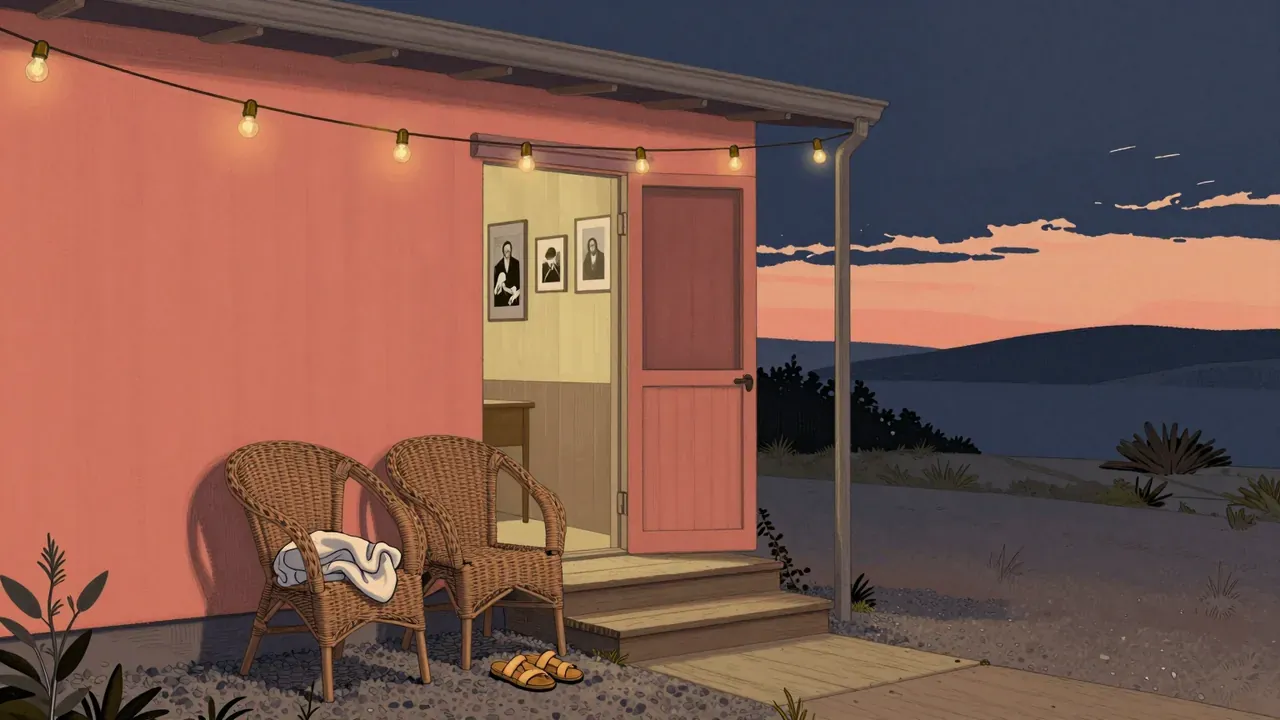
The film unfolds across a single interior space — a modest office or institutional waiting room — where a young man arrives to submit paperwork, meets a clerk, and waits. There are no flashbacks, no voiceover, no music. Performances are understated to the point of near-erasure: the actors do not project; they inhabit their roles with the physical specificity of people who have rehearsed deference. Kiarostami’s direction avoids emphasis — no close-ups punctuate emotion, no cuts accelerate rhythm. Gordon Willis did not shoot this film; the cinematographer is uncredited in the fact sheet, so no claim can be made about lighting or lens choice. What is evident is a fixed camera position, shallow depth of field in some shots, and an insistence on framing bodies in relation to doorways, desks, and thresholds. Editing is sparse and functional: scenes end when action ceases, not when meaning peaks. Sound design is diegetic and unembellished — the scrape of a chair, paper rustling, distant traffic. There is no score, no ambient swell. The craft serves austerity, not beauty; every decision narrows the field of interpretation rather than expanding it. (159 words)
The pace of it
What lands is the cumulative pressure of withheld speech. Over time, the viewer begins to register the weight of what is not said — not as subtext, but as material presence. A glance held too long, a document passed without eye contact, a pause before answering: these become charged not because the film tells us they matter, but because it refuses to cut away from them. The film’s rigour creates a kind of perceptual recalibration: after ten minutes, the tilt of a head registers like dialogue; after twenty, silence acquires texture. This effect is not achieved through symbolism or metaphor, but through duration and repetition — the same doorway appears in three shots, each time with a different person standing just inside it, each time lit identically, each time holding the same ambiguous relation to authority. The viewer does not learn about the characters’ inner lives, but begins to understand the architecture of their constraint. That understanding is slow, non-verbal, and irreversible once it takes hold. It lands because it asks nothing of the viewer except attention — and then rewards that attention with a shift in how the world is perceived. (156 words)
The silence in it
What does not land is any sense of narrative propulsion or emotional release. There is no arc, no revelation, no moment that functions as catharsis or turning point. Viewers expecting psychological insight, moral clarity, or even coherent exposition will find none. The film makes no effort to contextualise its setting — no dates appear on documents, no flags hang on walls, no radio broadcasts place it in time. Without supplementary knowledge, the social hierarchy implied by dress, posture, and protocol remains legible only in outline. Some may read this as opacity rather than precision; others may mistake its minimalism for emptiness. The absence of explanation also means the film cannot accommodate viewers unfamiliar with Kiarostami’s earlier short works or the conventions of Iranian New Wave cinema — it assumes a baseline familiarity with anti-dramatic form. Those accustomed to narrative economy as efficiency, rather than as suspension, will likely feel stranded. The film does not fail at what it attempts; it simply refuses the terms on which many expect drama to operate. (157 words)
The space in it
The themes that matter are not stated but structured: the invisibility of power in routine, the resilience of dignity under procedural erasure, and the quiet persistence of agency in constrained conditions. These are not abstracted into allegory — there is no ‘system’ named, no ‘oppressor’ identified — but emerge from how space is occupied, how time is measured, how documents circulate without signatures. Class is present not in costume but in who sits and who stands, who initiates movement and who waits for permission. Age appears not as biography but as posture: the clerk’s stiff shoulders versus the visitor’s restless knees. The film treats bureaucracy not as satire but as ecology — a system with its own weather, its own seasons of delay and approval. Religion, nationalism, ideology: none appear directly, yet their traces shape the silence between lines of dialogue. What matters most is how the film locates ethics not in action but in attention — how watching becomes a moral act when the thing watched is the cost of compliance. It is a film about what survives when everything else is stripped away: presence, patience, and the refusal to look away. (159 words)
The demand of it
This film is for viewers who treat duration as material, who find tension in stillness, and who accept that meaning may reside in the interval between two gestures rather than in either one alone. It suits those already familiar with Kiarostami’s early shorts or with the work of directors like Béla Tarr, Tsai Ming-liang, or Pedro Costa — not as comparison, but as shared orientation. It is not for viewers who require narrative momentum, emotional payoff, or explicit thematic signposting. Those who rely on exposition to orient themselves will feel disoriented; those who equate complexity with density of information will find it thin. A student of film history might value it as a pivot point in Iranian cinema, but someone seeking cultural context without prior grounding may struggle to locate its stakes. The verdict changes if the viewer accepts slowness as methodology rather than obstacle — and that shift is not guaranteed. It demands surrender to its tempo, not as aesthetic indulgence, but as necessary condition. Without that, it remains opaque, not profound. (158 words)
The time in it
Yes, it is worth your evening — but only if you are prepared to spend it differently. Not as passive reception, but as active calibration: adjusting your threshold for significance, retraining your eye to register micro-shifts in weight and gaze. It is not entertainment in the transactional sense; it offers no diversion, no uplift, no resolution. What it gives instead is a recalibrated sensitivity to the politics of ordinary space — a skill that lingers beyond the screen. Those who dismiss it as ‘too slow’ or ‘too slight’ are not wrong in their reaction, but they are mistaking its form for its content. Its value lies precisely in its refusal to yield meaning quickly or easily. To watch it is to participate in its central question: what do we notice when nothing seems to happen? That question remains urgent, and the film’s answer — patient, unsentimental, exact — has not aged. It is worth your evening not because it fills time, but because it alters how you occupy it. (159 words)