The village as microcosm
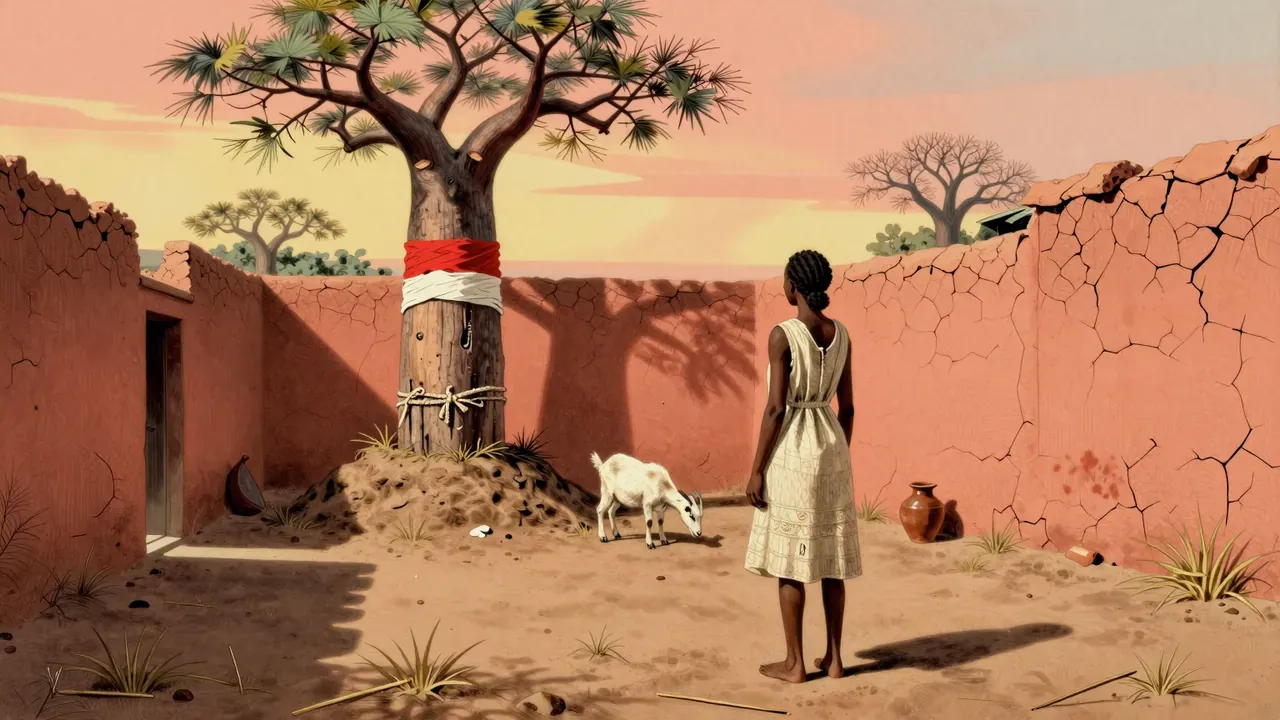
Ceddo is a Senegalese historical drama set in a West African village during the late pre-colonial period — after European traders have arrived but before formal French administration. It is Ousmane Sembène’s deliberate, unsentimental reckoning with cultural sovereignty: not as nostalgia, but as contested terrain. The film names and centres the ceddo — those outside dominant religious and political orders — not as relics but as agents resisting absorption by Islam, Christianity, and the slave trade. Sembène frames the village as a microcosm, compressing centuries of ideological friction into a single, tightly wound conflict. He does not seek to resolve that conflict, nor to assign moral primacy to any one tradition; instead, he insists on the ceddo’s right to self-definition, even in failure. This is not allegory dressed as history, but history sharpened into political clarity — an act of cinematic decolonisation that refuses both European chronology and imported frameworks of legitimacy. The film’s ambition is structural: to reorient narrative authority away from external doctrines and toward internal logic, ritual, and speech. (158 words)
The language of refusal
The story unfolds through ritual gesture, withheld dialogue, and long-held compositions: Tabata Ndiaye’s Dior Yacine moves with quiet command, her silence more declarative than exposition. Sembène avoids psychological portraiture; motivations are collective, not individual. Manu Dibango’s score uses Wolof percussion and brass motifs without melodic concession — it underlines tension, never explains it. Cinematography favours medium distance and shallow focus, keeping faces legible but refusing intimacy; interiors are lit like thresholds, not sanctums. There is no voiceover, no flashback, no explanatory caption. The abduction of the princess is shown without flourish; the Imam’s death is abrupt, unceremonious. Performances avoid emphasis: even the king’s collapse reads as exhaustion, not tragedy. Editing follows rhythm over revelation — scenes end before resolution, cutting to drumbeats or empty courtyards. The film’s craft is anti-spectacular: it builds gravity through restraint, not accumulation. Its pacing is unhurried not because it lingers, but because it refuses to rush meaning into legibility for outsiders. (159 words)
The princess as subject
What lands is the film’s refusal to flatter its audience. Its moral architecture holds no safe position: the ceddo are neither noble savages nor pure resisters, the Muslims neither fanatics nor liberators, the Christians neither villains nor saviours. The force of Dior Yacine’s final act lies not in triumph but in its futility — she kills the Imam, but the village is already converted, the king dead, the ceddo scattered. That ambiguity lands with weight because it is earned: every character acts from coherent, historically grounded conviction. The film’s visual discipline — the way light falls across mud walls, how cloth hangs on shoulders, how drums are held — grounds abstraction in texture. Even the banning context lands not as anecdote but as extension: spelling ‘ceddo’ with two d’s is a grammatical insistence on Wolof orthography, and thus on epistemic autonomy. The film’s coherence is total: form, language, politics, and sound all operate from the same premise — that African history must be narrated from within its own syntax. (157 words)
Religion as infrastructure
What does not land is the film’s resistance to emotional scaffolding. Its austerity can read as opacity to viewers accustomed to exposition, character arcs, or tonal cues. There is no musical swell at moments of crisis, no close-up to signal interiority, no narration to clarify lineage or doctrine. Some may find the pacing inert rather than deliberate — particularly in the middle stretch, where council scenes repeat structural beats without variation. The absence of named historical figures or dates may frustrate those seeking pedagogical clarity. The film assumes familiarity with West African cosmologies and Wolof social hierarchy; it offers no glossary, no translation beyond what French subtitles provide. Its refusal to distinguish between spiritual conviction and political coercion may also unsettle viewers who expect moral signposting. And while the ban’s linguistic dimension is intellectually sharp, it remains a footnote — the film itself does not dramatise orthographic struggle, so that layer stays external unless the viewer brings it in. (156 words)
Spelling as sovereignty
The themes that matter are sovereignty of belief, the violence of conversion as statecraft, and the erasure of women’s agency within historiography — not as abstract concerns but as lived, bodily facts. Sembène treats religion not as doctrine but as infrastructure: mosques and shrines are sites of power reallocation, not faith. The slave trade enters not as spectacle but as economic pressure — visible in the white traders’ idle presence, the rust on iron bars, the silence around missing villagers. Dior Yacine embodies the film’s central thesis: that modern Africa cannot emerge without women speaking, leading, and deciding — not as symbols but as subjects with tactical intelligence and lethal resolve. The ceddo’s resistance is not to change per se, but to change imposed without consent, without reciprocity, without memory. Colonialism here is not yet administrative but already atmospheric — a shift in who names things, who interprets omens, who decides what counts as law. These are not themes illustrated; they are the film’s grammar. (155 words)
The grammar of restraint
This film is for viewers who accept that history is not a sequence of events but a field of competing claims — and who trust cinema to hold complexity without simplification. It suits those familiar with West African oral traditions, Wolof language politics, or postcolonial theory, though none of those are prerequisites. It is not for viewers who require narrative propulsion, emotional hand-holding, or clear moral binaries. Those expecting a ‘resistance hero’ arc will find Dior Yacine’s trajectory too elliptical; those seeking ethnographic detail will find the film too pointedly political. It repels viewers who mistake austerity for emptiness, or who read silence as absence rather than strategy. A historian of Senegalese Islam might object to the compression of theological nuance; a Wolof speaker might note dialect choices that flatten regional variation. But the verdict holds: this is not a film about ‘Africa’ as monolith, but about one village’s stubborn, flawed, necessary assertion of self-determination — and that demand reshapes who the film is for. (159 words)
History as present tense
Yes, it is worth your evening — provided you watch it as an argument in image and rhythm, not as entertainment. Its 120 minutes accumulate weight precisely because they refuse to yield easy access: the film rewards attention, not passive consumption. It is not ‘difficult’ in the sense of obscurity, but demanding in its insistence on your intellectual participation — you must track shifts in power through posture, not plot. Those who dismiss it as slow miss how every cut serves a polemic: the camera lingers on hands making rope, not because it is picturesque, but because labour is continuity. The film’s value lies in its unwavering commitment to a single, urgent question — who gets to define reality? — and its refusal to outsource the answer to Europe, to scripture, or to sentiment. To call it ‘unrewarding’ would be to mistake its rigour for indifference. It earns its time, but only if you meet it on its terms. (158 words)