A child, watched
Naked Childhood is Maurice Pialat’s first feature film, a drama set in working-class France in 1968 and centred on François, a ten-year-old boy moving between foster homes after being abandoned by his mother. It does not aim to diagnose the foster care system or mount a social argument; Pialat stated he had no intention of making a ‘social film’. Instead, the film observes François with uninflected attention — not to explain his behaviour, but to register its contradictions: cruelty and tenderness, withdrawal and sudden care, instability and flashes of loyalty. The historical moment — student riots in Paris — appears only as background noise, a faint radio report or distant murmur, deliberately kept at arm’s length. Pialat treats the boy’s world as self-contained, refusing symbolic framing or moral punctuation. This is not realism as exposé, nor naturalism as indictment. It is realism as duration: time spent watching a child navigate adult indifference without commentary, without recourse to psychology or redemption. The film’s ambition is narrow and exacting: to hold a sustained, unsentimental gaze on a life that rarely holds still long enough to be seen.
The look of it
The story unfolds through a series of placements and departures, structured less by plot than by rhythm — the slow accumulation of small gestures, repeated routines, and unspoken tensions. Raoul Billerey and René Thierry, playing the older foster carers, underplay their roles with a quiet physicality that avoids both caricature and pathos; their authority is worn, not asserted. François, played by an unnamed child actor (not listed in the fact sheet), is never directed toward expressiveness — his face often turns away, his voice drops mid-sentence, his actions resist interpretation. Claude Beausoleil’s cinematography keeps the image grounded: shallow focus, natural light, interiors shot at eye level, no establishing shots to orient the viewer. There are no score cues, no close-ups for emphasis, no editing that clarifies cause and effect. Scenes end before resolution, begin mid-action, and often omit transitions. Dialogue is sparse and functional; silences are neither pregnant nor poetic, just present. The writing by Pialat and Arlette Langmann avoids exposition — we learn François’s history through fragments: a folded letter, a nurse’s offhand remark, a glance at a photograph. This restraint is methodical, not accidental.
What stays in the frame
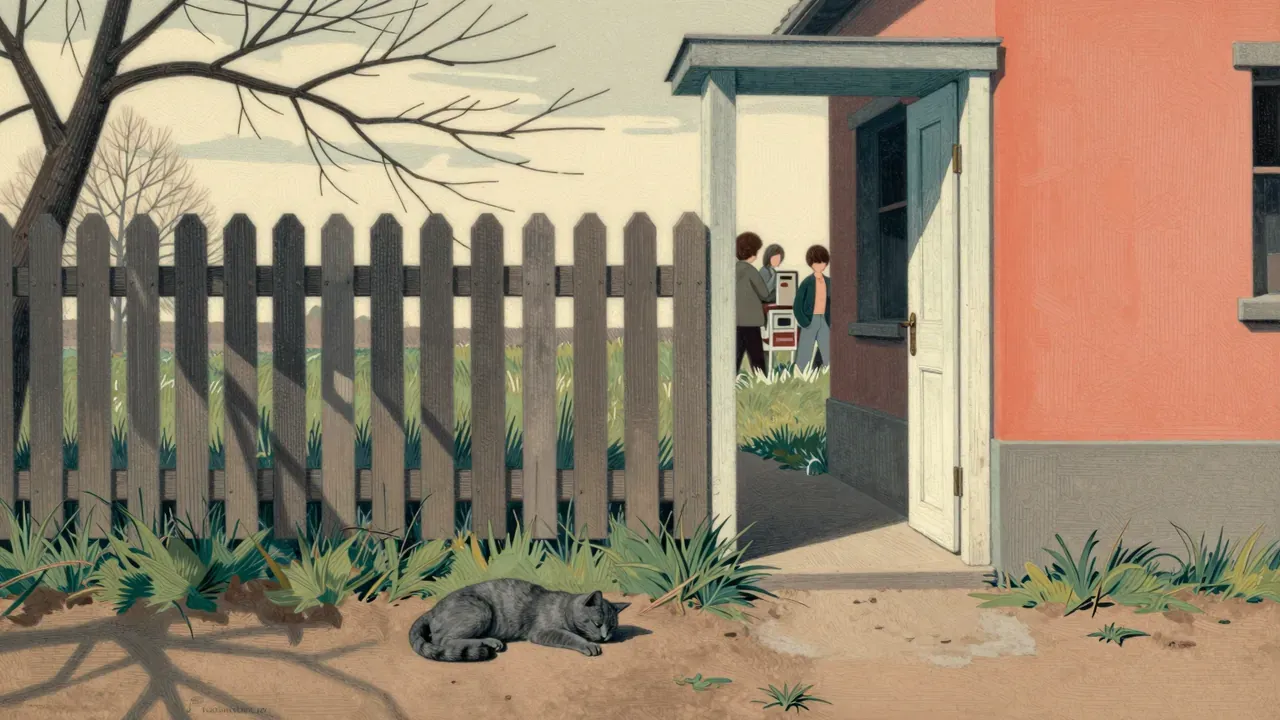
What lands is the cumulative weight of unremarkable moments: François kneeling beside the injured cat, then later washing its fur; him silently folding laundry for Nana while she dozes; the way he watches the Joingny daughter from across the yard, not speaking, not approaching. These are not ‘redemptive’ beats — they carry no narrative promise — yet they register as real because they are unaccompanied by music, reaction shots, or editorial framing. The film trusts the viewer to hold contradictory impressions: that François is both damaged and observant, withdrawn and attentive, unreliable and deeply responsive to kindness when it arrives without demand. The Thierrys’ home works not because it offers stability, but because it asks little and gives quietly — a shared meal, a chair by the stove, space to exist without performance. Pialat refuses to resolve the tension between François’s volatility and his capacity for care, and that refusal feels honest rather than evasive. The film’s power lies in its patience: it allows time for things to settle, for meaning to accrue slowly, like dust on a windowsill.
What stays out
What does not land is any sense of psychological coherence or narrative momentum. Viewers expecting motivation — why François drops the cat, why he steals, why he withdraws — will find no answers, only recurrence. The film offers no interior monologue, no flashbacks, no therapist’s office, no explanatory voiceover. Its refusal to interpret leaves some sequences feeling inert rather than ambiguous: a long take of François staring out a window may read as contemplation or vacancy, depending on the viewer’s tolerance for uncertainty. The lack of context around the foster system — no caseworker scenes, no bureaucratic procedure, no comparative portraits of other children — risks flattening structural critique into individualised pathos. And while the avoidance of politics is deliberate, the near-total erasure of 1968’s upheaval means the film’s temporal setting feels ornamental rather than anchoring. Some will find this austerity noble; others will read it as evasion — a choice that privileges aesthetic discipline over social texture.
The weight of ordinary things
The themes that matter are not announced but embedded: the quiet violence of institutional neglect, the fragility of belonging when it must be earned daily, and the way care circulates unevenly among people who have little to give. Class is present not as backdrop but as material condition — worn furniture, thin walls, shared bedrooms, meals stretched across three generations. The film treats childhood not as a stage but as a site of negotiation: François learns early that affection is conditional, safety temporary, trust a risk with no guarantee of return. His resilience is never heroic — it is practical, often weary, sometimes cruel. The film also explores the limits of adult responsibility: the Joingnys are neither villains nor fools, just people whose resources — emotional and material — run out. The Thierrys offer more, but their capacity is bounded by age, illness, and exhaustion. There is no ideal foster parent here, only varying degrees of endurance. What emerges is not a thesis about care, but a taxonomy of its forms — transactional, dutiful, reluctant, tender — all operating within tight margins.
Who it presumes
This film is for viewers who value observational precision over narrative propulsion, and who accept that some lives resist explanation. It suits those accustomed to arthouse pacing — the patient viewer, the student of performance, the person who finds emotional resonance in silence and repetition. It is not for those who require psychological clarity, moral resolution, or even basic exposition; its refusal to guide interpretation will frustrate anyone seeking guidance or catharsis. A viewer expecting social realism in the mode of Ken Loach or Costa-Gavras will misread its restraint as detachment. Someone who values character development as progressive revelation will find François opaque. That said, the verdict would shift if the film offered even one scene that clarified its stance — a single conversation between adults about policy, or a moment where François articulates his own experience — but it does not. Its rigour is its boundary.
What it costs
Yes, it is worth your evening — but only if you approach it as a study in duration and restraint, not as a story with stakes to resolve. Its eighty-two minutes unfold with the weight of lived time, not plotted time: nothing is rushed, nothing is underlined. You will not leave with answers, but you may leave with a sharper sense of how children absorb neglect, how kindness functions without fanfare, and how class shapes the grammar of everyday care. Those who dislike ambiguity, or who need narrative closure, will feel short-changed — and they are not wrong to expect more signposting. Yet the film’s integrity lies in its refusal to accommodate that expectation. Its value is not in what it explains, but in how faithfully it renders a world where explanation is scarce, and where survival depends on reading rooms, faces, and silences more carefully than words.