The shape of the day
Peter Hujar’s Day is a biographical film built from a single real-life conversation: Linda Rosenkrantz’s 1974 interview with photographer Peter Hujar, later published as a book. It does not dramatise his life broadly but holds to that one afternoon in her SoHo apartment, using it as a frame to reconstruct his preceding day — December 18, 1974 — through memory, digression, and interruption. The film attempts no exposition, no contextual gloss, no biographical summary beyond what Hujar himself recounts. Its ambition is structural and temporal: to treat a recorded oral account as both script and subject, letting the rhythm of recollection — hesitations, corrections, repetitions, silences — govern pace and emphasis. It avoids period signposting beyond what Hujar names: Elle magazine, Susan Sontag, Allen Ginsberg, the Peace Eye Book Store. There are no establishing shots of 1970s New York, no cutaways to historical footage. What matters is the texture of attention — how memory works when prompted, how identity accrues in anecdote, how art lives inside routine. It is a film about time measured not in plot points but in cigarettes smoked, phone calls answered, negatives developed. (158 words)
The sound of memory
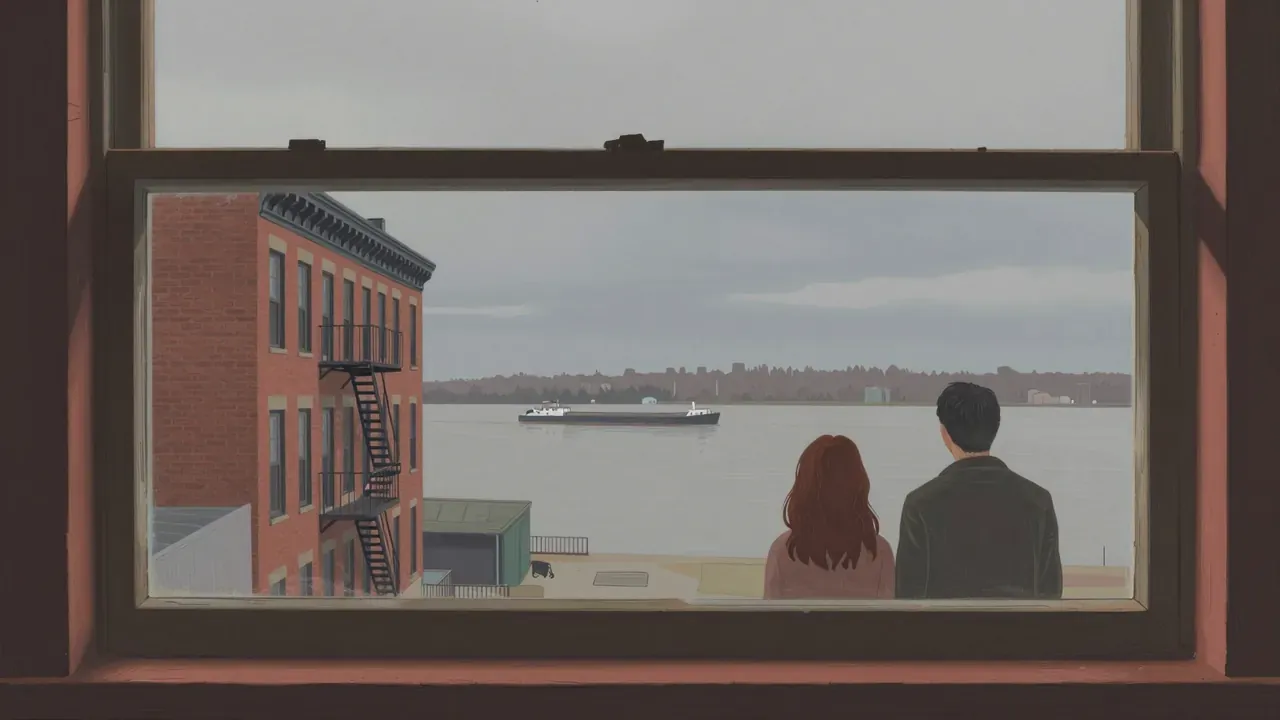
The story unfolds almost entirely within one room, anchored by Ben Whishaw’s performance as Hujar: physically still but verbally restless, shifting between self-deprecation and quiet pride, irritation and tenderness. Rebecca Hall’s Rosenkrantz listens more than she speaks, her presence calibrated to draw out rather than direct — a subtle counterweight to Whishaw’s rhythmic monologue. Alex Ashe’s cinematography keeps the space intimate but never claustrophobic; light falls evenly across the apartment’s worn surfaces, avoiding stylisation in favour of fidelity to the room’s lived-in grain. Affonso Gonçalves’ editing sustains the conversational flow without smoothing its irregularities — pauses hold, sentences trail, interruptions land with quiet weight. There are no flashbacks, no re-enactments of the day being described; instead, the camera rests on Whishaw’s face as he remembers, or on Hall’s hands adjusting the tape recorder, or on the river visible through the window — a silent third participant. The craft serves restraint: every choice defers to the spoken word, treating dialogue not as vehicle but as material. (159 words)
The weight of detail
What lands is the accumulation of small, unremarkable moments made resonant by attention: Hujar calculating fees while waiting for an editor, his frustration at Ginsberg’s resistance to conventional portraiture, the quiet exhaustion of developing film late into the night. The film trusts that the weight of a life resides in these details — the persimmons bought at the vegetable stand, the harpsichord practice before bed, the way he watches a sex worker apply makeup in a truck’s reflection. Whishaw and Hall generate warmth without sentimentality; their rapport feels earned, grounded in shared intellectual curiosity rather than dramatic conflict. The film’s refusal to elevate any moment above another — no climax, no revelation, no turning point — becomes its strength. It resists the biopic’s urge to distil meaning and instead lets meaning emerge from duration: the length of a cigarette burn, the time it takes to develop a negative, the silence after a question hangs too long. This patience rewards close listening. The film does not ask for empathy but invites alignment — with Hujar’s rhythms, his irritations, his stubborn belief in the dignity of craft even when he doubts its value. (156 words)
The cost of fidelity
What does not land is the film’s occasional drift into abstraction without sufficient grounding. A few passages — particularly those concerning Hujar’s failing eyesight or his reflections on mortality — risk becoming generalised rather than specific, leaning on tone where the script offers little concrete anchor. The structure, while faithful to Rosenkrantz’s book, places heavy demand on the viewer’s tolerance for verbal repetition and narrative stasis; some sequences — such as the extended darkroom work — feel less like immersion and more like endurance. There is no attempt to dramatise the stakes of Hujar’s artistic uncertainty, so his anxieties about portraiture or legacy remain internalised, never tested against external consequence. The film’s rigour becomes a limitation when it refuses even minimal visual variation to signal shifts in emotional register or temporal layering. A viewer unfamiliar with Hujar’s photographs or Rosenkrantz’s project may find the film’s density impenetrable not because it is obscure, but because it assumes familiarity with a particular mode of artistic introspection — one that values process over product, memory over event. (154 words)
The labour of time
The themes that matter are time as labour, memory as reconstruction, and the quiet violence of artistic ambition. The film treats a day not as a unit of progress but as a site of repeated effort — photographing, printing, retouching, calling, listening, remembering. Hujar’s exhaustion is physical, metabolic, tied to cigarettes and insomnia and failing vision, yet it never reads as melodramatic because it is inseparable from his work. His conversations with Ginsberg, Sontag, Burroughs are less about fame than about the friction between artistic intention and external expectation: how a portrait assignment becomes a negotiation of power, how a magazine commission demands compromise, how reputation can distort perception. Ageing appears not as decline but as recalibration — his eyes weaken, his energy wanes, yet his attention sharpens. The film’s most persistent theme is the solitude of creation: even amid visitors, phone calls, shared meals, Hujar remains fundamentally alone with his negatives, his harpsichord, his thoughts. That solitude is neither tragic nor heroic — just the condition of making something that outlives its maker. (157 words)
The terms of attention
This film is for viewers who value precision of language over narrative propulsion, who find tension in hesitation and resonance in repetition. It suits those accustomed to arthouse pacing — fans of Andrew Haigh’s Lean on Pete or Joanna Hogg’s Archipelago — and those with prior interest in New York’s 1970s art scene, photography as practice, or oral history as form. It is not for viewers who require plot, escalation, or visual spectacle; those expecting biopic conventions — childhood flashbacks, romantic subplots, career-defining triumphs — will find it withholding. Some critics may argue its formal austerity borders on asceticism, mistaking restraint for absence. A viewer who prefers exposition over implication, or who finds sustained interiority alienating, will disengage early. The film’s success depends on willingness to sit with ambiguity — to accept that Hujar’s day yields no grand conclusion, only the accumulated weight of attention paid. Change the framing — add archival photos, voiceover context, or dramatised scenes — and the film’s integrity collapses. Its value lies precisely in its refusal to explain itself. (159 words)
The silence after
Yes, it is worth your evening — provided you arrive prepared to listen rather than watch, to follow thought rather than action. Its seventy-six minutes pass with the quiet insistence of a well-tuned clock: unhurried but exact. The film earns its duration not through incident but through accumulation — of detail, of rhythm, of character revealed in offhand remarks. It asks little of the viewer except presence, and repays that presence with uncommon clarity about how artists live inside their work. Those who dislike static compositions or dialogue-heavy films may find it inert; those who mistake stillness for emptiness will miss its density. But for anyone willing to inhabit its tempo, the film offers a rare kind of intimacy: not emotional confession, but intellectual companionship. It does not resolve, persuade, or console — it observes, records, honours. Its final image — two people looking out at the river, silent — is not an ending but a continuation: of memory, of time, of the unspoken things that bind us to others and to our own days. (158 words)