The shape of it
Before the Rain is a Macedonian drama built around a cyclical, three-part structure — WORDS, FACES, PICTURES — that loops back on itself without resolution. It does not aim to document the 1990s Balkan conflicts as history but to frame them as a self-replicating pattern: violence begets silence, silence begets misrecognition, misrecognition begets violence again. Milcho Manchevski’s first feature uses this form to resist linear causality and national myth-making alike. The film avoids exposition, biography, or political context beyond what appears in gesture, glance, or offhand line. Its ambition is structural and ethical: to show how identity hardens into enmity when language fails, when memory is severed, when return becomes indistinguishable from repetition. It treats Macedonia not as a setting but as a condition — one where belonging is conditional, speech is dangerous, and care is punished. The film’s refusal to locate blame in individuals or nations, and its insistence on symmetry between perpetrator and victim across time and geography, is deliberate. It asks the viewer to hold contradiction without relief: that Kiril’s kindness and Aleksandr’s complicity are part of the same system.
The look of it
The story moves through three discrete yet interlocking segments, each anchored by a different protagonist — a monk, a photo editor, a photographer — linked only by implication and recurrence. Manuel Teran’s cinematography keeps compositions tight and grounded: interiors are dim but legible, exteriors washed in flat Macedonian light, no glamour in the framing of ruin or rain. Performances avoid emphasis: Katrin Cartlidge’s Anne registers fatigue before grief; Rade Šerbedžija’s Aleksandr carries weight without explanation; Labina Mitevska’s Hana speaks little but holds every scene she enters. Editing by Nicolas Guster sustains the loop without flourish — cuts land with quiet finality, never surprise. Anastasia’s score uses Macedonian folk motifs sparingly, mostly as texture beneath silence. There is no voiceover, no flashbacks, no exposition. Dialogue is sparse and often untranslated (Albanian, Macedonian), forcing attention to posture and proximity. The bicycle whistle — a nod to Butch Cassidy — is the only overt reference, and it lands not as homage but as dissonance: a Western tune in a place where such levity has no purchase. The craft serves restraint, not ornament.
The weight of it
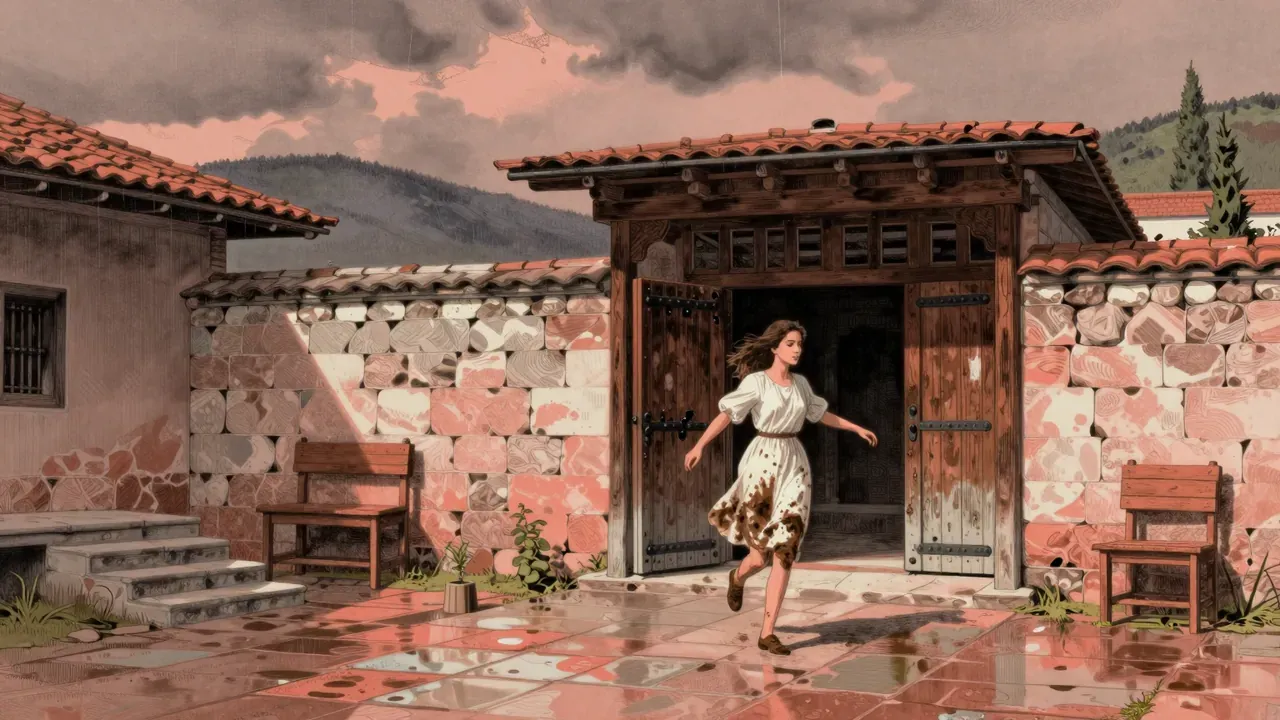
What lands is the film’s architecture: the way the final shot — Zamira running toward the monastery — mirrors the first, making narrative closure impossible and moral certainty untenable. The cyclical form is not a gimmick but the point: no character escapes the logic of their environment, and no act of conscience interrupts the sequence. The silence Kiril keeps, the silence Anne breaks with her pregnancy announcement, the silence Aleksandr breaks by confessing his role in a killing — all are variations on the same failure of speech to protect. The film’s most effective moments are small: Zamira placing a finger to her lips as she dies; Aleksandr sleeping in his abandoned house, hearing wind through broken windows; the waiter and patron arguing in a London restaurant before gunfire erupts — not as plot but as echo. These do not build to catharsis but to recognition: that violence migrates, repeats, and finds new vessels without needing new motives. The film earns its austerity because every withheld explanation sharpens the question it poses: what would break the cycle, and who would pay?
The distance in it
What does not land is the film’s reliance on Western archetypes to carry emotional weight outside their context. Aleksandr’s Pulitzer-winning photographer persona feels imported — a cipher for Western guilt rather than a fully realised man. His confession about Bosnia lacks specificity: we see no faces, hear no names, learn no dates, and the film offers no mechanism for how he arrived at that moment. This vagueness risks flattening real histories into allegory. Similarly, the London segment — though brief — functions less as parallel world than as moral contrast, positioning Britain as passive witness rather than implicated actor. Some viewers will find the symmetry between Kiril’s vow and Aleksandr’s silence overextended, the parallels too neat where life is ragged. Others may reject the film’s refusal to name institutions, parties, or timelines — not as artistic choice but as evasion. The cyclical structure, while rigorous, can feel like stasis rather than critique to those who expect narrative progression or political clarity. The film assumes fluency in its formal language; those unfamiliar with Eastern European cinema’s traditions of elliptical storytelling may read ambiguity as absence.
The air of it
The themes that matter are not war or ethnicity in themselves, but how language collapses under pressure — how words become weapons, then disappear, then reappear as slogans. Nationalism here is not ideological but atmospheric: it lives in the way villagers gather without being summoned, in the speed with which suspicion becomes consensus, in the silence that follows a gunshot. The film treats translation not as technical problem but as existential barrier: Kiril cannot understand Zamira’s gratitude, just as Aleksandr cannot translate his remorse into action that changes anything. Another theme is return — not as homecoming but as re-entry into a system that has moved on without you. Aleksandr’s village sees him as foreign not because he left, but because he returned with questions instead of answers. The film also interrogates the ethics of witnessing: Anne edits photographs she does not take; Aleksandr takes photographs he does not control; the camera watches everything but intervenes in nothing. These are not abstract concerns but material ones — tied to labour, migration, memory, and the limits of empathy across borders both geographic and linguistic.
The audience for it
This film is for viewers who value formal rigour over exposition, who accept silence as meaning, and who do not require characters to explain their motives. It rewards patience with structural payoff, not emotional release. It is not for those who need clear protagonists, chronological clarity, or historical grounding — the film gives none of these willingly. Those who expect war films to clarify sides, assign responsibility, or offer redress will find Before the Rain withholding, even frustrating. Viewers accustomed to British or American social realism may struggle with its refusal to name causes or propose solutions. It is also not for those allergic to ambiguity: the film’s power lies in its unresolved repetitions, not in revelation. A viewer who values psychological realism over symbolic architecture, or who prefers narrative momentum to structural recursion, will likely disengage. That said, the film’s brevity — 113 minutes — means its demands are contained. Its difficulty is architectural, not intellectual: it asks only that you follow the loop, not decode it.
The time of it
Yes, it is worth your evening — not as entertainment but as calibration. It recalibrates how much silence can hold, how little dialogue a film needs to convey consequence, and how deeply structure can shape meaning. Its 113 minutes pass without hurry, and its ending does not resolve but reverberates: you leave thinking not about what happened, but about what must happen next — and whether it already has. Those who find it unrewarding are not wrong; they are simply outside its contract, which assumes willingness to sit with discomfort without resolution. The film’s reputation rests on its coherence, not its accessibility — and that coherence remains intact decades on. It does not date because it refuses topicality: its concern is not 1994 but recurrence. To dismiss it as ‘cold’ or ‘distant’ is to mistake its method for its message. Its power is cumulative, not immediate — and cumulative power requires presence, not just attention. If you watch it once and feel little, watch it again: the second viewing reveals how precisely every cut, pause, and untranslated word serves the loop.