What the legend carries
La Llorona is a Guatemalan thriller that uses the folkloric figure of the Weeping Woman not as a source of jump scares but as a vessel for reckoning — with genocide, impunity, and inherited complicity. It centres on an elderly former dictator, Enrique Monteverde, whose 1982–83 campaign against Mayan communities ends in a hollow legal conviction, swiftly overturned. The film’s ambition is structural: to fold political history into domestic space, to make the house a microcosm of state violence, and to let the supernatural emerge not from elsewhere but from what has been buried — bodies, testimony, memory. Jayro Bustamante treats the legend as allegory, not ornament; Alma, the young Kaqchikel maid, is neither ghost nor monster but a focal point where trauma condenses, resurfaces, and finally acts. This is not folklore repackaged for genre audiences. It is folklore reactivated — as accusation, as evidence, as consequence. The film refuses to separate horror from history, or haunting from accountability. Its frame is narrow — one house, one trial, one unraveling family — but its reach is forensic, insisting that justice does not require a courtroom to be present, only attention.
The look of it
The story unfolds with deliberate restraint: protest chants bleed through walls, water accumulates in quiet corners, dialogue is sparse and weighted. María Mercedes Coroy’s Alma moves with stillness that unsettles rather than startles; Julio Díaz’s Monteverde conveys menace not through outbursts but through physical decay and unblinking entitlement. Bustamante directs, writes, produces and edits — a unified hand evident in the film’s precise, low-contrast compositions and measured pacing. Pascual Reyes’ score avoids orchestral swells, favouring sparse percussion and submerged vocal textures that mimic breath-holding and submersion. Editing is elliptical but never obscure: scenes cut before resolution, trusting the viewer to hold the implication — a child’s wet dress, a folded flyer, a hand gripping an oxygen tank. The camera lingers on surfaces — tile, skin, water — not to aestheticise but to register residue: sweat, damp, stain, silence. There are no flashbacks; memory arrives as somnambulism, as nightmare, as repetition. The craft serves containment: every choice tightens the pressure inside the house, making the outside world — the protests, the past — feel both inescapable and inaudible.
How the house holds its breath
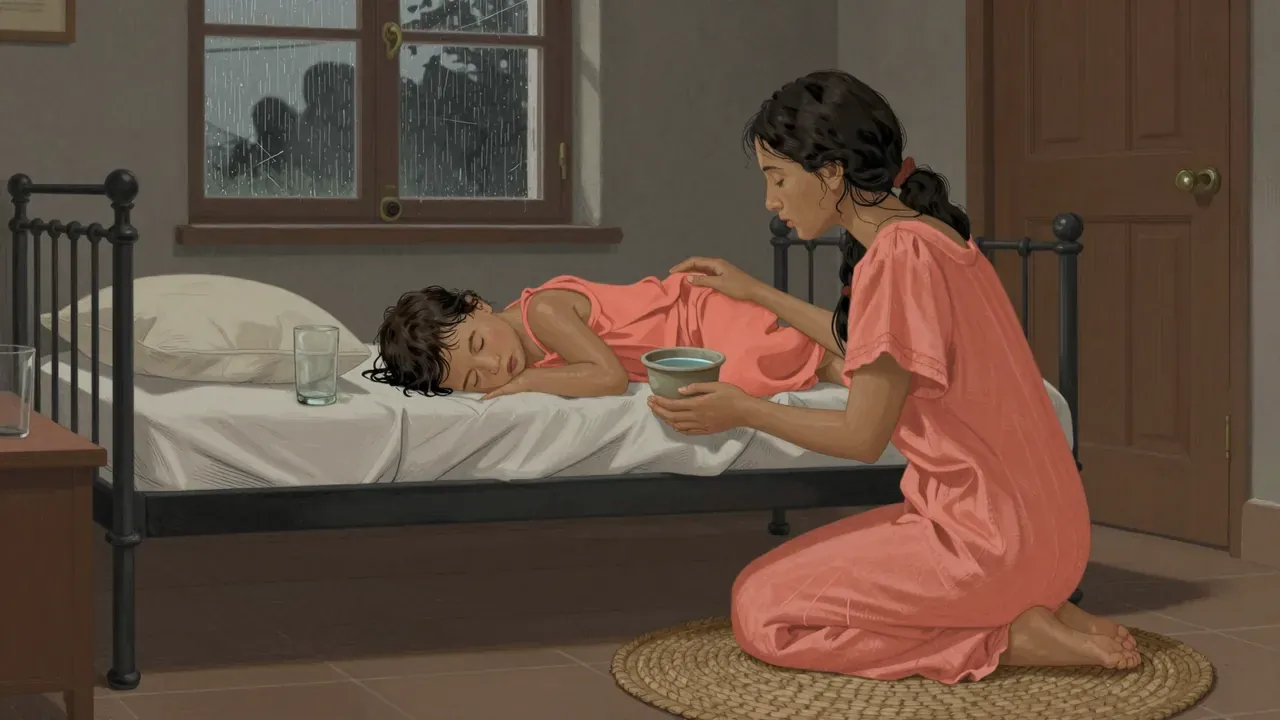
What lands is the film’s moral architecture — how it makes guilt tactile, generational, environmental. The way water behaves — pooling, dripping, rising — becomes a grammar of return: not spectral vengeance but hydrological inevitability. Carmen’s bed-wetting, Sara’s breath-holding, Alma’s silent immersion — these are not metaphors staged for effect but embodied consequences, rendered with clinical care. The casting of Kaqchikel actors in roles rooted in Kaqchikel experience grounds the allegory in specificity, not abstraction. Valeriana’s quiet suspicion, Natalia’s dawning discomfort, even Letona’s brief, wordless encounter with two child spirits — all land because they avoid exposition and trust gesture, rhythm, duration. The final sequence — Carmen’s trance, the stranglehold, the funeral’s echoing wail — does not climax so much as exhale, leaving behind a silence thick with implication. There is no catharsis, only confirmation: the system failed, but the logic of consequence did not. That coherence — between form, theme and historical weight — is where the film holds firm.
Where the silence stretches thin
What does not land is the film’s middle stretch, where inter-familial tension dilates without deepening. Natalia’s arc — her unease, her questions, her eventual withdrawal — feels under-serviced, less like character development than narrative scaffolding. The generational friction between Carmen and Natalia lacks the texture of their shared silences earlier in the film; their arguments verge on schematic, as if assigned to carry thematic weight rather than earned through behaviour. Similarly, the subplot around Valeriana’s suspicions of Alma’s origins remains unresolved, not as ambiguity but as omission — a thread introduced then dropped. Some viewers may find the pacing too austere, the horror too muted, the political framing too literal where the folklore might have allowed more slippage. The film’s refusal to indulge genre expectations — no jump scares, no gore, no exposition dump — is a strength, but also a risk: its rigour can read as distance, its precision as coolness, especially when the emotional stakes of Alma’s backstory arrive late and without visual or sonic emphasis.
What the walls remember
The themes that matter are not layered but interwoven: impunity as habit, memory as hydrology, justice as recurrence rather than resolution. Class and race are not background but infrastructure — the house staff speak Kaqchikel, the family speaks Spanish; the pool is cleaned by hands that were once displaced by the same regime that now owns the villa. Gender operates as both vulnerability and vector: women bear witness, transmit memory, enact ritual, and ultimately administer consequence — but always within constraints imposed by patriarchal and colonial power. The film treats trauma not as individual pathology but as environmental condition: the weeping is not metaphorical but architectural, audible through walls, felt in humidity, visible in damp floorboards. It insists that genocide does not end with verdicts or verdict reversals — it continues in the silence after the gavel, in the hired help who quit, in the daughter who cannot sleep, in the granddaughter who learns to hold her breath. These are not ideas illustrated but conditions sustained — minute by minute, frame by frame.
Who walks in, and who walks out
This film is for viewers who value political horror that trusts its audience to sit with silence, ambiguity and historical weight — those accustomed to the pacing of Lucrecia Martel or the ethical precision of recent Latin American arthouse thrillers. It is not for viewers seeking conventional genre payoffs: no chases, no reveals, no cathartic violence beyond what the narrative demands. Those who expect folklore to function as spectacle, or who require explicit exposition of historical context, will likely find it withholding. A viewer who values visceral scares over sustained unease, or who prefers narrative clarity to elliptical implication, will leave unsatisfied. The film assumes familiarity with Guatemala’s civil war, or at least willingness to absorb its contours through suggestion. It rewards patience, not passivity — but that patience must be active, attentive, historically literate. Without that engagement, the film risks feeling inert rather than intentional.
The weight of the evening
Yes, it is worth your evening — provided you approach it as a tightly wound political parable, not a haunted-house thriller. Its ninety-seven minutes accumulate like sediment: slow, inevitable, irreversible. The power lies not in surprise but in recognition — of patterns, of repetitions, of the ways power cloaks itself in routine. Some critics found its pacing sluggish, its horror minimal; others saw that restraint as its moral core. If you watch expecting jump scares or linear revenge, you will misread it. If you watch listening for what is unsaid — in the pauses, the water sounds, the untranslated Kaqchikel phrases — you will hear it clearly. It is not entertainment. It is an act of bearing witness, calibrated to the scale of one house, one family, one weeping woman who was never fictional to begin with.