The shape of longing
Nostalghia is a Russian writer’s slow disintegration in Italy, filmed by Andrei Tarkovsky outside the Soviet Union for the first time. It attempts not to narrate a journey but to embody a state: the untranslatable ache of nostalghia — a Russian-specific longing that Tarkovsky described as both soul-draining and spiritually generative. The film does not seek psychological realism or cultural exposition; instead, it treats memory, landscape, and ritual as physical substances — air thick with humidity, stone cold to the touch, candle flame trembling in stillness. Its ambition is metaphysical: to make visible what Tarkovsky called ‘the inner life of its author’, using the Italian countryside not as backdrop but as resonant chamber. The script, co-written with Tonino Guerra, strips away exposition, leaving only gesture, silence, and recurrence — the lit candle, the drained pool, the repeated crossing. This is not a film about research into an 18th-century composer; it is about the impossibility of completing any act of translation — linguistic, emotional, spiritual — when the self is already elsewhere. (159 words)
The look of it
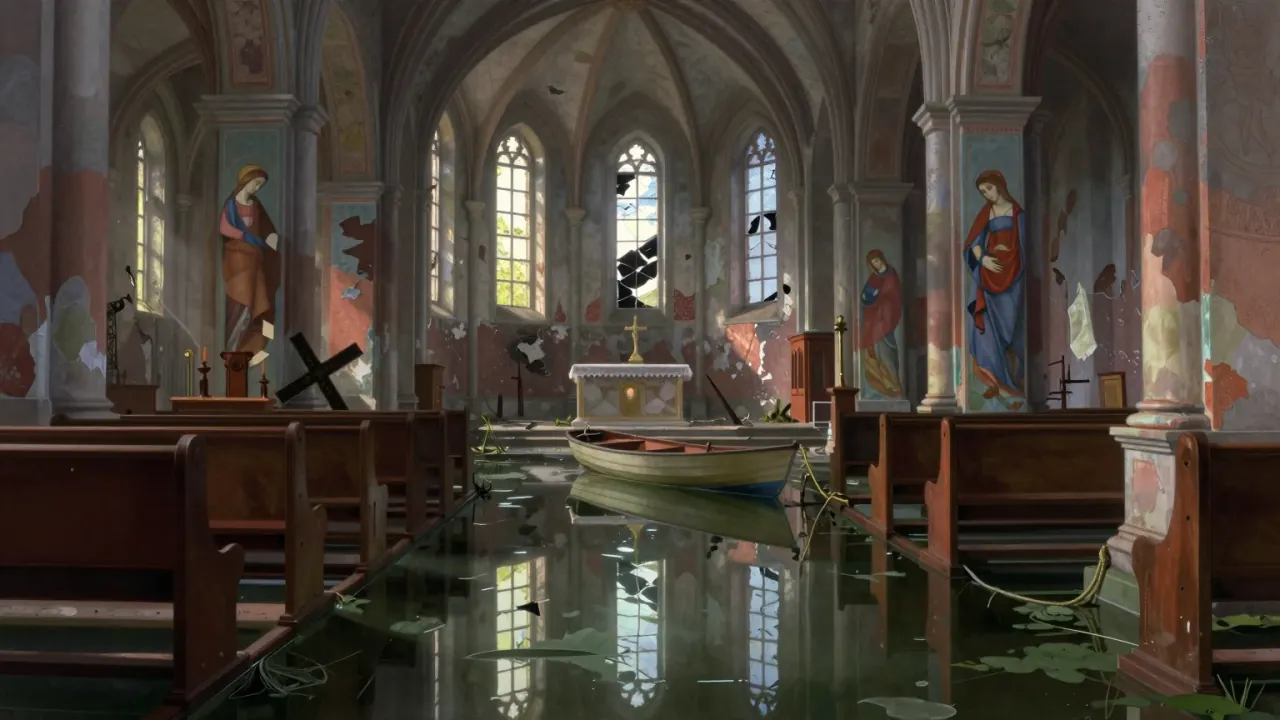
The story unfolds in long, unbroken takes: Giuseppe Lanci’s camera moves with deliberate weight, holding on faces until breath becomes audible, on landscapes until light shifts perceptibly. Oleg Yankovsky plays Andrei Gorchakov with minimal inflection — his exhaustion is in posture, in the way he turns from Eugenia without looking at her, in how he blinks slowly under Tuscan sun. Erland Josephson’s Domenico is less a character than a presence — voice low, movements precise, eyes fixed beyond the frame. There are no close-ups for emphasis; intimacy arrives through duration, not proximity. The editing by Amedeo Salfa sustains this rhythm: cuts are rare, often occurring only after minutes of stillness. Debussy appears in the score, though Beethoven’s Ninth and Verdi’s Requiem dominate key passages — not as accompaniment but as counterpoint to silence. The locations — Bagno Vignoni’s empty thermal pool, San Galgano’s roofless abbey, the flooded church at Cittaducale — are not chosen for beauty but for their capacity to hold absence. Every element serves the same grammar: slowness as syntax, repetition as punctuation, emptiness as subject. (158 words)
What holds
What lands is the film’s physicality of sorrow. The drained pool sequence — Andrei walking its cracked, dry basin, candle guttering, breath ragged — carries the weight of ritual made desperate, not symbolic. You feel the chill of stone beneath bare feet, the strain in his shoulders, the way light bleaches colour from his face as he nears collapse. The final shot — Andrei and a dog resting before his imagined Russian house — lands not as resolution but as quiet completion: a body returning to its origin, even if only in image. The use of real Italian locations, stripped of postcard charm, makes alienation tactile — not abstract but atmospheric, like humidity clinging to skin. Even the minor roles register: Delia Boccardo’s Domenico’s wife speaks few lines, yet her stillness in the doorway conveys decades of endurance. The film’s refusal to explain — why Domenico immolates, why Andrei dies mid-crossing, why the candle matters — does not frustrate but deepens; meaning accrues in accumulation, not revelation. This is not cinema that persuades. It settles. And once settled, it does not leave. (157 words)
Where it thins
What does not land is the film’s structural reliance on repetition without variation. The second visit to the mineral pool, the third iteration of the candle walk, the fourth recurrence of the dream-logic linking Eugenia, Mary, and Andrei’s wife — these do not deepen but dilute, especially for viewers unfamiliar with Tarkovsky’s syntax. The pacing assumes patience as prerequisite, not invitation; it offers no foothold for attention to re-anchor once it drifts. Some performances falter under the weight of stillness: Domiziana Giordano’s Eugenia remains emotionally schematic — a conduit for desire and disappointment, never fully individuated. The decision to shoot in Italian, while politically necessary after Mosfilm’s withdrawal, creates a subtle dissonance: Yankovsky’s heavily accented delivery distances him further from the language of his own interior monologue, yet the script gives him no internal voice to compensate. The film’s resistance to exposition also means its political subtext — Domenico’s asylum history, the critique of post-fascist institutional abandonment — stays implied rather than engaged. It trusts the viewer to supply context; when they cannot, the scenes flatten into mood without momentum. (159 words)
The ache beneath the word
The themes that matter are not nostalgia as sentimentality but as ontological condition — a rift between self and place so absolute it reshapes perception. Tarkovsky treats memory not as recollection but as geography: Russia exists in Andrei not as image but as gravitational pull, altering his gait, his sleep, his sense of time. The film interrogates translation not only across languages but across states of being — sanity and madness, faith and despair, life and ritual death. Domenico’s candle walk is not metaphor but embodied theology: salvation as endurance, not belief. The recurring motif of water — mineral pool, flooded church, rain on stone — speaks to permeability: between worlds, selves, past and present. Even the sky, which struck Tarkovsky most on location, functions thematically: mutable, indifferent, charged only by the observer’s inner weather. This is not a film about exile as circumstance but as constitution — the idea that some souls carry their homeland within them like a wound, and that healing may require not return but surrender. The film’s quietest moments — a hand resting on damp stone, a dog’s head lifting at a distant sound — argue that compassion begins not in speech but in shared stillness. (158 words)
Who it meets
This film is for viewers who treat time as material, not currency — those who sit with silences longer than thirty seconds without checking a screen. It rewards attention calibrated to breath, light, texture. It is not for those who require narrative propulsion, psychological clarity, or emotional payoff measured in catharsis. People who find Bergman’s Winter Light or Béla Tarr’s Satantango exhausting will likely find Nostalghia impenetrable, not because it is obscure but because it refuses to meet conventional thresholds of engagement. Those who expect films to explain themselves — through dialogue, montage, or music cues — will leave frustrated. The film assumes its audience has already felt the weight of a home they cannot name, or the exhaustion of translating themselves across borders. Anyone seeking historical detail about Pavel Sosnovsky or Renaissance frescoes will be disappointed: the film uses research as pretext, not subject. Its value lies entirely in its refusal to accommodate. That refusal is its integrity — and its barrier. (159 words)
Your evening, returned
Yes, it is worth your evening — but only if you give it your full, unmediated attention for its full 121 minutes, without pause, without distraction, without expectation of reward. It is not entertainment; it is immersion. Those who watch it while scrolling, or who stop to check messages, will gain nothing — the film’s logic resides in duration, not incident. Its power emerges cumulatively: in the third hour of your day, the fifth minute of a single take, the seventh time the candle flickers. Some will call it self-indulgent; others, essential. The difference lies not in the film but in the viewer’s willingness to let go of narrative control. If you have ever stood in a foreign place and felt your own pulse slow to match its rhythm — that is the audience this film presumes. It asks for nothing but presence. And in return, it offers not answers, but resonance: a mirror held up not to character, but to consciousness itself. (159 words)