What it is trying to do
Wise Blood is a film adaptation of Flannery O’Connor’s 1952 novel, directed by John Huston in 1979. It attempts to translate O’Connor’s dense, theological grotesquerie — her Southern Gothic idiom of violent grace, moral extremity, and comic spiritual desolation — into cinematic form. The film does not soften the novel’s rigour: it sustains its central paradox — that atheism, when pursued with evangelical fervour, becomes its own kind of religion — and treats blasphemy, self-mutilation, and delusion as expressions of unquenchable metaphysical hunger. It is not satire in the sense of mockery, nor comedy in the sense of release; rather, it uses absurd incident and deadpan delivery to expose the fragility of all systems of meaning, including those erected against meaning itself. Huston’s direction avoids psychological explanation or redemptive arc, holding instead to O’Connor’s conviction that character is revealed not through motive but through extremity of action. The film’s ambition is structural and tonal fidelity: to make the viewer feel the weight of belief — and its absence — as physical pressure.
How it works
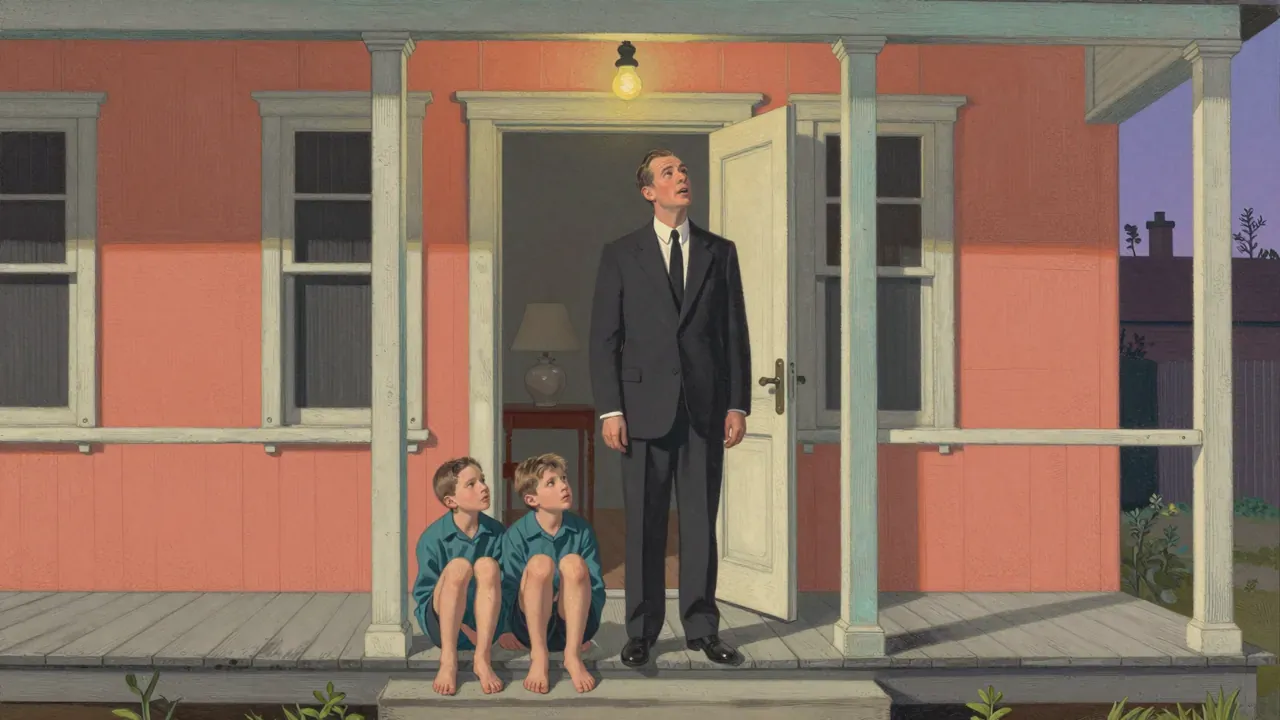
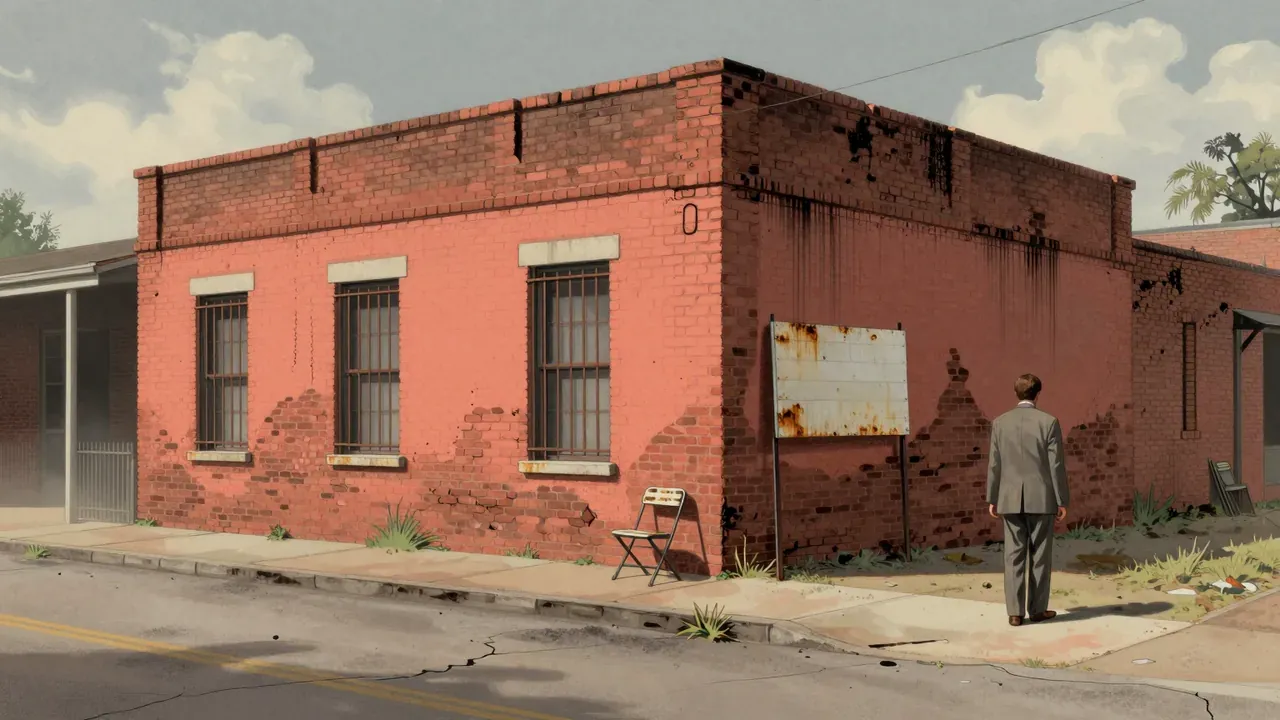
The story follows Hazel Motes’ descent from militant anti-theology into self-annihilation, structured around repeated inversions: sight and blindness, preaching and silence, purity and corruption. Brad Dourif’s performance anchors this with unblinking intensity — his Haze speaks in clipped, flat cadences, his face rarely yielding emotion yet radiating compulsion. John Huston appears twice as the grandfather, his presence spectral and unmoored from time, while Harry Dean Stanton and Ned Beatty offer grounded, weary counterpoints as flawed men caught in Haze’s orbit. Gerry Fisher’s cinematography favours shallow focus and muted Georgia light, keeping interiors dim and exteriors washed out, as if the world itself lacks sufficient illumination for clarity. Alex North’s score is sparse, using dissonant brass and hollow percussion to underscore ritual rather than emotion. Editing avoids emphasis, letting scenes run long enough to become uncomfortable — a refusal to cue the audience how to feel. The production design, overseen by Sally Fitzgerald, leans into vernacular detail: peeling paint, second-hand clothes, museum vitrines holding real artefacts — all treated without irony or condescension.
What lands
What lands most decisively is the film’s tonal control: its ability to sustain a pitch of grave absurdity without slipping into parody or despair. The shrunken head, the gorilla suit, the misspelled opening titles — none are winks at the audience, but extensions of the same logic that drives Haze’s barbed-wire torso and quicklime blinding. These elements cohere because the film never treats its characters as jokes or victims, but as figures operating within an internally consistent moral physics. Dourif’s stillness reads as conviction, not vacancy; Amy Wright’s Sabbath Lilly carries genuine longing without sentimentality; Dan Shor’s Enoch Emory moves with the twitchy sincerity of someone who believes he has found revelation in a museum basement. The film’s pacing, often slow and deliberate, allows the weight of each gesture — a slammed door, a thrown corpse, a silent stare — to settle before the next. This restraint makes the eruptions of violence or derangement land not as shocks but as inevitabilities, earned by the accumulated logic of the world.
What does not
What does not land is the framing device of Huston’s grandfather, which remains under-integrated: his appearances lack narrative function beyond symbolic reinforcement, and their dreamlike detachment sits uneasily beside the film’s otherwise grounded surrealism. The subplot involving Hoover Shoates feels truncated — his opportunistic mimicry of Haze is introduced with energy but resolved too abruptly, leaving his role as cultural parasite underexplored. Some supporting performances, particularly William Hickey’s Asa Hawks, verge on caricature without the compensating depth given to other figures; his feigned blindness lacks the theological ambiguity that makes Haze’s self-blinding resonant. The film’s commitment to austerity also works against accessibility: there is no exposition, no voiceover, no visual metaphor made explicit, and viewers unfamiliar with O’Connor’s concerns may read the plot as nihilistic rather than dialectical. The final stretch — Hazel’s muteness, the landlady’s futile care — risks monotony if the viewer has not already accepted the film’s terms of engagement.
The themes that matter
The themes that matter are not abstract but embodied: the impossibility of true negation, the body as site of theological argument, and the South as a landscape saturated with inherited belief. Hazel’s ‘Church of Truth Without Christ’ fails not because it is illogical, but because it cannot escape the grammar of faith — its sermons, its rituals, its martyrs. His self-blinding mirrors Asa’s fraudulence not as irony but as tragic symmetry: both men use the body to declare a position on transcendence. The film treats religion not as doctrine but as habit, posture, and repetition — visible in the way characters hold themselves, speak, or move through space. Secularism here is not liberation but another form of possession, just as rigid and demanding. The American South is neither backdrop nor stereotype, but a geography where theology is weather: inescapable, changeable, capable of sudden storm. There is no outside to this system — even the museum, the police station, the boarding house operate by its unspoken rules. Grace, in O’Connor’s sense, arrives not as comfort but as interruption — and the film ends precisely at the moment before that interruption can be named.
Who should watch it, and who should not
This film is for viewers who value formal discipline over exposition, who find moral complexity more compelling than resolution, and who accept that comedy and horror may share the same syntax. It suits readers of O’Connor, students of Southern literature, or anyone attentive to how belief manifests physically — in gesture, costume, architecture. It is not for those seeking narrative propulsion, emotional catharsis, or psychological realism; its refusal to explain motivation or reward persistence with insight will frustrate viewers accustomed to conventional character arcs. Those who require clear authorial stance — whether sympathetic or critical — will find Huston’s neutrality alienating. A viewer who values thematic clarity over atmospheric density, or who expects satire to clarify rather than deepen ambiguity, would likely leave unsatisfied. The film’s power depends on sustained attention to its rhythms and repetitions — a demand it makes without apology, and one that changes nothing about its structure or tone.
Is it worth your evening
Yes, it is worth your evening — provided you watch it on terms it sets, not ones you bring. Its 106 minutes unfold with the gravity of a liturgical rite: deliberate, unyielding, resistant to distraction. It rewards patience not with payoff but with accumulation — each scene adding weight to the central paradox until it becomes inescapable. Those who dismiss it as bleak or obscure have likely missed its dark humour, its precise physical choreography, or the quiet dignity in its minor characters’ endurance. It is not a film to enjoy, but one to inhabit — and once inhabited, it lingers. Anyone expecting uplift, explanation, or even coherence in the conventional sense will feel short-changed. But for those willing to sit with its silences and absorb its textures, Wise Blood offers a rare experience: cinema that thinks with its eyes, ears, and nerves — not just its script.