The last poet
Testament of Orpheus is Jean Cocteau’s self-authored coda: a black-and-white fantasy film in which he appears as himself, dressed as an 18th-century poet, moving through a mythic France that folds time, biography and legend into a single plane. It does not tell a story in the conventional sense but stages a ritual of farewell — one that reassembles motifs from his earlier Orphic films and his wider work in poetry, theatre and painting. Cocteau treats the camera not as a recorder but as a mirror and a portal: he walks past himself, addresses statues, converses with historical figures and dead poets, and inserts brief colour footage as if puncturing monochrome memory with a flash of lived sensation. The film’s ambition is neither narrative coherence nor emotional exposition, but formal reckoning — a deliberate, slow-motion inventory of what has preoccupied him across forty years of making art. It assumes familiarity with his prior films and symbols, and it presumes the viewer will accept poetic logic over causal logic. Its structure is associative, its grammar elliptical, its tone wry and unapologetically self-referential. (159 words)
The cast of mirrors
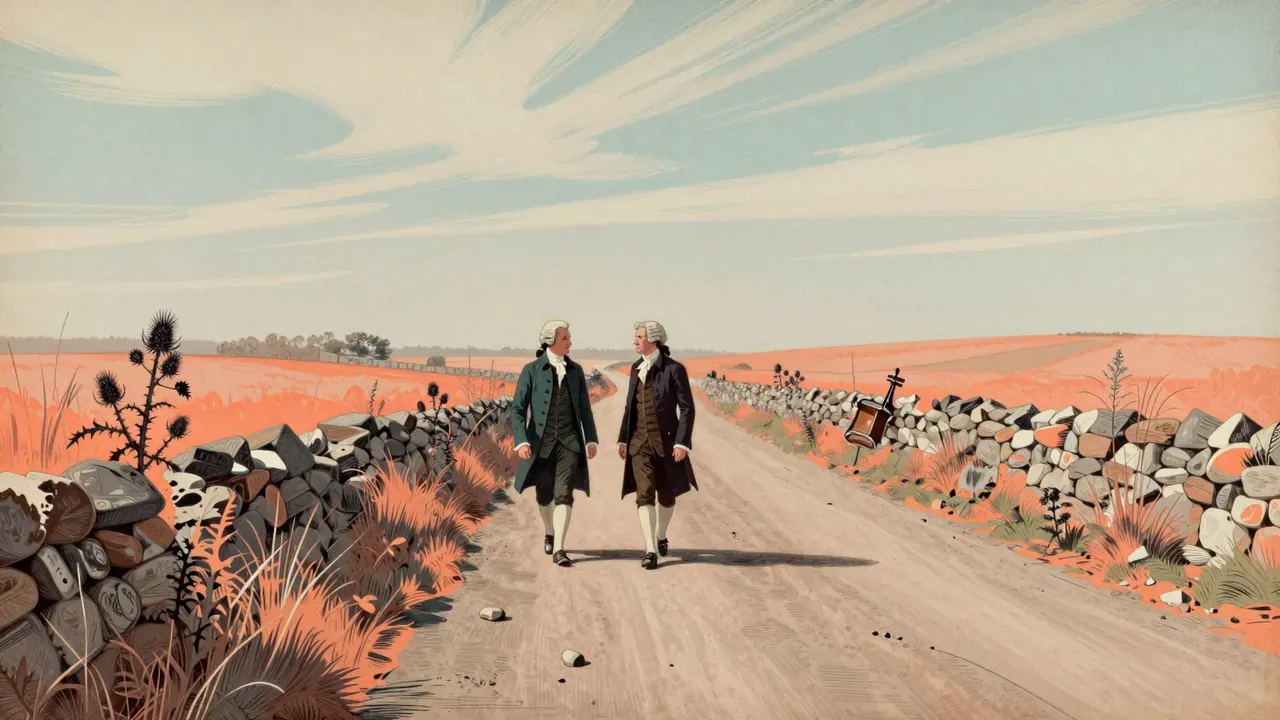
The film unfolds in vignettes rather than scenes: Cocteau, in powdered wig and frock coat, traverses gardens, ruins, studios and empty roads, encountering figures who appear as themselves or as archetypes — Picasso sketching, Marais standing silent, Brynner on horseback, Aznavour singing briefly. There are no performances in the dramatic sense; instead, presence functions as citation. Georges Auric’s score is spare and baroque-tinged, underscoring transitions more than emotions. Marie-Josèphe Yoyotte’s editing favours long takes and abrupt cuts — notably the double-take where Cocteau glances back to see himself walking behind him, a literalisation of retrospection. The black-and-white photography is high-contrast and theatrical, with deep shadows and sharp silhouettes; the few seconds of colour film feel less like ornament than rupture. Claudine Auger, Lucia Bose and María Casares appear without dialogue, as embodiments of muse or fate. Charles Aznavour sings one song; Jean-Pierre Léaud appears as a young poet who might be Cocteau’s younger self. No character develops; all serve as nodes in a personal cosmology. (157 words)
The double take
What lands is the film’s quiet insistence on continuity — between life and myth, past and present, creator and creation. The repeated motif of Cocteau seeing himself — first in a mirror, then on the road, then in a statue — accumulates weight not through explanation but repetition, like a refrain in a villanelle. The stillness of many shots allows space for the viewer to register texture: the grain of stone, the drape of fabric, the way light falls across a shoulder. The cameos do not distract because they are never framed as spectacle; Picasso sketches without comment, Marais stands without speech, and their presence feels earned by decades of shared artistic labour, not by star power. The film’s pacing — unhurried, almost ceremonial — matches its subject: a lifetime’s work being folded, not summarised. Even the colour insert works not as gimmick but as punctuation: a breath drawn before silence. These choices cohere because they are all governed by the same principle: that art is not made in isolation, but as conversation across time, medium and self. (156 words)
The untranslated mirror
What does not land is the film’s refusal to orient the uninitiated. Without knowledge of The Blood of a Poet or Orphée, the references remain cryptic rather than resonant — the statue of Orpheus, the recurring motif of the mirror, the invocation of Eurydice — all assume prior engagement. The film offers no exposition, no translation, no hand-holding, and its irony is too dry to function as accessibility. Some sequences — such as Cocteau’s walk through a deserted château garden — risk monotony when viewed outside the context of his broader project. The lack of narrative propulsion means that moments intended as epiphanic can read as inert, especially for viewers accustomed to psychological motivation or cause-and-effect plotting. The cameo appearances, while respectful, do not generate dramatic energy; they are acknowledgements, not interactions. And though the film’s self-consciousness is deliberate, it can harden into self-absorption when the viewer does not share Cocteau’s frame of reference. That is not a flaw in execution, but a limit of address: it speaks to a specific audience, and does not strain to speak beyond it. (158 words)
The folded years
The themes that matter are mortality, authorship and the porous boundary between artist and archetype. Cocteau does not portray himself as a man nearing death, but as a figure stepping out of linear time into myth — becoming Orpheus not by retelling the myth, but by inhabiting its grammar. The film treats creativity as a form of necromancy: summoning the dead (Picasso, Marais, the idea of Orpheus), quoting oneself across decades, turning memory into architecture. Ageing is present not as decline but as accrual — every shot contains traces of earlier work, every gesture echoes a prior image. The recurring mirror motif is not about vanity but about doubling as method: the artist splitting himself to observe, revise and re-enter his own material. There is also a quiet interrogation of legacy — not how one will be remembered, but how one remembers oneself. The film’s final image — Cocteau walking away from the camera, then turning to look directly at it — closes the loop not with resolution, but with acknowledgement: the gaze returned, the contract between maker and witness renewed, even as the frame empties. (155 words)
The initiated path
This film is for viewers who already know Cocteau’s Orphic Trilogy, or who have spent time with his poetry, drawings or stage designs — those who recognise his visual syntax and are willing to sit with its repetitions. It is also for students of avant-garde cinema who value formal rigour over narrative convenience, and for anyone interested in how artists construct late-style statements. It is not for viewers seeking plot, character development, emotional arc or cultural context — there is no exposition of French post-war life, no social commentary, no psychological realism. Those who find self-reference alienating, or who require clear stakes and consequences, will likely disengage within ten minutes. A critic who values accessibility over authorial control — say, someone who praised Truffaut’s The 400 Blows for its empathy — would find Testament of Orpheus withholding. But that withholding is structural, not accidental: change the film’s relationship to its audience, and you change its purpose. (159 words)
The quiet hour
Yes, it is worth your evening — provided you approach it as a ritual rather than a story. Its eighty-one minutes unfold at the pace of thought, not action, and reward attention to composition, timing and recurrence. It does not ask for suspension of disbelief but for participation in a symbolic logic — one that becomes legible only when you stop waiting for explanation and begin tracing connections: between this shot and that film, this line and that poem, this face and that photograph. Those who watch it expecting drama will leave unsatisfied; those who come prepared to witness a master assembling his own mythology will find it exacting, melancholy and precise. It is not entertainment in the habitual sense, but it is rare: a film that makes no concessions to duration, distribution or digestibility, and remains coherent on its own terms. To call it ‘difficult’ mistakes its clarity for obscurity. Its difficulty lies in its honesty. (159 words)