The setting as witness
Two Monks is a 1934 Mexican black-and-white film that uses Gothic monastic setting and dual flashbacks to explore memory, guilt, and the unreliability of subjective truth. It does not aim for narrative resolution but sustains tension through psychological doubling: two men recount the same fatal incident with mutually exclusive moral claims, neither version fully verifiable. The film’s ambition lies in its structural daring — deploying contradictory testimony sixteen years before Rashomon — and its visual commitment to expressionist distortion as a register of inner collapse. It treats the monastery less as sacred space than as a pressure chamber where conscience, illness, and repressed desire converge. There is no detective, no external arbiter; the mystery is not who did what, but how perception fractures under remorse and physical decay. Its project is not exposition but embodiment: making the viewer feel the weight of unabsolved history through pacing, framing, and soundless intensity. Agustín Jiménez’s cinematography and Carlos Toussaint’s sets work in concert to compress space and warp perspective, anchoring the metaphysical inquiry in tangible, tactile unease. (158 words)
The double confession
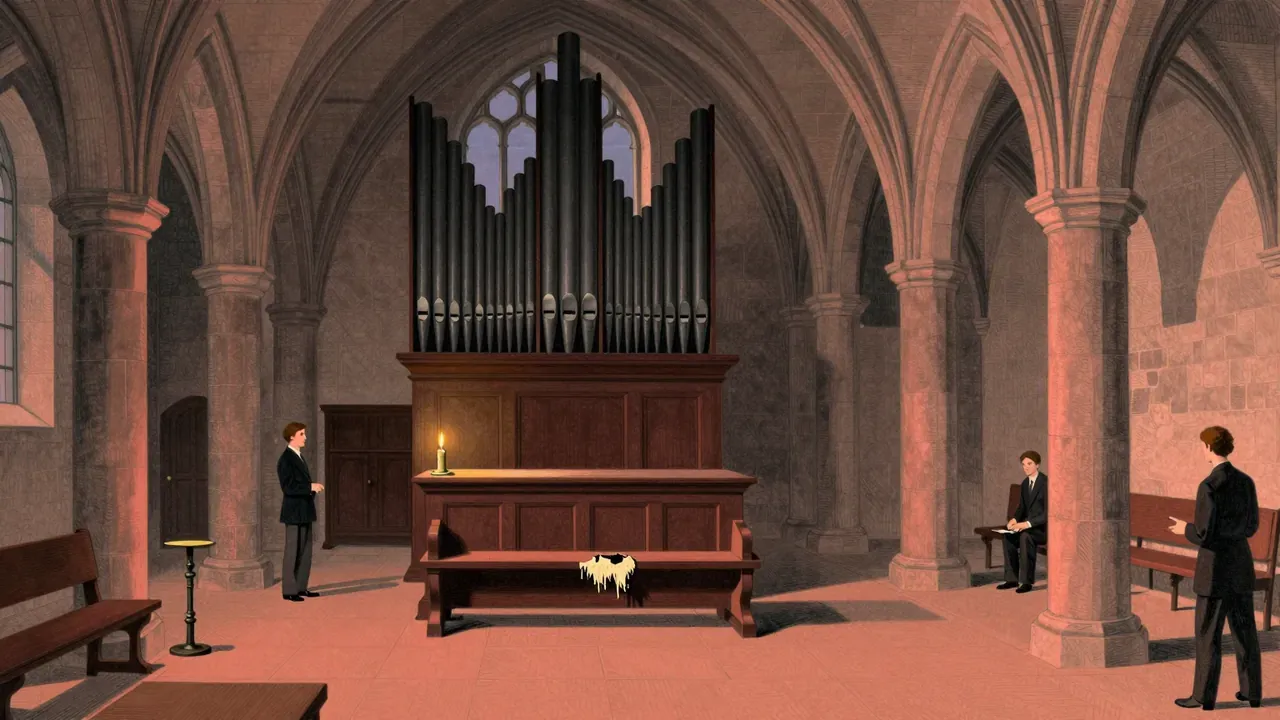
The story unfolds in three tightly interwoven layers: the present-day monastery, Javier’s flashback, and Juan’s counter-flashback. Víctor Urruchúa and Carlos Villatoro carry the film with restrained physicality — Urruchúa’s Juan moves with controlled reserve, Villatoro’s Javier with tremulous volatility — while Magda Haller’s Ana remains deliberately opaque, her motivations filtered through both men’s recollections. Bustillo Oro’s editing stitches the timelines without exposition, trusting the audience to hold dissonance. Jiménez’s lighting carves faces from shadow, especially in the cell scenes, where candlelight flickers across stone like nervous thought. Toussaint’s sets are claustrophobic yet monumental: arches loom, corridors narrow, the pipe organ dominates the final sequence not as instrument but as skeletal architecture. The absence of non-diegetic music heightens the austerity; silence becomes a character. Even the crucifix strike is muted, its violence registered in recoil and stillness rather than impact. The film’s craft serves its thesis: truth is not uncovered but performed, and performance is always partial. (159 words)
Illness as narrative engine
What lands is the cumulative dread of moral recursion — the way each confession deepens rather than dispels ambiguity. The monastery’s Gothic texture feels earned, not decorative: the damp stone, the hollow acoustics implied by composition, the way light falls only where it must. Villatoro’s collapse at the organ carries visceral weight because his earlier restraint makes the breakdown legible as physiological surrender, not theatrical flourish. The final cross above the door works not as piety but as visual punctuation — a stark, unresolved glyph after emotional exhaustion. The film’s most effective device is its refusal to privilege either man’s account: the contradictions are left intact, forcing attention onto gesture, hesitation, and what is omitted. When Juan holds Javier in his last moments, the gesture reads as grief, duty, or penance — the film offers no key. That sustained uncertainty is the achievement. It lingers not because it answers questions, but because it recalibrates how the viewer weighs evidence, motive, and memory. The restraint of the performances and the rigour of the structure make the emotional toll feel earned, not imposed. (157 words)
The look of it
What does not land is the framing device’s thinness: the prior’s role remains functional rather than resonant, and Beltrán de Heredia’s performance, while precise, lacks the textural depth needed to anchor the theological dimension. The flashback transitions, though clean, occasionally blur temporal logic — a momentary disorientation that feels like a gap in continuity rather than intentional disjunction. Emma Roldán’s Gertrudis appears only in Javier’s memory, her presence unexplained and her function unclear, leaving a minor but persistent hole in the domestic backstory. The film’s austerity also risks alienation: there is no warmth, no levity, no visual relief, and the 85-minute runtime feels longer because the pacing resists release — not as a formal choice that accumulates power, but as an unbroken monotone that dulls the very intensity it seeks to sustain. Some viewers will find the lack of psychological exposition frustrating rather than provocative, especially given the melodramatic source material. Carl J. Mora’s ‘timid experiment’ critique holds weight here: the film dares much structurally but pulls back from the full extremity its themes invite. (159 words)
What is left unsaid
The themes that matter are memory as contested terrain, guilt as somatic fact, and redemption as deferred, perhaps impossible. The film treats confession not as catharsis but as repetition — Javier and Juan do not resolve their past so much as rehearse its failure in different keys. Illness is never metaphorical: Javier’s consumption shapes his perception, his stamina, his very capacity to narrate; Juan’s return from voyage implies distance, but his body betrays no recovery — he is as trapped as his friend. The monastery is not a refuge but a stage for internal exile, its rituals hollowed out by private torment. Free will is undermined not by fate but by habit: both men re-enact patterns of jealousy, obligation, and miscommunication without conscious choice. The song Javier composes becomes a motif of interrupted harmony — heard first as collaboration, then as weaponised dissonance. There is no external evil spirit, only the human capacity to misread, misstep, and misremember. The film’s existential weight comes from its refusal to locate blame outside the self — even the prior’s absolution is withheld, placing moral agency squarely with the men themselves. (156 words)
The cross above the door
This film is for viewers who value structural precision over emotional accessibility, who find tension in ambiguity rather than resolution, and who respond to visual language as argument. It rewards patience with black-and-white tonality, attention to compositional weight, and tolerance for silence as dramatic material. It is not for those who require clear moral coordinates, narrative momentum, or psychological exposition — its withholding will read as evasion, not discipline. Viewers expecting the lushness of later Mexican Golden Age melodrama or the catharsis of classical tragedy will leave unsatisfied. Those who admire early German Expressionism for its psychological compression, or who study narrative unreliability as craft rather than gimmick, will find it essential. A viewer who finds Carl J. Mora’s ‘timid experiment’ verdict persuasive would likely prefer films where form serves legibility, not interrogation. Change the pacing to allow breath, or deepen the prior’s role into active moral interlocutor, and the film’s austerity might become generosity instead of barrier. (158 words)
The final note
Yes, it is worth your evening — but only if you arrive prepared to sit with discomfort, to hold two irreconcilable truths, and to accept that some questions have no answer beyond the act of asking. Its 85 minutes pass with deliberate gravity, not tedium, because every frame serves its central inquiry: how do we live inside stories we cannot verify? The Criterion Collection’s inclusion is justified not by polish but by historical courage — a 1934 Mexican film staking a claim on subjectivity long before it became cinematic orthodoxy. Those who dismiss it as cold or remote miss how its chill is diagnostic, not aesthetic. It is not entertainment in the conventional sense, but it is urgent, coherent, and formally audacious. To call it ‘difficult’ is accurate; to call it ‘unrewarding’ is to mistake clarity for depth. Its value lies in what it refuses: simplification, judgement, and closure. For the right viewer, it is not just worth an evening — it lingers long after. (159 words)