What the film is
Clouds of Sils Maria is a psychological drama built around role reversal, temporal dislocation, and the porous boundary between performance and lived identity. Olivier Assayas wrote it with Juliette Binoche in mind, and the film’s central project is to place her — an actress who rose to prominence playing a young woman in a play about intergenerational desire — into that same play two decades later, now as the older woman undone by the younger one. It is not a film about theatre per se, but about how time rewrites roles, how assistants become mirrors, and how cultural currency shifts beneath a performer’s feet. The script folds real-world concerns — social media scrutiny, generational friction, the commodification of image — into its structure without exposition. Its ambition is structural and tonal: to sustain ambiguity between rehearsal and reality, between mentorship and dependency, between grief and projection. It refuses resolution in favour of lingering resonance, treating the Maloja Snake — both weather phenomenon and metaphor — as a motif for slow, inevitable, beautiful dissolution.
How it works
The story unfolds across three physical registers: the polished interiors shot in Germany, the alpine exteriors of Sils Maria and South Tyrol, and the theatrical space of London’s stage. Yorick Le Saux’s 35mm cinematography gives the Swiss landscapes a tactile, grainy stillness while keeping domestic spaces cool and slightly detached. Marion Monnier’s editing avoids rhythmic insistence; scenes breathe, often holding on faces just past comfort. Binoche plays Maria Enders with contained volatility — her gestures are precise, her silences weighted, her fatigue visible in the set of her jaw. Stewart’s Valentine is quieter in volume but sharper in implication: she parses social media, corrects syntax, anticipates need, and withdraws without warning. Moretz’s Jo-Ann Ellis is deliberately elusive — less a character than a vector for Maria’s anxieties. The craft serves restraint: no score swells, no cut tightens for emphasis, no lighting flatters. Even Chanel’s presence — in wardrobe, in script, in financing — feels integrated rather than branded, part of the film’s quiet assertion that capital and culture are inseparable layers of the same surface.
What lands
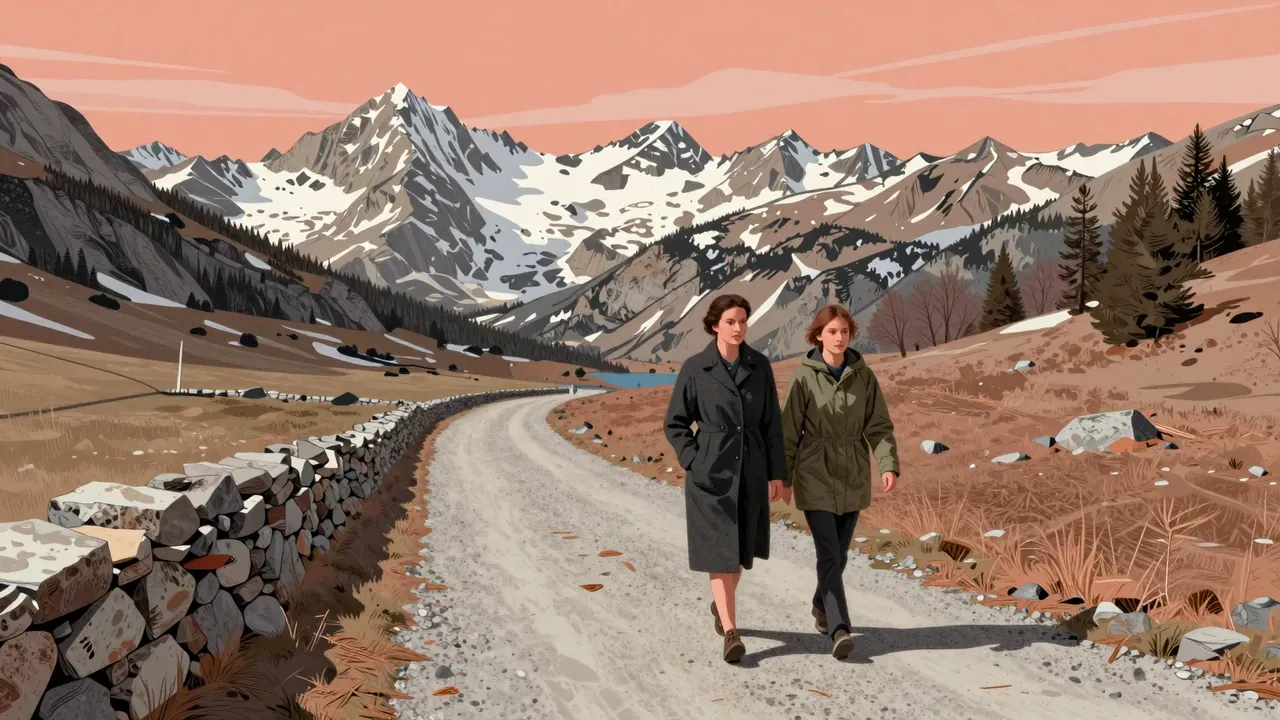
What lands most firmly is the texture of the relationship between Maria and Valentine. Their dynamic is never named, never resolved, never sentimentalised — yet it accumulates weight through accumulation of small acts: reading lines aloud, adjusting a scarf, sharing silence on a mountain path. The film trusts the audience to register shifts in posture, inflection, proximity. Stewart’s performance lands because it resists the obvious: she is neither subservient nor rebellious, but observant to the point of unsettling intimacy. Binoche’s work lands because it refuses vanity — Maria’s discomfort with ageing is not expressed in monologue but in hesitation before a mirror, in a pause before accepting praise, in the way she grips her coffee cup when Jo-Ann arrives. The Maloja Snake itself lands: not as spectacle, but as a slow, silent, natural event witnessed without commentary, its presence felt more than seen. The film’s refusal to explain what happens to Valentine at the end lands too — it leaves space for the viewer to sit with absence, not fill it with narrative closure.
What does not
What does not land is the framing device of the fictional play Maloja Snake. Though Assayas has described it as a condensed version of Fassbinder’s Petra von Kant, its own dramatic logic remains underdeveloped — its plot feels like scaffolding rather than architecture, and its emotional stakes rely entirely on the actors’ investment, not the text’s inherent power. Jo-Ann Ellis, as written, functions more as a cipher than a character: her scandals are reported, not dramatised, and her confrontation with Maria lacks the tension the script implies it should carry. The London theatre scenes feel abruptly staged, their artificiality unmoored from the rest of the film’s grounded tone. There is also a structural slackness in the final third: the shift from Sils Maria to London dissipates momentum, and the young filmmaker’s visit reads as thematic padding rather than dramatic necessity. These choices do not undermine the film, but they do expose where Assayas prioritises mood over mechanics — and where mood alone cannot carry the weight intended.
The themes that matter
The themes that matter are not abstracted but embedded: ageing as professional erasure, not biological decline; celebrity as a condition of perpetual translation, where every gesture is parsed for meaning by unseen audiences; and the assistant as both confidante and rival — a role that blurs labour, loyalty, and intimacy. The film treats time not as linear but recursive: Maria rehearses Helena’s suicide while Rosa recounts Wilhelm’s assisted death; Valentine researches Jo-Ann online while Maria watches her own past performances on a laptop. Technology here is not futuristic but functional — a tool for surveillance, comparison, and self-erasure. Gender is treated as performative but not ironic: the power dynamics between women are presented without moral framing, neither condemned nor celebrated. The Alps function not as backdrop but as counterpoint: vast, ancient, indifferent. In that landscape, human dramas shrink — not to insignificance, but to scale. The film’s deepest concern is with how identity persists, or fractures, when the roles you’ve inhabited no longer fit, and no new ones have been written for you.
Who should watch it
This is for viewers who value sustained attention over exposition, who find tension in withheld information and resonance in unresolved relationships. It suits those familiar with European arthouse conventions — long takes, ambient sound, narrative ellipsis — and those willing to sit with ambiguity rather than seek answers. It is not for viewers who require clear motivation, causal plotting, or emotional catharsis. Those expecting a conventional backstage drama or a generational clash with defined winners and losers will find it withholding. People who rely on dialogue to drive meaning may struggle with stretches where silence or landscape carries the weight. It is also unlikely to satisfy those seeking political urgency or social critique delivered with rhetorical force — its critique is structural, not polemical. A viewer who values craftsmanship over clarity, or who finds intelligence in restraint, will respond; one who equates depth with density of incident will not.
Is it worth your evening
Yes, it is worth your evening — provided you approach it as a piece of sustained atmospheric inquiry rather than a story with endpoints. Its 124 minutes unfold with unhurried precision, each scene calibrated to accumulate meaning slowly, like condensation on glass. It rewards patience not with payoff but with texture: the grain of film, the chill of mountain air, the weight of a glance held too long. It is not a film to consume but to inhabit for its duration — and its afterimage lingers not because of plot but because of presence. Those who dislike films that trust the viewer to infer rather than instruct may find it inert. But for anyone attuned to the subtleties of performance, the politics of proximity, or the quiet violence of time passing, it offers something rare: a drama whose form and subject are inseparable. It earns its length by refusing shortcuts, and its intelligence lies in what it omits.