The making of it
Nouvelle Vague is a dramatised reconstruction of the 23-day shoot of Jean-Luc Godard’s Breathless (1960), staged as a period drama set in Paris, spring and summer 1959. It does not adapt Breathless’s plot or characters but instead treats the making of that film as its subject — a procedural about creative risk, institutional resistance, and the friction between theory and practice. Directed by Richard Linklater and written by Laetitia Masson, it attempts fidelity not to historical record but to the spirit of Cahiers du Cinéma’s critical ethos: that cinema should be personal, urgent, and unbound by studio convention. The film’s ambition is structural as much as thematic: to embody the French New Wave’s methods — improvisation, brevity, visible authorship — while remaining legible to contemporary audiences unfamiliar with the movement’s polemics. It avoids biopic shorthand, refusing to psychologise Godard or mythologise his collaborators; instead, it lingers on logistical hiccups, scheduling disputes, and technical compromises. Its central wager is that the conditions of production — the arguments over jump cuts, the exhaustion of shooting on location with minimal crew, the tension between Seberg’s Hollywood discipline and Godard’s anti-professionalism — are themselves the story worth telling. Word count: 148
The look of it
The narrative unfolds chronologically across two production weeks, anchored by David Chambille’s black-and-white 35 mm cinematography in the Academy ratio, which deliberately mimics the grain, gate weave, and contrast of a 1960 print. Catherine Schwartz’s editing sustains a clipped, episodic rhythm — scenes often end mid-sentence or mid-gesture, reinforcing the film’s interest in process over polish. Performances avoid mimicry: Zoey Deutch plays Jean Seberg with quiet watchfulness rather than star power, Aubry Dullin’s Belmondo is physically restless but emotionally guarded, and Guillaume Marbeck’s Godard is less a genius than a stubborn, sleep-deprived man insisting on decisions he cannot yet justify. Supporting roles — notably Antoine Besson as Truffaut and Matthieu Penchinat as Chabrol — function as counterpoints, their measured pragmatism framing Godard’s volatility. The script’s French dialogue, translated and refined by Masson, favours functional exchanges over exposition; much is conveyed through glances, pauses, and the weight of silence in cramped offices or rain-slicked streets. Costume, production design, and sound design all serve restraint: no anachronisms, no score beyond diegetic radio fragments, no editorialising voiceover. Word count: 152
The gestures in it
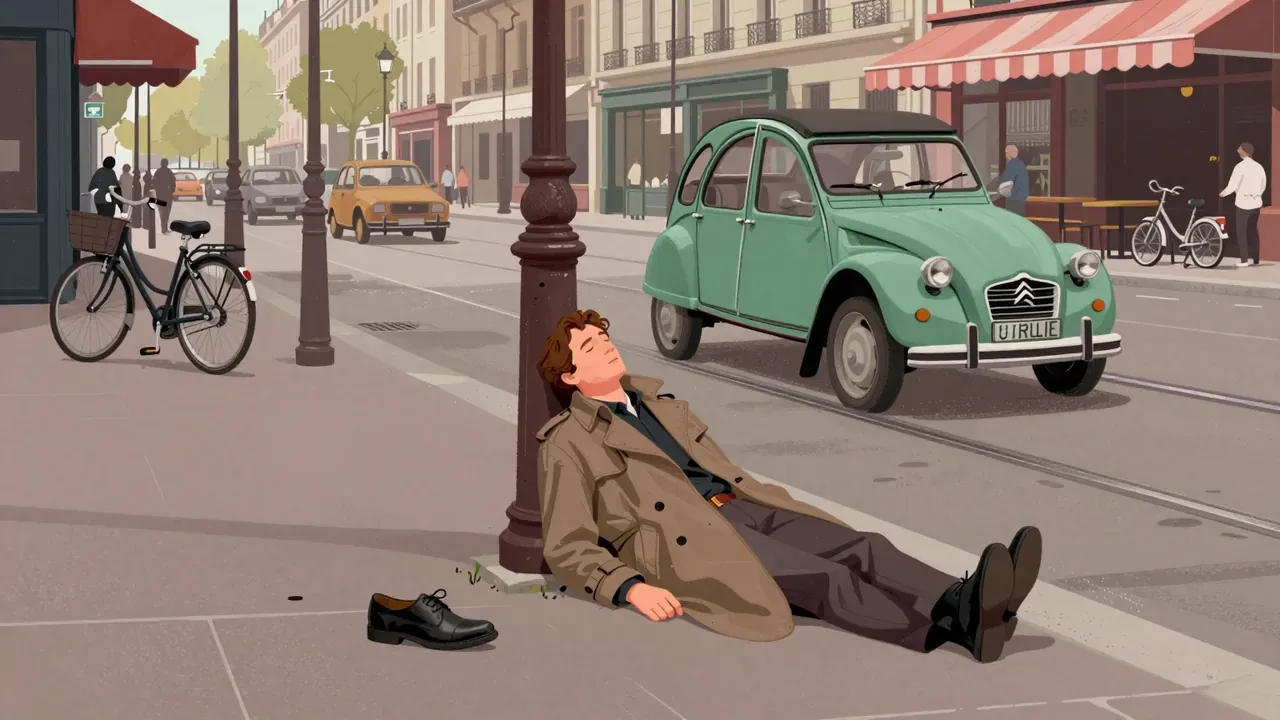
What lands most firmly is the film’s tactile sense of time and place: the clatter of typewriters at Cahiers du Cinéma, the smell of wet pavement and cigarette smoke clinging to wool coats, the low hum of a 16 mm camera motor in a narrow Montparnasse alley. The recreation of Breathless’s production logistics feels lived-in — the frustration of waiting for light, the awkwardness of filming dialogue without sound recording, the way Godard’s insistence on shooting in sequence forces actors to hold emotional continuity across days. Several sequences achieve quiet precision: the first meeting between Seberg and Godard, conducted through Moreuil as translator and intermediary; the moment Belmondo hears his own voice dubbed in English and recoils; the final take of the street death scene, shot in one long take with no rehearsal. These moments work because they root abstraction — ideas about authorship, spontaneity, rebellion — in physical consequence. The tableaux interludes, naming critics and filmmakers of the era, land with solemn grace, not reverence: each is a quiet citation, not a monument. The film’s affection for its subjects is evident but never sentimental; it admires their rigour more than their legend. Word count: 150
The arguments in it
What does not land is the film’s attempt to dramatise Godard’s internal evolution. His shifts in confidence, doubt, or conviction remain opaque — less because they are withheld, more because the script gives him no private language, no voiceover, no solitary moments of reflection. His motivations are externalised through argument or action, leaving little room for ambiguity or contradiction beyond what the facts allow. Similarly, the portrayal of Seberg’s ambivalence lacks psychological texture: her departure feels procedural rather than emotional, her refusal to search Michel’s pockets registered as professional boundary-setting rather than moral recoil. The film also struggles with scale — it is too tightly focused on the shoot to accommodate the broader cultural ferment it invokes. Scenes referencing Rossellini’s visit or Melville’s advice feel like citations rather than interactions, their impact diluted by brevity. And while the decision to omit Truffaut’s The 400 Blows from direct depiction is defensible, its absence leaves Godard’s competitive drive under-explained, reducing his rivalry to background noise. Word count: 149
The refusal in it
The themes that matter are authorship as labour, not inspiration; the gap between criticism and creation; and the material constraints that shape aesthetic revolution. Nouvelle Vague treats the New Wave not as a stylistic rupture but as a series of small, cumulative refusals — to rehearse, to sync sound, to fix continuity, to defer to producers. It foregrounds how theory becomes habit: Godard’s insistence on jump cuts is less a manifesto than a habit formed during editing, just as Seberg’s line readings reflect her training in Hollywood naturalism, not ideological alignment. The film also traces how authority migrates — from Beauregard’s office to Godard’s notebook to Coutard’s camera to Decugis’s cutting bench — and how each transfer involves negotiation, compromise, and quiet resistance. Gender operates as structure, not subplot: Seberg’s presence is constantly mediated — by husband, producer, director, interpreter — and her exit signals not failure but recalibration. There is no nostalgia here for lost authenticity, only attention to how every choice — lens, ratio, frame rate, take count — carries political weight. Word count: 147
The knowledge in it
This is for viewers who value craft over charisma, process over plot, and who approach film history not as canon but as contested terrain. It rewards patience with quiet scenes, tolerance for unresolved tension, and familiarity with Breathless or at least its reputation. It is not for those who require clear character arcs, emotional catharsis, or exposition that spells out stakes. Fans of Linklater’s Before trilogy may find its conversational density familiar, but its austerity is closer to Éric Rohmer than to Dazed and Confused. Those expecting a vibrant, kinetic homage — like Bertrand Tavernier’s Safe Conduct — will find it too restrained; those hoping for a Godard biopic will find it too detached. Its appeal narrows further for viewers unfamiliar with the New Wave’s key texts or figures: without that context, some scenes read as bureaucratic rather than revolutionary. A viewer who dislikes films where nothing ‘happens’ except conversation, waiting, and minor technical setbacks will leave unsatisfied. Word count: 149
The ending of it
Yes, it is worth your evening — provided you watch it on a screen large enough to register Chambille’s grain and Schwartz’s pacing, and with the expectation that its pleasures are cumulative, not climactic. It repays attention not through revelation but through accumulation: the third time you see Godard adjust his glasses before calling ‘action’, the fifth time Seberg checks her watch outside a café, the seventh time Belmondo lights a cigarette without looking at the flame — these repetitions build a world you inhabit, not observe. It is not a film to stream distractedly; it demands stillness. Some will call it dry, others austere, but its discipline is deliberate, not deficient. Those who find it inert likely expect drama where it offers documentation, or energy where it offers endurance. A single viewing suffices, but its textures — the texture of paper, of film stock, of Parisian light — linger longer than expected. Word count: 150