The look of it
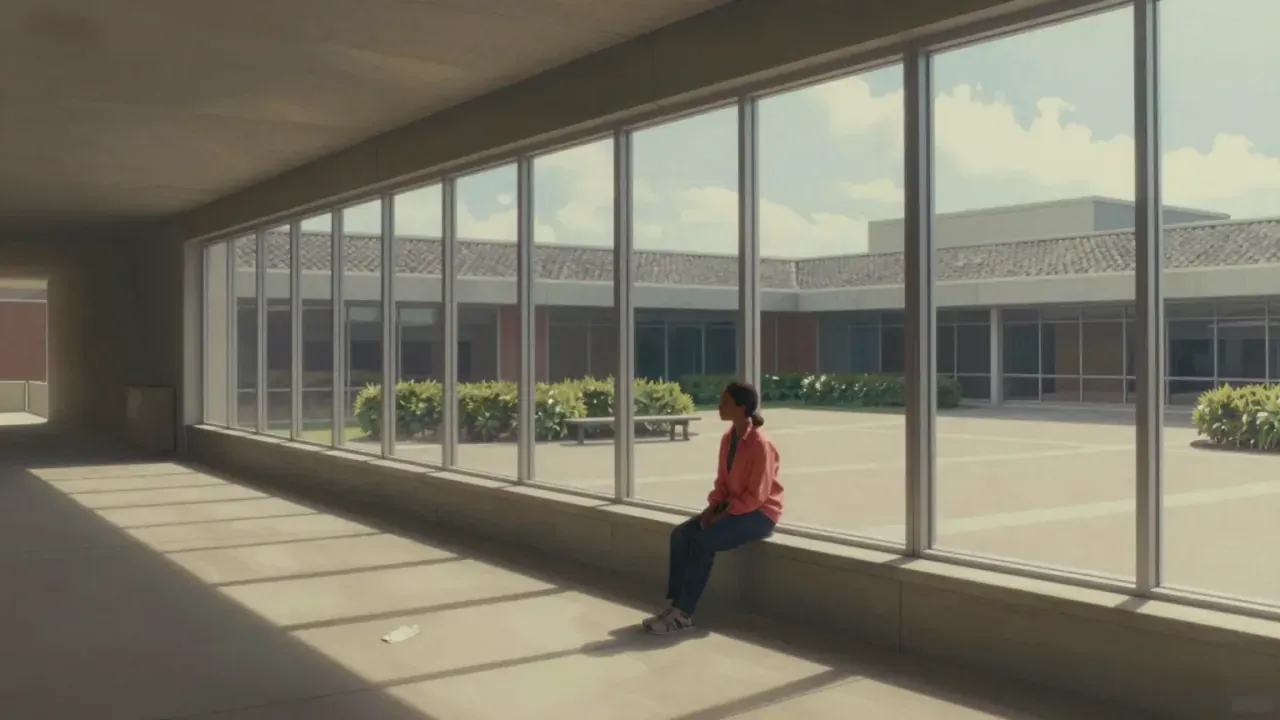
Columbus is a drama about two people who meet in a Midwestern town known for its Modernist architecture, and whose conversations about buildings become a way of talking around their own lives. It tries to hold silence and speech in balance: the weight of unspoken family histories, the difficulty of choosing between duty and desire, the quiet intensity of connection that forms without promise of permanence. Kogonada’s debut does not seek to resolve those tensions but to frame them with the same care he applies to a building’s proportion or a doorway’s negative space. The film treats architecture not as backdrop but as grammar — a shared language through which Jin and Casey articulate what they cannot say directly about grief, obligation, or longing. Its ambition lies in restraint: to make emotional precision visible, to let composition carry meaning usually assigned to dialogue or plot turns. It assumes attention, not explanation; it invites the viewer to notice how a corridor’s length echoes a character’s hesitation, or how a window’s framing isolates one person while including another just out of focus.
The weight of it
The story unfolds over several days in Columbus, Indiana, following Jin Lee as he waits beside his comatose father and meets Casey, who works at the local library. Their exchanges are unhurried, grounded in observation — of buildings, of each other’s habits, of silences that settle like dust. John Cho gives Jin a contained gravity: his stillness reads as both reserve and exhaustion, his dry humour never masking the ache beneath. Haley Lu Richardson matches him beat for beat, her Casey outwardly steady but constantly recalibrating — her gestures small, her pauses deliberate, her hope carefully guarded. Elisha Christian’s cinematography keeps the frame clean and the light even, often holding wide shots that place the characters within the architecture rather than against it. Hammock’s score avoids melody in favour of sustained tones and slow decay, reinforcing the film’s preoccupation with presence and absence. There are no dramatic reversals, no contrived confrontations — only accumulation: of glances, of shared walks, of sentences left unfinished and then quietly resumed.
The rhythm of it
What lands most firmly is the reciprocity between character and setting. The Saarinen and Pei buildings are not decorative; they function as emotional counterweights — their clarity and calm offering contrast to the characters’ internal disorder. When Jin and Casey stand before the North Christian Church, the camera holds them in the same frame as the structure’s soaring lines, and the alignment feels earned, not imposed. Cho and Richardson’s performances land because they refuse theatricality: their chemistry is built on listening, on shifts in posture, on the way Casey tucks her hair behind her ear when she’s uncertain, or how Jin exhales slowly before answering a question he’d rather avoid. The film’s pacing lands too — its 100 minutes feel neither rushed nor slack, but measured, like breath held just long enough to register change. Even minor roles register: Parker Posey’s Eleanor carries decades of unspoken history in a single glance; Michelle Forbes’ Maria conveys fragility and resilience without tipping into pathos. Nothing here shouts for attention; everything earns its place by persisting quietly.
The cost of it
What does not land is any sense of urgency beyond the personal. The film’s refusal to dramatise Jin’s father’s condition — beyond the fact of the coma — risks flattening the stakes for some viewers. There is no medical detail, no hospital bureaucracy, no visible strain on Jin’s resources; the situation remains abstracted, almost aestheticised. Likewise, Casey’s mother’s recovery arc is sketched in broad, emotionally economical strokes — effective for the film’s tone, but thin if read as social realism. The architecture, while integral, occasionally threatens to overwhelm character: a lingering shot on the Cleo Rogers Library may deepen mood but does little to advance Jin or Casey’s understanding of each other. Some will find the restraint indistinguishable from inertia — the film asks for patience, and those unwilling to grant it may perceive emptiness where it intends resonance. It does not build momentum in the conventional sense; it accumulates texture instead, and that choice excludes viewers who require narrative propulsion or clear cause-and-effect.
The shape of it
The themes that matter are architecture as metaphor for interior life, the weight of inherited expectation, and the quiet courage of incremental self-assertion. Jin’s resentment toward his father is not about neglect in the ordinary sense, but about the substitution of intellectual legacy for emotional presence — a tension mirrored in the buildings themselves, which are celebrated for their ideas more than their human use. Casey’s dilemma is less about ambition versus care than about whether responsibility must always mean stasis. Her eventual decision to leave is not triumphant but tentative, underscored by uncertainty rather than resolution. The film treats time as non-linear: memory intrudes without warning, past conversations echo in present silences, and the city’s buildings — many designed mid-century — stand outside chronology, anchoring the characters in a continuum they did not choose but must navigate. Absence is treated as material: empty rooms, unspoken words, gaps between generations — all structured with the same intentionality as a Saarinen façade.
The terms of it
This is for viewers who value composition over exposition, who find emotional weight in stillness, and who are comfortable sitting with ambiguity longer than most films allow. It suits those familiar with Ozu or early Linklater — not as reference points, but as temperamental kin. It is not for viewers who rely on plot mechanics to stay engaged, or who expect character arcs to follow a rising-falling curve. Those who need explicit moral framing or psychological explanation will find Columbus withholding. A viewer expecting a romance will be disappointed; one seeking a meditation on how space shapes feeling will find it exact. The film’s slowness is structural, not incidental — remove it and the architecture collapses into scenery, the performances into mannerism. Someone who finds beauty in restraint will call it essential; someone who equates stillness with stagnation will call it inert. Nothing changes that verdict except a shift in what the viewer believes cinema is for.
The measure of it
Yes, it is worth your evening — provided you arrive willing to watch closely and listen quietly. Its 100 minutes ask for attention, not endurance, and repay it with cumulative precision: a gesture, a pause, a building’s shadow falling across a face at dusk. It is not an event film, nor a comfort watch; it is a film to be inhabited, not consumed. Those who find richness in understatement will leave with images and rhythms that linger — the curve of a stairwell, the sound of footsteps on concrete, the way two people learn to share silence without filling it. It is not for everyone, but for its audience, it is rare: a debut that trusts its form, its performers, and its viewers equally. To dismiss it as ‘too quiet’ mistakes stillness for emptiness. To embrace it is to accept that some truths are held in the space between words — and that architecture, like feeling, is the structuring of emptiness.