A different kind of adaptation
Ran is Akira Kurosawa’s 1985 adaptation of King Lear transposed to the Sengoku period, using Shakespeare’s structure and emotional architecture but grounding it in Japanese history, legend, and Kurosawa’s own late-life reckoning. It is not a translation but a reconstitution: Hidetora Ichimonji is no tragic fool but a warlord whose lifetime of violence makes his downfall a moral inevitability, not just a misjudgement. The film attempts three things at once — to stage epic warfare with physical and logistical rigour; to render psychological disintegration through visual composition rather than exposition; and to compress decades of political decay, personal regret, and spiritual exhaustion into a single, unbroken descent. Its ambition is structural as much as thematic: to build a world where colour, costume, landscape, and silence all serve narrative logic, where every castle, banner, and horse carries historical weight and symbolic function. It does not seek empathy for Hidetora so much as comprehension — of how power calcifies, how loyalty curdles, and how chaos emerges not from disorder but from the collapse of meaning.
The grammar of wide shots
The story unfolds in three acts, each anchored by a major battle or siege, with dialogue pared to ritualistic brevity and long stretches of near-silence punctuated by sudden, brutal action. Tatsuya Nakadai’s Hidetora moves from imperious stillness to trembling incoherence without recourse to histrionics; his face remains the film’s most active site of change. Takao Saito, Asakazu Nakai, and Shōji Ueda shoot almost entirely in wide and medium-long lenses, holding frames static until movement enters from off-screen — a cavalry charge, a fleeing figure, smoke rising over a ridge. Emi Wada’s costumes are not decorative but dialectical: the red, blue, and yellow banners of the sons signal factional identity before a word is spoken. Toru Takemitsu’s score avoids melody in favour of sustained dissonance and percussive rupture, often dropping out entirely during key confrontations. Kurosawa edits with deliberate asymmetry — jump cuts fracture time, while extended takes force attention on duration, exhaustion, and consequence.
The weight of the world
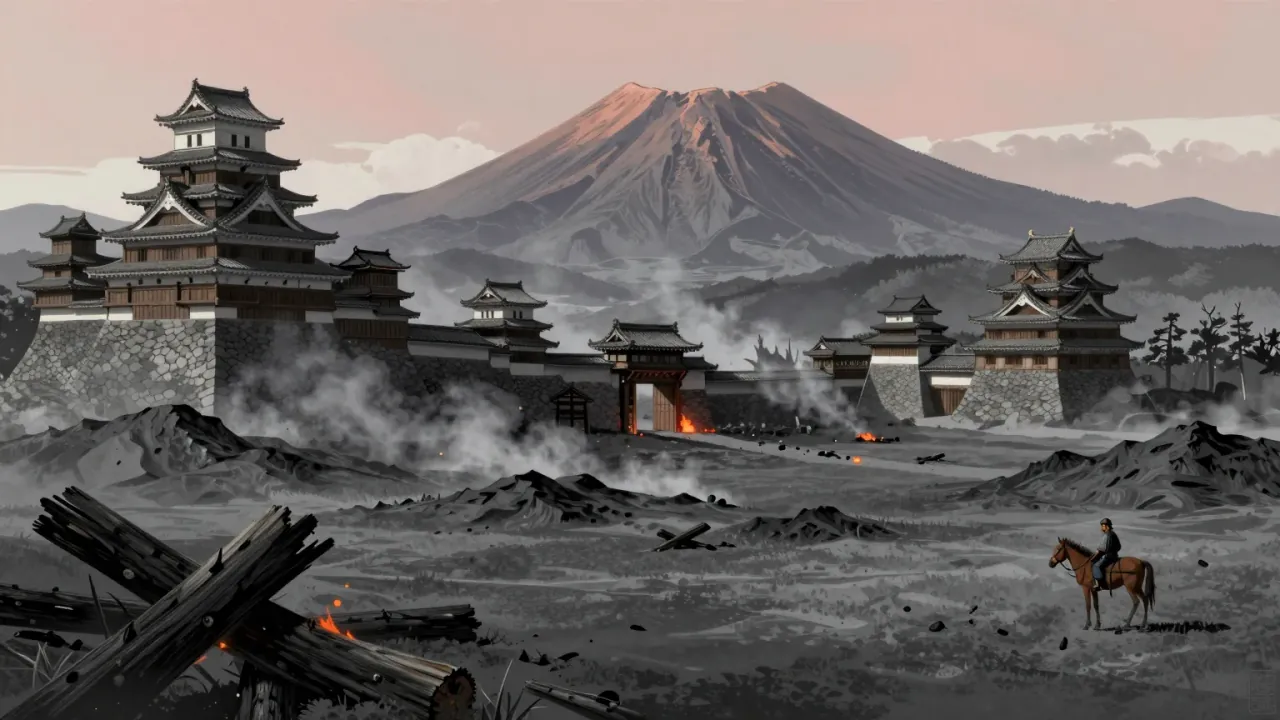
What lands is the sheer material conviction of the world: the weight of armour, the grit of ash on skin, the way light falls across Kumamoto Castle’s stone walls at dawn. The third-act siege of the Third Castle — shot on location, with no miniatures, no digital enhancement — holds its ground not as spectacle but as physical fact: fire consumes timber, smoke chokes breath, and Nakadai stumbles through real flame in one continuous take. The Fool Kyoami’s interludes work because they are never comic relief but structural punctuation — a reminder that tragedy requires both gravity and witness. The colour palette — especially the saturated reds and yellows against grey volcanic plains — does not symbolise emotion so much as register it: rage, warning, blood, authority, all held in pigment. Even minor characters like Tango or Lady Kaede carry narrative density in posture and glance; their motivations need no voiceover because their actions follow from established precedent and social law.
Where the frame holds too still
What does not land is the film’s occasional reliance on allegorical shorthand — particularly in the final stretch, where Tsurumaru’s blindness and isolation verge on schematic rather than earned. The gold-sprayed field Kurosawa cut from the final edit haunts the film as an absence: its removal leaves some transitions feeling abrupt, as if narrative momentum has been sacrificed for austerity. The middle act’s pacing falters slightly when the focus shifts from Hidetora to Jiro’s court; the political machinations there lack the visceral immediacy of the battlefield or the intimacy of madness. Some performances — particularly among the younger sons’ retainers — remain functional rather than individuated, serving plot over psychology. And while the Shakespearean parallels are clear, the film’s refusal to explain its departures — why Saburo’s loyalty feels less like virtue than fatalism, why Kaede’s vengeance reads as historical necessity rather than personal grievance — may leave viewers unfamiliar with either Lear or Sengoku history grasping for connective tissue that the film deliberately withholds.
What ‘ran’ really means
The themes that matter are not loyalty or betrayal in the abstract, but the transmission of violence across generations: Hidetora blinded Tsurumaru, then is himself undone by the children of those he destroyed. Chaos — the literal meaning of ‘ran’ — is not the opposite of order but its exhausted residue: what remains when institutions, families, and memory have all been hollowed out. Ageing here is neither dignified nor pitiable but forensic: Kurosawa studies the body’s failure as evidence of moral attrition. Power is shown not as something wielded but as something that accrues, fossilises, and finally collapses under its own mass. There is no redemption arc, no catharsis beyond recognition — only the slow dawning that Hidetora’s suffering is not exceptional but structural, the logical terminus of a life spent treating people as terrain. The film treats landscape as conscience: Mount Aso’s dormant caldera, the ruins of Azusa Castle, the empty courtyards of Himeji — all hold memory more reliably than any character.
Who the film waits for
This is for viewers who value sustained visual argument over exposition, who can sit with silence longer than most films allow, and who accept that coherence may reside in composition, not dialogue. It rewards patience with texture — the weave of a banner, the grain of weathered wood, the rhythm of hoofbeats receding. It is not for those who require psychological exposition, narrative signposting, or moral resolution; anyone expecting a conventional arc of fall-and-redemption will find Ran withholding, even adversarial. Those who dislike non-English-language films with subtitles, or who struggle with 160-minute runtimes without scene breaks or musical cues, will likely disengage early. A viewer who values Takemitsu’s score as atmosphere rather than accompaniment, or who sees costume design as narrative infrastructure, will find Ran rich. Someone who prefers character-driven intimacy over architectural storytelling may feel distanced — and that distance is intentional, not a flaw.
Why it lasts
Yes, it is worth your evening — provided you set aside the expectation of entertainment and instead prepare for immersion in a fully realised, morally unblinking world. Its 160 minutes pass without hurry because nothing is filler: every frame serves geography, hierarchy, or consequence. It earns its length through accumulation — of detail, of consequence, of visual memory. Those who argue it is ‘cold’ or ‘remote’ mistake restraint for indifference; those who call it ‘overlong’ have not felt the weight of the Third Castle’s collapse, or watched the slow fade of Hidetora’s gaze as it loses purchase on reality. A viewer who watches on a small screen, without full sound, or while distracted, will miss the film’s central discipline: its insistence that meaning resides in duration, scale, and silence. To see Ran properly is to submit to its tempo — and in doing so, discover how rarely cinema trusts time to do its work.