filmbriefs
Topic

Law

Rules with force behind them, and the profession that interprets them.

37
in film
13:00
average
481 min
in total
90
across the network
Law across the network →
All briefs37
13:00

A Dry White Season

Euzhan Palcy · 1989

Euzhan Palcy’s 1989 drama follows a white South African teacher drawn into resistance after his Black gardener is tortured and killed by police in 1976 Soweto. Adapted from André Brink’s novel, it traces Ben Du Toit’s moral unraveling through courtrooms, classrooms and clandestine document-hiding — with Donald Sutherland, Marlon Brando and Janet Suzman. Shot in Zimbabwe and at Pinewood Studios, it is a trial film grounded in legal process, not polemic.
13:00

Anatomy of a Fall

Justine Triet · 2023

Anatomy of a Fall is a 2023 French legal thriller directed by Justine Triet, following a German writer accused of murdering her French husband. Structured around a meticulously rendered courtroom trial and fragmented flashbacks to their isolated mountain home, the film interrogates how truth is assembled — and undone — through translation, testimony and institutional procedure. Sandra Hüller delivers a tightly controlled performance amid a restrained, linguistically precise production.

13:00

Anatomy of a Murder

Otto Preminger · 1959

Otto Preminger’s 1959 Anatomy of a Murder is a rigorously procedural crime drama set in Michigan’s Upper Peninsula. James Stewart plays a small-town lawyer defending an army lieutenant accused of murder, using an 'irresistible impulse' insanity plea. Shot on location with documentary restraint, it prioritises legal mechanics over psychology, and evidentiary tension over emotional payoff. Sam Leavitt’s cinematography and Duke Ellington’s score support, never dominate, its deliberate pace. Though acclaimed for authenticity, it resists moral framing — leaving viewers with the structure of doubt, not the comfort of verdict.

13:00

Body Heat

Lawrence Kasdan · 1981

A 1981 neo-noir thriller set in sweltering south Florida, Body Heat follows a small-time lawyer drawn into a lethal affair with a wealthy man’s wife. Written and directed by Lawrence Kasdan, it updates classic noir fatalism with 1980s sexual frankness and structural rigour. Its power lies in atmosphere, implication, and the slow, inevitable collapse of illusion — forged wills, assumed identities, and withheld truths all converge in a climax that reframes everything that came before.

13:00

Breaker Morant

Bruce Beresford · 1980

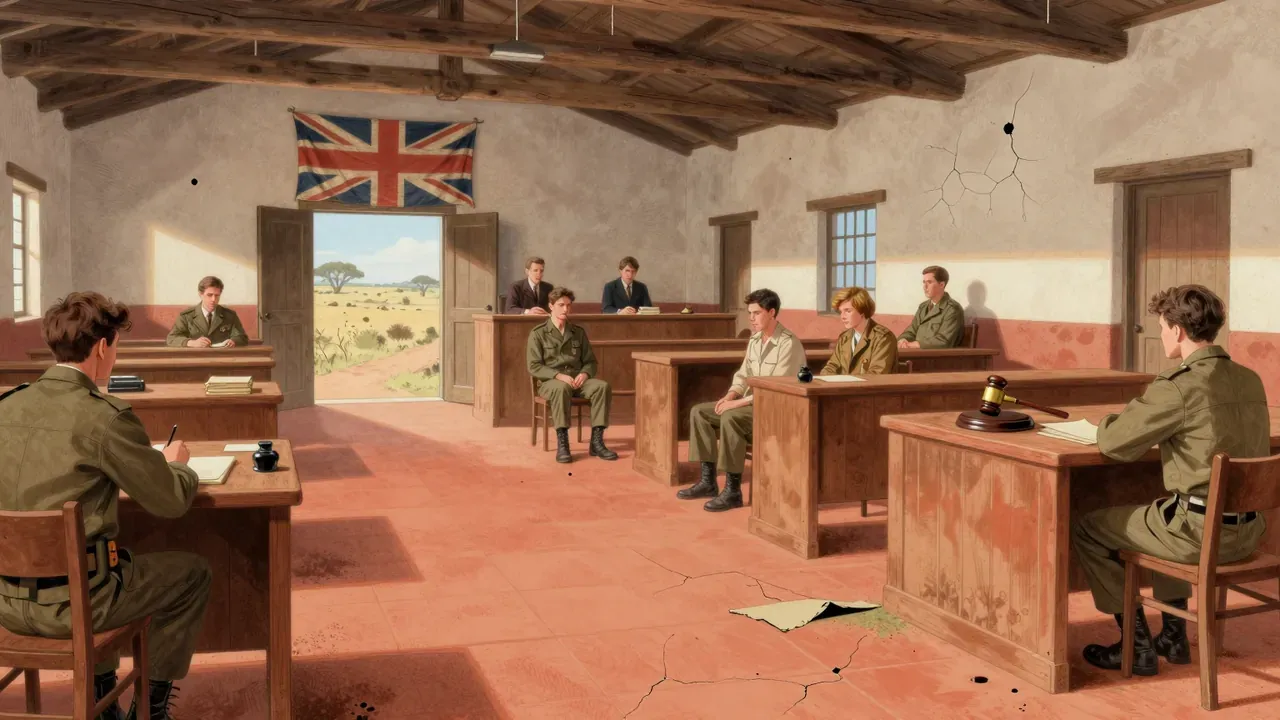
Breaker Morant (1980), directed by Bruce Beresford, dramatises the 1902 court martial of three Australian lieutenants accused of war crimes in the Boer War. Structured around courtroom testimony and fragmented flashbacks, it foregrounds procedural injustice over moral verdict, using restrained craft to expose how military justice serves political ends. Adapted from Kenneth G. Ross’s play, it won ten Australian Film Institute Awards and remains a benchmark of Australian cinema’s engagement with colonial accountability.

13:00

Certain Women

Kelly Reichardt · 2016

Kelly Reichardt’s 2016 triptych adapts three Maile Meloy stories set in Montana, following a lawyer, a builder’s wife and a ranch hand as they navigate quiet crises of agency, expectation and connection. Shot by Christopher Blauvelt and edited by Reichardt, it uses precise framing, location sound and deliberate pacing to explore how law, geography and gender shape ordinary lives — without exposition, score or resolution.

13:00

Chains

Raffaello Matarazzo · 1950

Raffaello Matarazzo’s 1950 Italian melodrama Chains follows mechanic Guglielmo Aniello, his wife Rosa, and the returned ex-fiancé Emilio whose blackmail threatens their marriage and family. Shot by Carlo Montuori and edited by Mario Serandrei, it builds tension through restraint — in performance, framing, and narrative economy — culminating in a courtroom verdict that affirms legality over morality. Though maligned by neorealist critics, its commercial success and inclusion in Italy’s ‘100 films to be saved’ list attest to its cultural resonance.

13:00

Close-Up

Abbas Kiarostami · 1990

Close-Up (1990) is Abbas Kiarostami’s reconstruction of a real 1980s Tehran fraud case: Hossein Sabzian, a print-shop worker, posed as filmmaker Mohsen Makhmalbaf to gain entry into a family’s home, promising them roles in a film. With full participation from Sabzian, the Ahankhah family, the journalist who exposed him, the judge, and Makhmalbaf himself, Kiarostami films their trial and re-enactments of key events — all playing themselves. The film treats identity, cinema, and justice not as abstractions but as lived, contingent acts of attention and consent.

13:00

Divorce, Italian Style

Pietro Germi, Renzo Marignano · 1961

Divorce, Italian Style (1961) is a Sicilian black comedy in which an impoverished nobleman plots to murder his wife in order to claim leniency under Italy’s honour-killing statutes. Directed by Pietro Germi and written by Germi, Ennio de Concini, Alfredo Giannetti and Agenore Incrocci, it stars Marcello Mastroianni as Ferdinando Cefalù, whose elaborate scheme exposes the contradictions between law, religion and social expectation in pre-divorce Italy. The film won the Academy Award for Best Original Screenplay and remains a benchmark of satirical precision.

13:00

Girls of the Night

Kinuyo Tanaka · 1961

Kinuyo Tanaka’s 1961 drama follows Kuniko, a woman repeatedly released from a reformatory after Japan’s Prostitution Prevention Law, as she seeks work and dignity across domestic service, factory labour, and horticulture — only to be rejected each time her history becomes known. With Chisako Hara in a performance of quiet endurance, and Asakazu Nakai’s unadorned cinematography, the film charts the quiet mechanics of social exclusion, not as cruelty but as routine. It ends not with resolution but relocation: Kuniko working as an ama in Bōsō.

13:00

Infernal Affairs II

Andrew Lau, Alan Mak · 2003

A 2003 Hong Kong crime thriller and prequel to Infernal Affairs, set between 1991 and 1997. It charts the rise of triad heir Ngai Wing-hau and the parallel infiltration of two moles—one in the police, one in the triad—against the backdrop of Hong Kong’s impending handover. Directed by Andrew Lau and Alan Mak, it expands the original’s moral universe into a generational study of power, loyalty and erasure.

13:00

La Poison

Sacha Guitry · 1951

Sacha Guitry’s 1951 French film follows a married couple in provincial France who independently decide to kill each other. Using black-and-white cinematography on colour-built sets, tight framing and uninflected performances — especially from Michel Simon and Germaine Reuver — the film treats homicide as a procedural puzzle, not a moral crisis. Written and directed by Guitry, with music by Louiguy and editing by Raymond Lamy, it unfolds with clockwork symmetry, offering irony without sentiment and structure without spectacle.

13:00

Marriage Story

Noah Baumbach · 2019

Marriage Story follows a New York theatre director and his actress wife as their amicable separation hardens into a bi-coastal custody battle. Written and directed by Noah Baumbach, it stars Adam Driver and Scarlett Johansson, with Laura Dern winning an Oscar for her turn as a formidable divorce lawyer. Shot by Robbie Ryan and edited by Jennifer Lame, it avoids melodrama in favour of procedural realism and emotional granularity — tracking how love endures as habit, memory, and quiet gesture long after the legal terms are settled.

13:00

Saint Omer

Alice Diop · 2022

Alice Diop’s debut fiction film reconstructs a French murder trial not to explain but to inhabit — following a pregnant novelist who attends the case of a Senegalese woman accused of killing her infant. Shot in austere, observant style, it treats law, motherhood, and migration as overlapping fields of unspoken pressure, refusing resolution in favour of sustained, ethically weighted attention.

13:00

Salvatore Giuliano

Francesco Rosi · 1962

Francesco Rosi’s 1962 docudrama reconstructs the life and death of Sicilian bandit Salvatore Giuliano not as myth or biography, but as a forensic inquiry into institutional complicity. Shot on location in Sicily with non-professional actors, it uses fragmented chronology, courtroom transcripts and contradictory testimony to expose how power operates across Mafia, carabinieri and judiciary. Giuliano appears only fleetingly — dead, distant, obscured — while figures like his betrayer Pisciotta and judges presiding over rigged trials occupy the frame. The film’s rigour lies in its refusal to narrativise, opting instead for procedural clarity and structural irony.

13:00

Samurai Rebellion

Masaki Kobayashi · 1967

Masaki Kobayashi’s 1967 jidaigeki follows a loyal samurai whose adherence to protocol forces him into open revolt against his daimyo. Based on Yasuhiko Takiguchi’s short story and scripted by Shinobu Hashimoto, the film traces how rigid hierarchy turns love, parenthood, and honour into liabilities. With Toshirō Mifune and Tatsuya Nakadai, Kazuo Yamada’s restrained cinematography and Tōru Takemitsu’s sparse, traditional score deepen its austerity. It won Best Film at Kinema Junpo and Mainichi, and the FIPRESCI Prize at Venice.

13:00

Scandal

Akira Kurosawa · 1950

A painter and a singer sue a tabloid for fabricating their romance, but the case becomes secondary to their lawyer’s moral collapse under financial pressure. Set in postwar Tokyo, Scandal pivots from social critique to intimate tragedy, anchored by Takashi Shimura’s performance as a man whose conscience frays in silence. Kurosawa’s direction is plain and precise; Fumio Hayasaka’s score uses irony to deepen unease. The film’s power lies not in its courtroom climax, but in the weight of unspoken guilt, a sick child’s breath, and torn posters fading on a city wall.

13:00

Seduced and Abandoned

Pietro Germi · 1964

Pietro Germi’s 1964 film Seduced and Abandoned uses dark procedural satire to examine Sicilian customs around forced marriage, statutory rape and legal 'honour repair'. Set in Sciacca, it follows fifteen-year-old Agnese Ascalone as her family, the Califanos and the courts negotiate her future through staged kidnappings, legal loopholes and public shaming. With Stefania Sandrelli and Saro Urzì, and written by Germi, Incrocci, Scarpelli and Vincenzoni, it is formally rigorous, morally unsentimental and structurally relentless.

13:00

Sennan Asbestos Disaster

Kazuo Hara · 2016

Kazuo Hara’s 2016 documentary Sennan Asbestos Disaster observes survivors of industrial asbestos exposure in Osaka over many years. With no narration, score, or archival inserts, it tracks legal battles, medical decline, and daily endurance — treating latency, embodiment, and institutional slowness as its core subjects.

13:00

Street of Shame

Kenji Mizoguchi, Yasuzō Masumura · 1956

Street of Shame (1956), Kenji Mizoguchi’s last film, follows five women working in a Tokyo brothel as Japan debates abolishing licensed prostitution. With restrained performances, Kazuo Miyagawa’s unemphatic cinematography, and Masashige Narusawa’s faithful adaptation of Yoshiko Shibaki’s novel, it treats prostitution not as moral failure but as labour embedded in debt, family duty, and social exclusion. The film ends not with liberation but with continuity: a young maid begins her first day as a prostitute. Its power lies in its refusal to dramatise change — or to pretend it is imminent.

13:00

The Ballad of Gregorio Cortez

Robert Milton Young · 1982

Robert Milton Young’s 1982 biographical Western follows Gregorio Cortez, a Mexican-American farmer wrongly accused after a fatal misunderstanding in 1901 Texas. Starring Edward James Olmos and shot on authentic locations—including the real Gonzales courthouse—the film unfolds with documentary restraint, charting twelve years of trials and imprisonment. Its strength lies in structural clarity and historical fidelity; its limitation, in emotional distance. Preserved by the Library of Congress in 2022, it is a rigorous, unsentimental account of jurisdictional violence on the US-Mexico border.

13:00

The Cousins

Claude Chabrol · 1959

Claude Chabrol’s 1959 drama follows two law students — the idealistic Charles and the jaded Paul — sharing an apartment in Paris. As Charles’s convictions erode under Paul’s effortless cynicism, the film traces the quiet transfer of worldview through proximity, culminating in an act of unintended violence. Shot by Henri Decaë and written with Paul Gégauff, it is a precisely observed, morally ambiguous study of bourgeois inertia and inherited disillusionment.

13:00

The Forgiveness of Blood

Joshua Marston · 2011

Set in rural Albania, The Forgiveness of Blood follows a brother and sister whose lives fracture after their father kills a neighbour in a land dispute governed by the Kanun, a customary code that demands revenge and confines men to their homes. Seventeen-year-old Nik is trapped indoors; fourteen-year-old Rudina quits school to run the family bread route. Shot in natural light with restrained performances and minimal dialogue, the film observes how ancient law interfaces with mobile phones, internet dreams, and adolescent longing — not as clash, but as quiet, daily recalibration.

13:00

The Inheritance

Masaki Kobayashi · 1962

Masaki Kobayashi’s 1962 drama follows the ruthless scramble among associates of a dying businessman to locate and manipulate his three illegitimate children before he divides his fortune. With Keiko Kishi, Sō Yamamura and Tatsuya Nakadai, and cinematography by Takashi Kawamata and music by Tōru Takemitsu, the film rejects sentiment in favour of procedural rigour — exposing how legality, kinship and mortality become instruments of financial gain.

13:00

The Thin Blue Line

Errol Morris · 1988

Errol Morris’s 1988 documentary reconstructs the wrongful conviction of Randall Dale Adams for the 1976 murder of Dallas police officer Robert Wood. Through stylised re-enactments, tightly framed interviews and Philip Glass’s score, it exposes inconsistencies in witness testimony and prosecutorial conduct. It helped overturn Adams’s sentence and redefined documentary form — not as observation but as active, cinematic intervention in questions of justice.

13:00

The Trial

Orson Welles · 1962

Orson Welles’s 1962 *The Trial*, filmed in France with Anthony Perkins and Jeanne Moreau, reworks Kafka’s novel into a stark, spatially disorienting vision of systemic power. Shot in abandoned stations and exposition halls, it uses scale, sound and silence to evoke procedural dread — not as metaphor but as lived atmosphere. Its enduring force lies in its refusal of explanation, catharsis or comfort.

13:00

The Truth

Henri-Georges Clouzot · 1960

A young woman stands trial for murder in 1960s France. Through flashbacks, the film traces her descent from provincial restlessness to Parisian disillusionment, her turbulent relationship with a conductor, and her eventual breakdown — all while lawyers debate not her actions, but what they say about her character. Brigitte Bardot gives a physically exacting performance; Clouzot and his collaborators build a world where emotion is evidence, memory is contested, and justice is procedural, not redemptive.

13:00

Two Prosecutors

Sergei Loznitsa · 2025

Sergei Loznitsa’s Two Prosecutors follows a young Soviet prosecutor in 1937 as he attempts to investigate the wrongful imprisonment of an Old Bolshevik during the Great Purge. Shot in a 1905 Riga prison and anchored by Aleksandr Kuznetsov’s restrained performance, the film unfolds with procedural exactness, refusing catharsis or moral simplification. Its power lies in accumulation: of silence, delay, and the quiet absorption of dissent into state machinery.

13:00

Unholy Desire

Shohei Imamura · 1964

Shohei Imamura’s 1964 drama follows Sadako, a woman excluded from her common-law husband’s family register, who endures rape, coercion, and bureaucratic erasure before filing a civil suit to claim legal recognition. Shot by Shinsaku Himeda and scored by Toshiro Mayuzumi, the film observes survival as daily practice — quiet, persistent, and rooted in material reality rather than moral arc.

13:00

Victim

Basil Dearden · 1961

Victim (1961), directed by Basil Dearden and written by Janet Green, is a British drama centred on a married barrister drawn into confronting a blackmail ring targeting gay men. Made before decriminalisation in England and Wales, it was the first UK film to name homosexuality explicitly and argue, through restrained craft and deliberate pacing, that the law itself enabled abuse. Starring Dirk Bogarde and Sylvia Syms, it trades spectacle for structural clarity — using cinematography, performance, and script to expose how statutes manufacture vulnerability.

13:00

Young Mr. Lincoln

John Ford · 1939

John Ford’s 1939 biographical drama follows a young Abraham Lincoln — played by Henry Fonda — from New Salem store clerk to Springfield lawyer, centring on a murder trial where logic and moral clarity defeat mob rule and false testimony. Shot in measured, shadowed compositions by Bert Glennon and Arthur Charles Miller, with a restrained score by Alfred Newman, the film builds Lincoln’s authority through gesture, silence and procedural rigour rather than speechifying or psychology. Though romantic subplots feel underdeveloped and historical compression sacrifices nuance, its ethical architecture and Fonda’s defining performance hold firm across eighty-five years.

13:00

Three Colours: Red

Krzysztof Kieślowski · 1994

Krzysztof Kieślowski’s final film closes the Three Colours trilogy with a precise, unhurried study of connection. A Geneva student and a reclusive retired judge form an unlikely bond, their lives echoing those of others around them — through chance, repetition, and quiet moral choice. Shot by Piotr Sobociński and scored by Zbigniew Preisner, it treats fraternity not as unity but as the slow, uncertain recognition of shared humanity. Universally acclaimed, it remains a benchmark of arthouse discipline: every frame serves its architecture, every silence carries weight.

13:00

Three Colours: White

Krzysztof Kieślowski · 1994

Krzysztof Kieślowski’s 1994 film Three Colours: White follows Polish barber Karol Karol’s fall from Parisian marriage into destitution, then his meticulous, ironic climb back to power in Warsaw — all to restore a sense of equality with the wife who discarded him. Shot by Edward Klosinski, scored by Zbigniew Preisner, and edited by Urszula Lesiak, it uses farce, restraint, and structural repetition to explore how balance is manufactured, not discovered. It is the second film in the Three Colours trilogy, themed on the French Revolutionary ideal of equality.

13:00

A Matter of Life and Death

Michael Powell, Emeric Pressburger · 1946

A Matter of Life and Death (1946) is a British fantasy romance in which an RAF pilot, saved from certain death by a bureaucratic error in the afterlife, must argue for his right to remain on Earth — not on technicality, but on the strength of his love for a woman he met moments after surviving. Directed by Michael Powell and Emeric Pressburger, it uses Technicolor for Earth and a custom 'Dye-Monochrome' process for the celestial realm, staging its metaphysical trial with procedural rigour and emotional precision.

13:00

Crimson Tide

Tony Scott · 1995

Crimson Tide is a 1995 action thriller directed by Tony Scott, starring Gene Hackman and Denzel Washington as rival officers aboard a U.S. nuclear submarine facing an ambiguous order to launch missiles. Set during a fictional Russian crisis, the film focuses on the ethical and procedural collision between experience and doctrine, played out in real time within the claustrophobic confines of the USS Alabama. With tight direction, restrained performances, and a score that pulses like a failing reactor, it sustains tension through dialogue, silence, and system failure — not spectacle.

13:00

The Lady from Shanghai

Orson Welles · 1947

Orson Welles’s 1947 noir, shot on location in San Francisco and Acapulco, uses a tangled murder plot to interrogate perception, law, and performance. Though heavily cut by Columbia Pictures, its surviving fragments—including the legendary hall-of-mirrors finale—retain a stark, unsettling power rooted in visual and ethical ambiguity.

13:00

The Story of Qiu Ju

Zhang Yimou · 1992

Set in rural Shaanxi in 1992, Zhang Yimou’s The Story of Qiu Ju follows a pregnant peasant woman’s dogged pursuit of a simple apology from the village headman who injured her husband. Shot with documentary restraint and anchored by Gong Li’s understated performance, the film charts her passage through layers of China’s evolving legal bureaucracy — not as satire or protest, but as a precise, unsentimental study of how institutions absorb, deflect, and ultimately misinterpret human need.