The Afterlife of Fibres
Sennan Asbestos Disaster is a Japanese documentary film directed by Kazuo Hara, released in 2016. It examines the long-term consequences of asbestos exposure at a factory in Sennan, Osaka Prefecture, focusing on survivors, their families, and the protracted legal and bureaucratic struggle for recognition and compensation. The film does not aim to reconstruct the disaster as event but to hold space for its slow, unrelenting aftermath: the bodily decay, institutional evasion, and quiet persistence of those who lived through it. Hara’s method is observational and durational — he returns over years, filming without narration or explanatory titles, allowing testimony, silence, and physical detail to accumulate weight. The film refuses forensic reconstruction or advocacy shorthand; instead, it treats time itself as evidence, measuring injustice not in verdicts but in breaths drawn with difficulty, in hands that tremble, in courtrooms where rulings arrive decades too late. It is a film about latency — of disease, of accountability, of memory — and how systems absorb harm without breaking.
The Camera That Stays
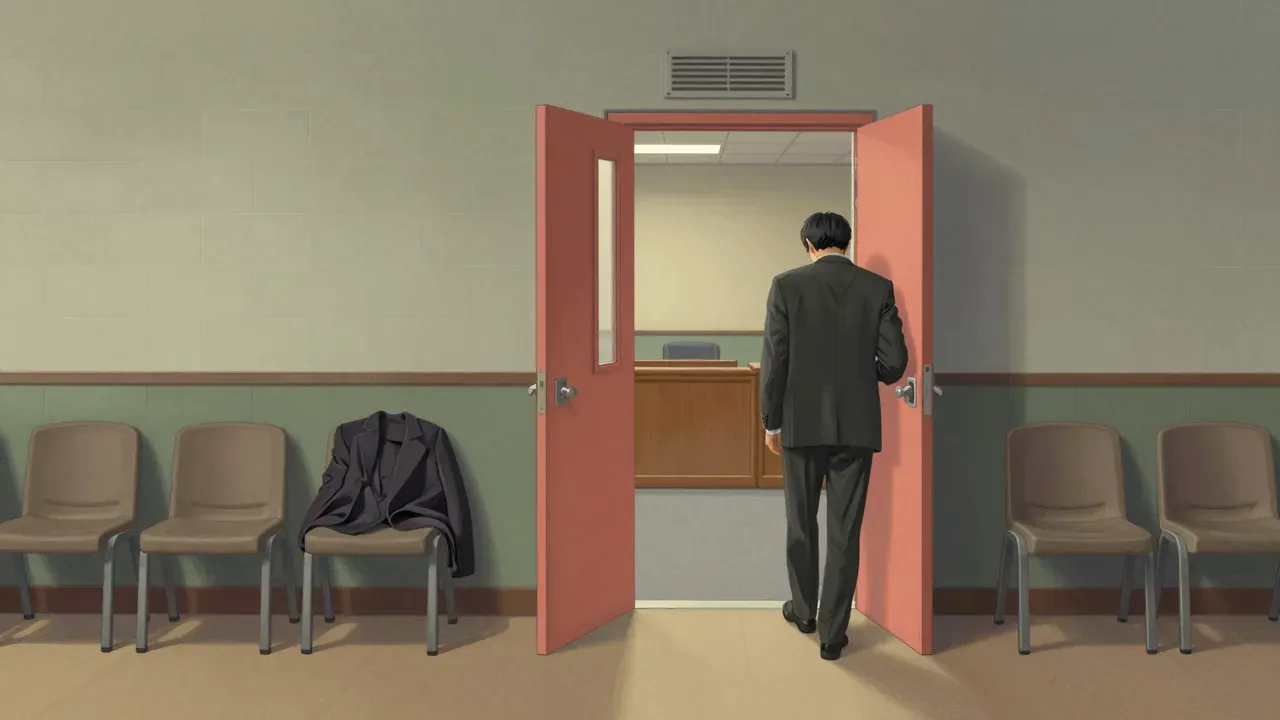
The film works through sustained attention rather than narrative propulsion. There is no score, no voiceover, no archival montage. Hara and his small crew film in fixed or slowly tracking shots, often from mid-distance, letting scenes unfold without intervention: a man coughing into a handkerchief during a meeting; a widow sorting medical records at a kitchen table; lawyers reviewing documents under fluorescent light. Cinematography is functional and unadorned — natural light dominates, interiors are dim but legible, focus stays shallow only when physiology demands it, as when a subject’s vision blurs mid-sentence. Editing is elliptical but never cryptic: cuts follow breath, pause, or bureaucratic rhythm — a hearing ends, then we see the same room empty, then a bus stop outside the courthouse. Performances are not performed; they are lived repetitions — the same arguments rehearsed before different panels, the same symptoms described to new doctors. Craft serves endurance: the camera stays, the mic stays, the film stays with people long after other documentaries would have cut to summary.
What the Body Keeps
What lands is the sheer, unvarnished duration of consequence. The film makes visible how asbestos injury is not a moment but a process — one that outlives diagnosis, outlives lawsuits, outlives the companies that profited from it. A scene in which an elderly woman demonstrates how she now sleeps upright to breathe does more than statistics ever could; her posture becomes a grammar of damage. The cumulative effect of repeated hearings — same benches, same formalities, same delays — conveys systemic inertia without needing to name it. Hara’s refusal to editorialise means the viewer must sit with discomfort: the gap between legal time and biological time, between corporate dissolution and bodily persistence. When a survivor quietly states he has outlived all his co-workers, the line carries no emphasis, no music, no cutaway — and so it lodges. The film lands because it trusts the viewer to register meaning in what is shown, not told; in what lingers, not what concludes.
The Absence That Speaks
What does not land is any sense of resolution or structural clarity. The film deliberately avoids mapping the corporate or regulatory architecture behind the disaster — no diagrams of supply chains, no interviews with former executives, no exposition of Japan’s asbestos import policies. This is not negligence but principle: Hara declines to grant coherence to a system designed to obscure. Yet for some viewers, particularly those unfamiliar with Japan’s postwar industrial history or its labour law frameworks, the absence of context may read as opacity rather than restraint. The legal proceedings remain procedural and opaque; names, statutes, and jurisdictional distinctions are rarely clarified. A viewer expecting a forensic exposé or a campaign-oriented documentary will find the film withholding. It also resists emotional escalation — there are no outbursts, no confrontations, no cathartic victories. That restraint is central to its ethics, but it may leave audiences accustomed to moral punctuation feeling adrift, as though the film refuses the very satisfaction its subject denies its subjects.
Time That Outlives
The themes that matter are latency, embodiment, and institutional time. Asbestos fibres embed silently, symptoms emerge decades later — the film mirrors this with its own pacing, refusing to rush toward revelation. Bodies here are not metaphors but archives: scarred lungs, stiffened joints, voices worn thin by chronic inflammation become primary sources. The film treats illness as social fact, not private tragedy. Institutional time — the glacial pace of courts, the erasure of liability through corporate reorganisation, the fading of public attention — is rendered not as abstraction but as daily friction: missed appointments, lost files, interpreters who do not appear. Class is present but unspoken: these are workers, not managers; families living in modest homes, not corporate headquarters. The film also explores intergenerational transmission — not genetic, but ethical and archival — as children inherit paperwork, testimony, and the burden of continuing claims. There is no theme of redemption, only of persistence: the insistence on being seen, even when visibility yields nothing but delay.
Who the Film Asks For
This film is for viewers prepared to sit with unresolved grief, procedural exhaustion, and the physical reality of slow violence — particularly those interested in documentary as ethical witness rather than explanatory tool. It suits audiences familiar with Hara’s earlier work, or with the Japanese ‘direct cinema’ tradition, where presence outweighs interpretation. It is not for viewers seeking narrative closure, historical synthesis, or moral simplification. Those who require clear villains, actionable takeaways, or visual relief will find it austere, even punishing. Some historians or policy analysts may object to its narrow frame — arguing that without macro-context, the film risks individualising systemic failure. That objection is valid, but it misreads the film’s aim: it does not seek to explain how the disaster happened, but to record how it continues. To change the verdict, the film would need to expand its scope — but that expansion would contradict its central argument: that attention, when sustained and unflinching, is itself a form of resistance.
The Weight of Two Hours
Yes, it is worth your evening — but only if you accept that value here lies in duration, not diversion. Two hours with this film is two hours spent inside a temporal logic most documentaries avoid: the time of waiting, of recurrence, of bodies remembering what institutions forget. It asks for patience, not passivity — the viewer must parse meaning from repetition, from silence, from the slight shift in a man’s posture between two hearings held years apart. It is not ‘entertaining’ in any conventional sense, nor does it offer solace or uplift. But it recalibrates attention: after watching, the weight of a single breath, the significance of a paused sentence, the politics of a courtroom clock feel newly charged. Those who dismiss it as ‘too slow’ or ‘too narrow’ are not wrong — they simply expect a different contract. The film honours its subjects by refusing to speed them up, simplify them, or make them legible on easier terms. That rigour is its worth — and its demand.


