The book behind it
A Dry White Season is a trial film set in apartheid-era South Africa, adapted from André Brink’s 1979 novel. It follows Ben Du Toit, a white schoolteacher whose gradual political awakening begins when his Black gardener, Gordon Ngubene, is arrested and tortured after his son is killed by police during the 1976 Soweto uprising. The film attempts to dramatise systemic injustice not through abstraction but through procedural detail: affidavits gathered, courtrooms entered, documents hidden and betrayed, legal arguments made and dismissed. Its aim is neither allegory nor spectacle but forensic moral reckoning — to show how complicity unravels when one person refuses to look away. Euzhan Palcy directs with documentary discipline, grounding outrage in cause-and-effect sequences rather than rhetorical flourishes. The film does not ask whether apartheid was wrong; it shows how its machinery functioned, who maintained it, and what it cost those who resisted — or simply bore witness. It treats the law not as neutral framework but as weapon and shield, deployed differently depending on skin colour and status.
The performances in it
The story moves with procedural rigour: Ben’s descent from passive bystander to targeted dissident unfolds across discrete, consequential steps — refusal to help, then reluctant inquiry, then evidence-gathering, then civil action, then violent reprisal. Donald Sutherland anchors this arc with restrained physicality: his posture tightens, his voice drops, his silences lengthen. Marlon Brando, as human rights lawyer Ian McKenzie, appears in only three scenes but shapes the film’s ethical gravity through stillness and precision of diction. Pierre-William Glenn’s cinematography avoids symbolic lighting; interiors are lit for legibility, not mood — offices, courtrooms and homes feel lived-in, unvarnished. Dave Grusin’s score uses Hugh Masekela’s flugelhorn sparingly, reserving its mournful tone for moments where dialogue has already failed. Editing by Glenn Cunningham maintains narrative clarity without accelerating pace: scenes breathe, decisions land, consequences follow without editorial prompting.
The moments that land
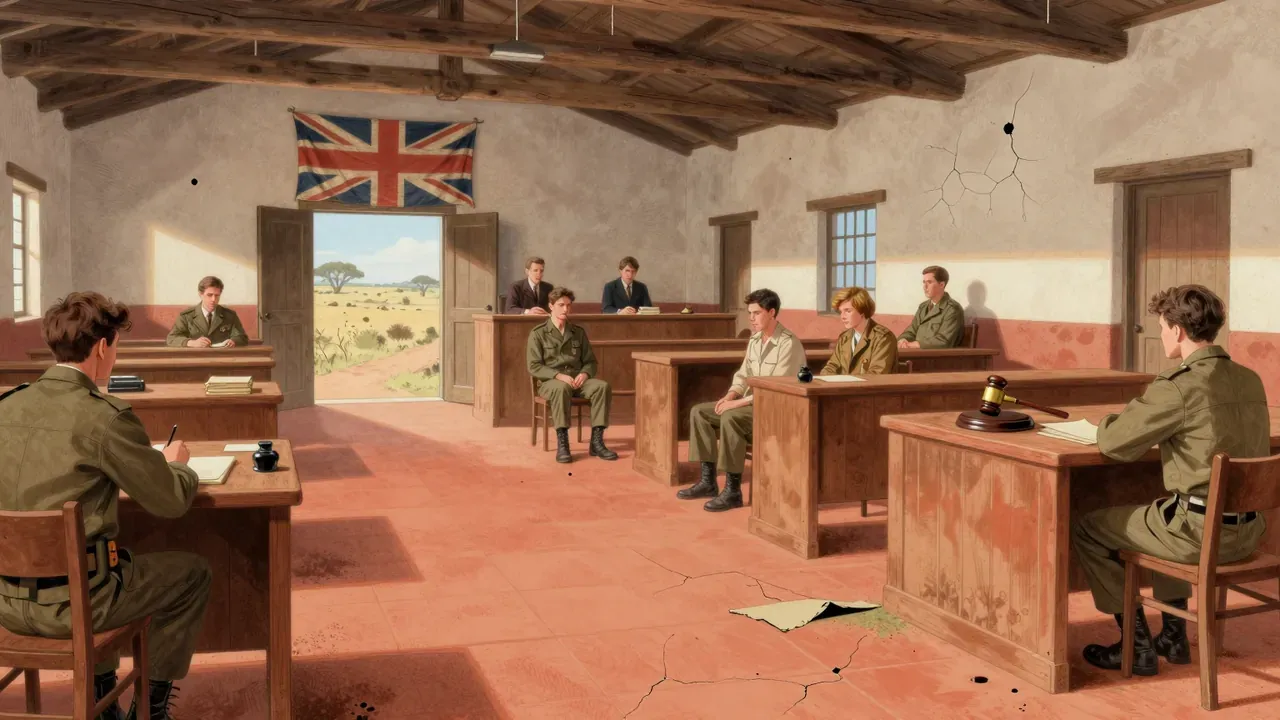
What lands is the cumulative weight of small betrayals — a daughter handing over documents she believes are real, a colleague turning away mid-conversation, a principal locking eyes before firing Ben without explanation. These are not melodramatic turns but quiet collapses of trust, rendered with behavioural accuracy. The courtroom sequence does not hinge on a dramatic reversal but on procedural dismissal: the judge rules evidence inadmissible on technical grounds, and Ben’s quiet exit says more than any monologue could. The film’s power resides in its refusal to flinch from bureaucratic cruelty — the way forms are misfiled, affidavits ignored, witnesses discredited not by falsehood but by procedure. Even the final act of violence — Ben run over by Captain Stolz — arrives without musical warning or slow motion, making it feel less like climax than continuation. This restraint gives the film its moral authority: it does not plead, it presents. The audience is not asked to feel pity but to register consequence.
The gaps in it
What does not land is the structural thinness of Ben’s interior life beyond his political shift. His marriage, his relationship with his children, even his profession as a teacher — all serve plot function rather than psychological texture. Janet Suzman’s Susan remains defined almost entirely by her opposition to Ben’s choices, with no discernible inner conflict or evolution beyond withdrawal. Susannah Harker’s Suzette likewise functions as catalyst and betrayer without sufficient groundwork for either turn. The film’s commitment to procedural realism leaves little room for ambiguity in motivation: characters act because the system demands it, not because they wrestle with doubt or desire. This makes the world coherent but occasionally schematic. The Zimbabwean locations, while serviceable, lack the granular specificity of Soweto — a limitation of production circumstance, not intent — and the Pinewood studio work, though technically sound, never fully escapes its artifice in crowd or street scenes.
The ideas in it
The themes that matter are not abstract ideals but operational ones: the fragility of evidence under authoritarianism, the vulnerability of documentation when institutions refuse accountability, and the isolation of dissent within professional and familial structures. It treats law not as ideal but as instrument — wielded by McKenzie to defend, by Stolz to intimidate, by Cloete to expel. Education appears not as liberation but as segregation: Ben teaches at a whites-only school, his son is expelled for defending Black classmates, and the curriculum itself is never questioned — only its enforcement. The film also insists on the materiality of resistance: hiding affidavits, copying pages by hand, memorising names, smuggling information. These are not heroic gestures but daily labours, easily undone by a child’s misplaced loyalty or a neighbour’s report. Its central tension is between visibility — Ben’s growing public profile — and erasure — the state’s capacity to disappear people, records, even memory.
Who it is for
This film is for viewers who value procedural clarity in political storytelling and who approach cinema as a medium for moral accounting rather than emotional catharsis. It suits those familiar with apartheid’s legal architecture or willing to absorb it through exposition and incident, not summary. It is not for viewers seeking character-driven interiority, tonal variety, or narrative release — there is no redemption arc, no institutional reckoning, no cathartic victory. Those who expect historical drama to resolve injustice on screen may find its ending unremitting. Its pacing assumes patience with incremental escalation; those accustomed to thriller rhythms may perceive inertia where the film intends deliberation. A viewer who values ambiguity in motivation or poetic licence in setting may find its adherence to factual logic limiting. Its power depends on sustained attention to cause and effect — not every viewer brings that expectation to a night at the cinema.
What it asks of you
It is worth your evening if you accept that some films exist not to entertain but to bear witness with forensic care. Its ninety-seven minutes accumulate weight not through spectacle but through accumulation: of names, dates, violations, silences. That it was made on a $9 million budget — with Brando working for union scale, Palcy researching undercover in Soweto — is visible in its focus, not its frugality. Those who dismiss it as ‘preachy’ or ‘didactic’ misunderstand its method: it does not lecture, it demonstrates. Its verdict is not delivered by a character but by structure — by the way courts adjourn, schools expel, documents vanish. To call it ‘heavy’ is accurate; to call it ‘unrewarding’ would be to mistake moral labour for narrative failure. It earns its duration by refusing shortcuts — and rewards attention with rigour, not relief.